NVDA at $148—would you bet on it?
Jensen Huang left amid scandal, and the stock crashed; on the day he returned, it surged 31%, leaving everyone stunned again. But with a closed-door congressional deposition on December 1 and a public Senate hearing on December 3, NVDA at $148 faces two major tests in two weeks. Is it a golden opportunity or a trap?
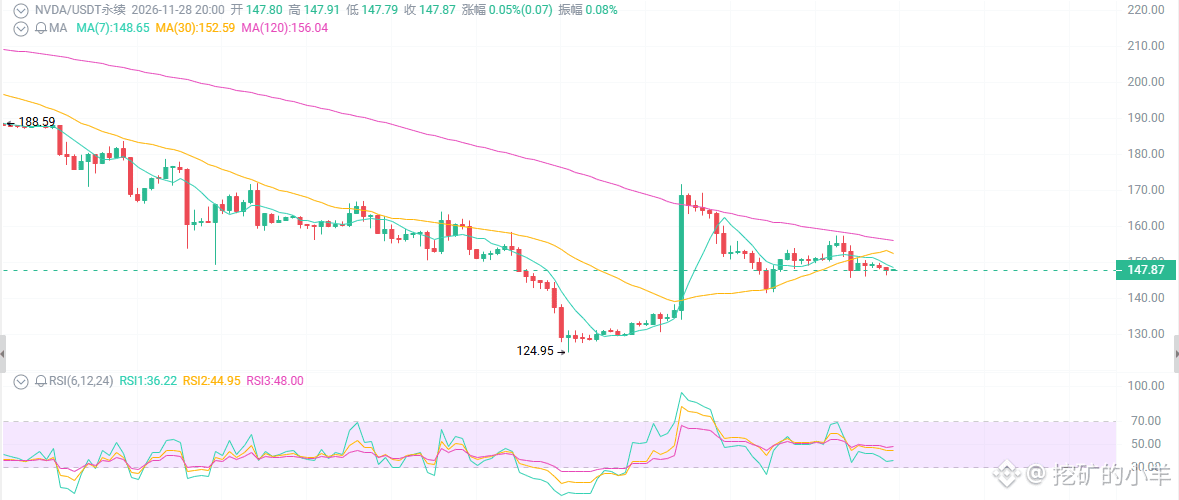
First, the big picture: it fell from $243 to $124, then rebounded 20% after being cut in half.
The October high was $243; the November low was $124.50, a drop of nearly 50%. Then Jensen Huang returned, and the stock surged 31% in a single day.
It is now fluctuating around $148. RSI is 38; MACD is negative but showing signs of recovery. The moving averages are in a bearish alignment, and the medium-term trend is still downward. Analysts’ price targets are generally around $240, implying upside of 60%+.
First point: Jensen Huang is back, but the trouble isn’t gone.
In mid-November, Jensen Huang briefly stepped down amid a personal scandal, and the stock fell sharply. He returned on November 23, and the stock surged 31% in a single day.
The market is telling you with that 31% move: this company can’t do without him.
But don’t celebrate too soon. On December 1, there will be a closed-door House deposition interview covering export controls and chip smuggling to China. On December 3, there will be a public hearing before the Senate Banking Committee.
In two weeks, Jensen Huang will face two major congressional tests. One wrong word, and the stock could show you exactly what a “high-altitude nosedive” looks like.
Second point: the valuation is absurdly cheap, but nobody dares to buy.
TTM P/E is 16x; forward P/E is 10–11x.
Nvidia’s valuation is now cheaper than that of many traditional manufacturers.
Revenue is up 103% year over year, gross margin is 75%, and net margin is 60%. With growth like this at a valuation like that, back in 2023, Wall Street could have sent the stock soaring.
But now nobody dares to buy. Why?
Because the market is afraid of Washington, not the earnings report.
Export controls, where the chips end up, and a declining share of revenue from China—the market doesn’t look at P/E for political issues; it looks at the political mood.
Third point: technically, the stock is at a “rise or fall” moment.
It has rebounded 20%, from $124.50 to $148. It is now stuck fluctuating in the $145–$155 range.
Support: $145–$148 (recent lows) → $140 → $125–$130 (strong demand zone)
Resistance: $155–$160 (first hurdle) → $170 → $183 (50 EMA) → $200+ (200-day moving average)
RSI is 38, neutral to weak—out of deeply oversold territory, but not yet in a strong zone.
MACD is flattening below zero, with signs of recovery, but the moving averages remain in a bearish alignment.
In the short term, this is a rebound, not a reversal. To confirm a reversal, it needs to hold above $160.