SSV at $2.7—would you touch it?
It fell from $65.8 to $1.48, a 97.7% drop, then surged 70% in a week—but guess what? This rally wasn’t driven by good news; it was a short squeeze. The project team itself has shifted to maintenance mode. Is this a golden opportunity, or just another trap for bagholders?
First, the surface-level picture: a sharp rise, but shaky foundations.
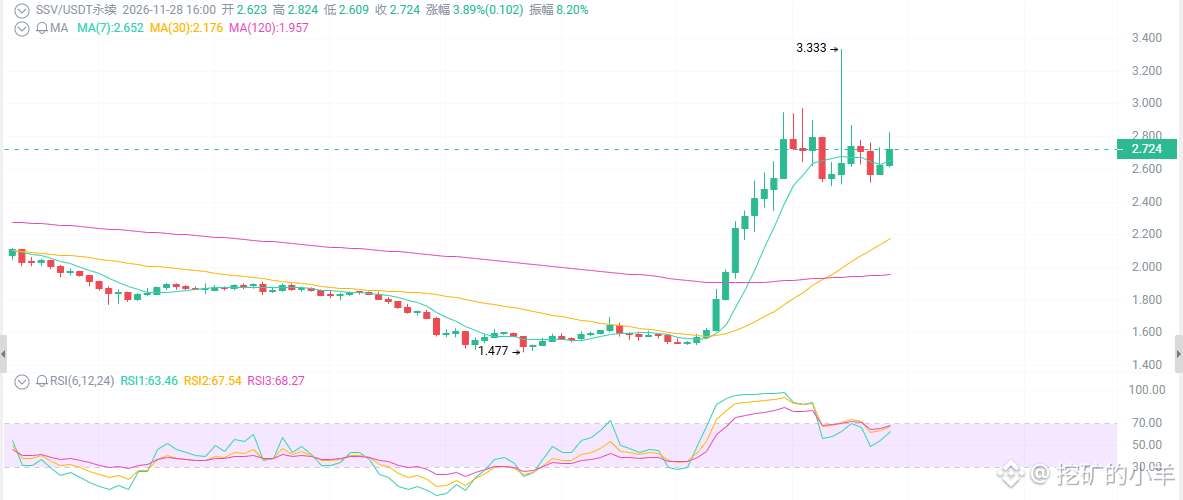
SSV climbed from its all-time low of $1.48 on November 22 to nearly $3.3 within a week, a gain of 70–76%. It’s now trading around $2.7. 24-hour trading volume has surged, but the move wasn’t driven by a new partnership, an airdrop, or a technological breakthrough—it was driven by short covering. Negative funding rates forced shorts to close their positions. The buying was forced, not voluntary.
First issue: the project team itself has hit the brakes.
SSV Labs proposed DIP-59, which favors a shift to maintenance mode—prioritizing security and support for Ethereum upgrades while putting new product development on hold until mid-2027.
That’s a neutral-to-cautious signal for the long-term narrative. There’s no strong short-term catalyst. If the team is proactively scaling back, what are you expecting to drive the price up?
Second issue: there’s a fundamental floor, but it isn’t very solid.
SSV is a core Ethereum DVT (Distributed Validator Technology) project, and the network still has billions of dollars’ worth of ETH staked. The sector has value: the more decentralized ETH staking becomes, the more important SSV is.
But the issue is valuation:
Circulating market cap of around $40 million, putting it in the middle-to-lower ranks
Monthly fee revenue in the hundreds of thousands of dollars
Fee capture is low relative to the amount of assets staked
Put simply: the story sounds good, but the cash flow doesn’t. The valuation is supported by expectations of ecosystem growth, not by profits in hard cash.
And SSV has fallen 97.7% from its ATH of $65.8 to $1.48. This isn’t a “pullback”—it’s a gasp for air after a near-total collapse. The rebound after recently hitting a new low shows that selling pressure is still being absorbed, and liquidity remains thin.
Third issue: the technicals favor short-term bulls, but the broader market isn’t cooperating.
After bottoming at $1.48 on November 22, SSV broke above a descending wedge on higher volume, confirming a short-term trend reversal. The daily and 4-hour charts have rebounded sharply from oversold territory, and the short-term moving averages have turned bullish.
RSI has recovered from oversold to neutral-high levels, and momentum is starting to fade
MACD momentum has narrowed after a bullish crossover
Medium- and long-term moving averages are still overhead, acting as resistance
BTC is fluctuating weakly around $59,000–$60,000, ETH is around $1,650, and the Fear and Greed Index is at 10–11—extreme fear
SSV is highly correlated with ETH. If ETH can’t stabilize, SSV’s rebound is like a tree without roots.