#比特币巨鲸四季度逆势加仓12万枚 🚀 ETFs see record $57.8 billion in outflows, but whales keep buying as prices fall
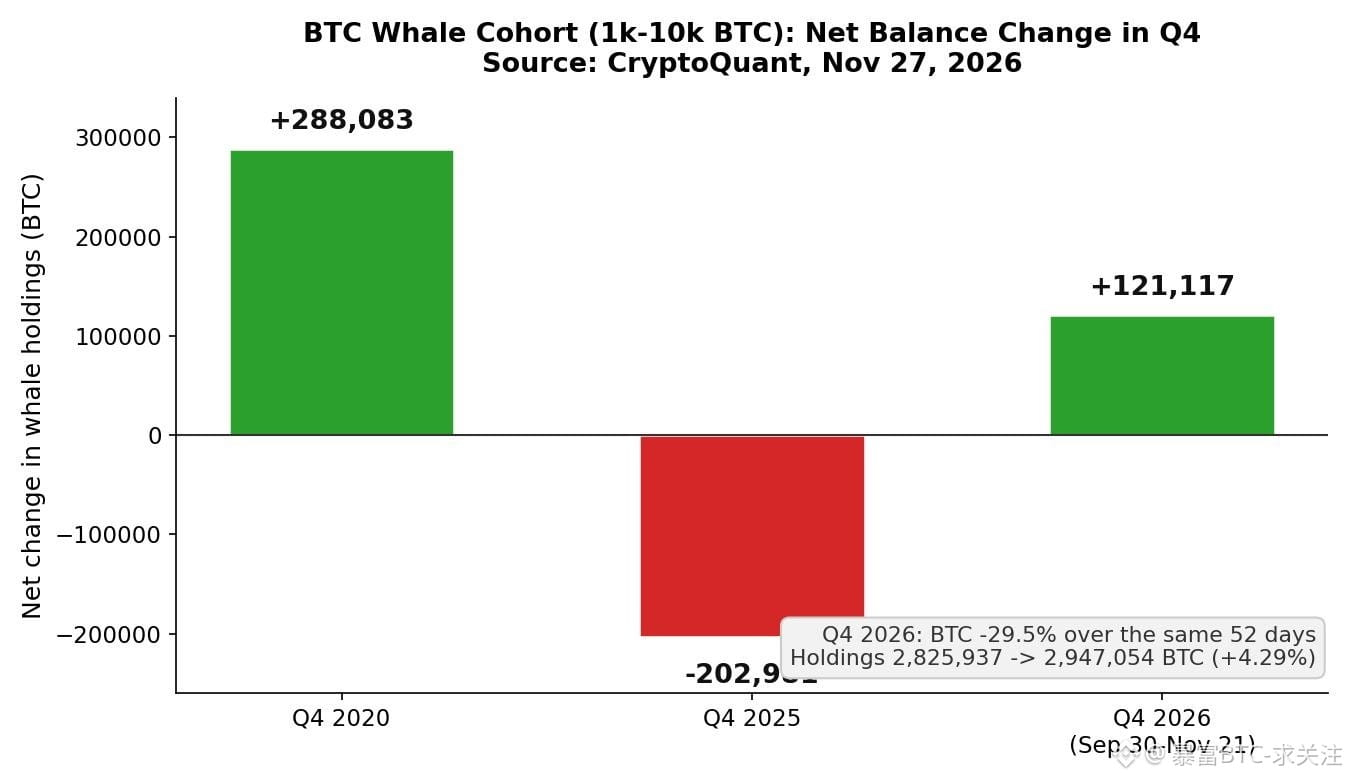
On November 27, CryptoQuant released its Q4 whale report: over the 52 days from September 30 to November 21, addresses holding 1,000 to 10,000 BTC added a combined 121,117 BTC, increasing their holdings from 2.826 million to 2.947 million BTC, a gain of 4.29%—while Bitcoin fell 29.5% over the same period, sliding from around $80,000 to $55,000. This was the biggest Q4 accumulation by this group since 2020: in Q4 2020, these addresses added 288,083 BTC, while in the same quarter last year they actually reduced their holdings by 202,981 BTC. In 7 of the 9 fourth quarters since 2017, these addresses reduced their holdings. This time, they’re doing the opposite—a rare exception.
Accumulating doesn’t mean they’re avoiding losses. These whales realized a net loss of $2.1 billion over 52 days, including a net loss of $197 million in a single day in November. Their unrealized profits shrank from $124.7 billion at the end of September to $23.8 billion, down 81%; their profit margin fell from 33.9% to 5.7%, its lowest level this year. Mid-sized holders with 100 to 1,000 BTC, by contrast, reduced their holdings by 15,169 BTC over the same period. Meanwhile, U.S. spot Bitcoin ETFs saw record monthly net outflows of $5.78 billion in November, with outflows for 8 consecutive trading days. BlackRock’s IBIT alone accounted for more than 80% of them. Yet London hedge fund Abraxas picked up 17,597 BTC from Binance and Kraken during the crash. Large holders are also borrowing against their Bitcoin rather than selling it: on CoinRabbit, the number of Bitcoin-backed loans over $100,000 rose 298.9% from September to October, while the average loan size fell 16.2%—they’re borrowing against their coins, not selling them. Glassnode also says the $50,000–$58,000 range has the densest buy wall since August.
My take has two parts. In the medium to long term, this is a real signal: with unrealized gains down to just 5.7% and $2.1 billion in losses on the books, whales are still accumulating. The nine-year pattern has been broken for the first time, suggesting large investors see $55,000–$60,000 as an accumulation zone, not an exit zone. The core point from my previous posts still stands: ETF outflows mean institutional money is leaving, while large on-chain holders are buying. In the short term, though, don’t rush to call the bottom. ETF outflows have continued for 8 days without easing, and a Fed rate hike on December 9 is all but certain. Bitcoin is currently around $59,500, and its RSI of 28 puts it in oversold territory—but it can get even more oversold. $58,700 is the first support level, with $55,000 next; a move back above $62,300 would be needed to signal a trend reversal. One caveat: an address balance doesn’t necessarily represent one person—custodial addresses can pool the coins of multiple clients. Whale accumulation doesn’t mean an immediate rally, either: these coins have only 5.7% in unrealized gains left, and another drop could leave them holding at a loss. Buy walls can also be canceled. ETFs are selling, whales are buying—the ownership of Bitcoin is shifting from Wall Street funds to large on-chain holders. $BTC