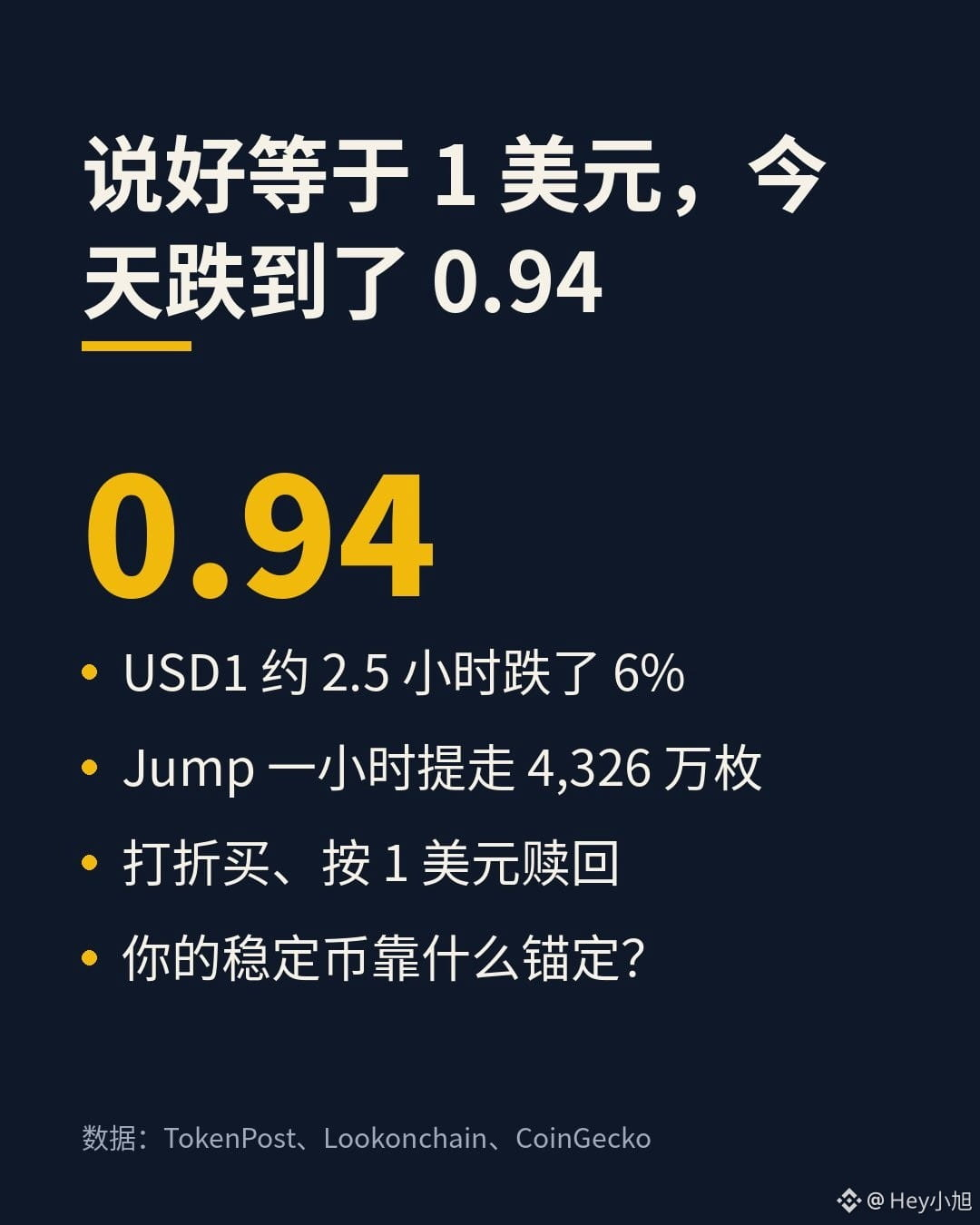
A stablecoin that is “always worth $1” fell to $0.94 on a major exchange this afternoon 🤔
First, the facts (as of 16:30 Beijing time on the 28th):
1. Today, stablecoin USD1 slid from $1 to around $0.94 over roughly 2.5 hours in its USDT trading pair on a leading exchange—a 6% drop (TokenPost).
2. At the same time, the reserve wallet of its issuer, World Liberty Financial, sold 12,121 Ethereum at an average price of around $1,655, receiving about 17.58 million USDC and 2.48 million USD1. The Ethereum had originally been bought at an average price of around $3,244, meaning a loss of nearly half.
3. On-chain data from Lookonchain: Jump Crypto withdrew about 43.26 million USD1 from exchanges within an hour, bought it at a discount, then found a redemption channel through the issuer at $1 per token.
4. USD1 has now recovered to around $0.994, but has yet to fully return to $1 (CoinGecko).
Let’s do the math: If all 43.26 million tokens were bought at $0.94 and redeemed at $1, the difference would be about $2.6 million. The actual purchase prices varied, so the profit wouldn’t be that high. But this is how stablecoins are “pulled back to $1”: as long as they can be redeemed for $1, someone will use real money to arbitrage the gap.
My take: A stablecoin’s stability isn’t determined by its name, but by three things: what backs it, whether it can be redeemed for $1 at any time, and whether ordinary people can meet the redemption requirements. Today, large institutions can redeem at $1, while retail investors can only sell at the market price on exchanges. If you hold stablecoins, you should at least know what keeps them pegged.
Do you know what keeps the stablecoins you hold pegged?
Sources: TokenPost, Lookonchain, PANews, CoinGecko
#稳定币 #USD1 #CryptoMarket