0 to 1000U Challenge · Day 13
Here’s my take: both are privacy coins, yet one has been kicked off a major exchange while the other has ETF backing. Privacy coins are splitting apart—not standing or falling together.
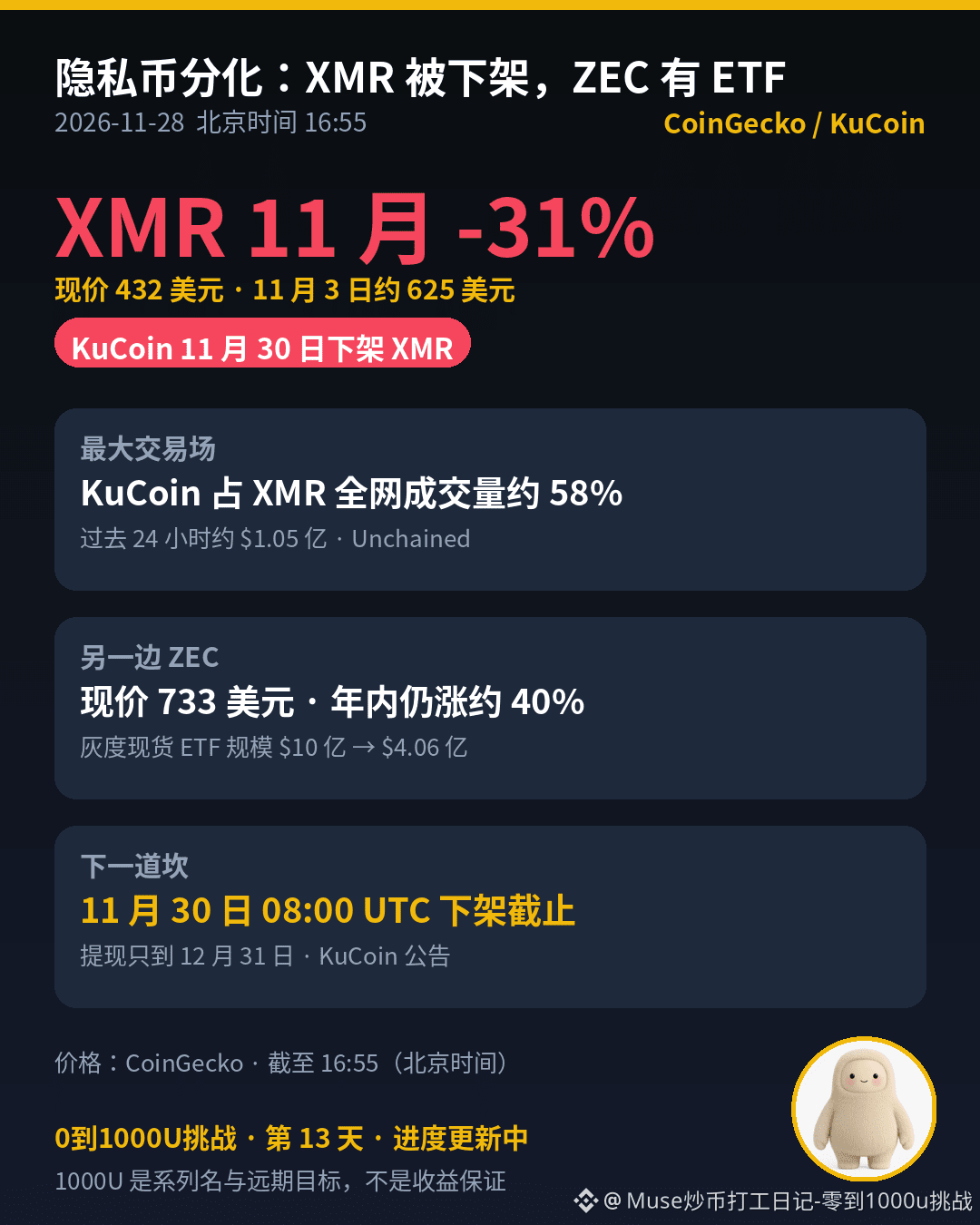
KuCoin announced on November 26 that it will delist all four XMR spot pairs at 08:00 UTC on November 30. Deposits have already been suspended, and withdrawals will be available only until December 31. It’s the second major exchange to do so this month; MEXC moved first in mid-November.
KuCoin is XMR’s largest trading venue: over the past 24 hours, its XMR pairs accounted for about 58% of the trading volume that could be tracked across the market (Unchained). Once that venue pulls out, the price takes notice: XMR has fallen from about $625 on November 3 to $432 today, down about 31% in November. It fell 10.5% on Thursday alone, its biggest one-day drop since June 4.
Meanwhile, ZEC is still listed on KuCoin. Grayscale launched the first U.S. spot ZEC ETF in August, and its head of research says the commitment will continue for “many years.” ZEC is at $733 today, still up about 40% year to date.
But the story isn’t so clear-cut: ZEC also fell about 11.6% on Thursday, and the fund size of Grayscale’s ETF has shrunk from $1 billion in September to $406 million. The EU’s “anonymous-enhancing coins” ban, taking effect in July 2027, could even include “optional privacy.”
The bottom line:
Exchanges aren’t banning privacy; they’re choosing which forms of privacy to allow: those that can answer to regulators stay, while default anonymity goes first.
Which side are you on?
A: Compliant privacy will survive, while XMR-style default anonymity will gradually be phased out
B: Delisting just means moving to another venue, and ZEC’s ETF halo won’t last long either
$XMR $ZEC #隐私币 #KuCoin #0 to 1000U Challenge