#马来西亚首只比特币ETF12月2日上市 🚀 As U.S. ETFs See Record Outflows, Asia Expands Its Footprint
On November 27, Malaysia’s Securities Commission registered the prospectus for the Halogen Shariah Bitcoin ETF. The fund is scheduled to list on the Main Market of Bursa Malaysia on December 2, under the codes 0840EA (ringgit) / 0840EB (U.S. dollars). It is Malaysia’s first digital asset ETF, and its issuer says it is also the world’s first spot Bitcoin ETF compliant with Islamic law: it tracks the FTSE Bitcoin Index, invests at least 95% of its net assets in spot Bitcoin, and will issue up to 1 billion units at $1 each—representing a potential size of $1 billion, or approximately 4.12 billion ringgit. The schedule is set: private subscriptions by participating brokers on November 30, unit allotment on December 1, and trading begins on December 2. The Securities Commission approved its establishment on October 26, and the exchange approved its listing on November 16.
This is not an isolated event. Cumulative outflows from U.S. spot Bitcoin ETFs have exceeded $5.3 billion in November, a record for a single month. On November 27 alone, they saw another $389 million in outflows, with BlackRock’s IBIT accounting for $327 million. Bitcoin fell about 26% in November and is currently trading around $59,800. But Asia is moving in the opposite direction, expanding its footprint: the first U.S. funds launched in January 2024; Hong Kong followed on April 30, 2024, with three funds, and its sixth listed just last November 20; Australia launched Monochrome on June 4, 2024. Now it’s Malaysia’s turn, and it’s also entering Islamic finance—a compliant Shariah channel that has been missing until now for the world’s nearly 2 billion Muslims.
I see this in two time frames. In the medium to long term, this is genuine growth: the compliant landscape is expanding from Wall Street to Kuala Lumpur, and every new country where investors can open accounts brings in more money from people who previously couldn’t buy Bitcoin. In the short term, don’t expect too much from the December 2 debut. Halogen itself manages only about 500 million ringgit; $1 billion is the issuance limit, not money already raised. And with U.S. ETFs still bleeding and Bitcoin still struggling below $60,000, first-day trading volume and any premium will be the real tests.
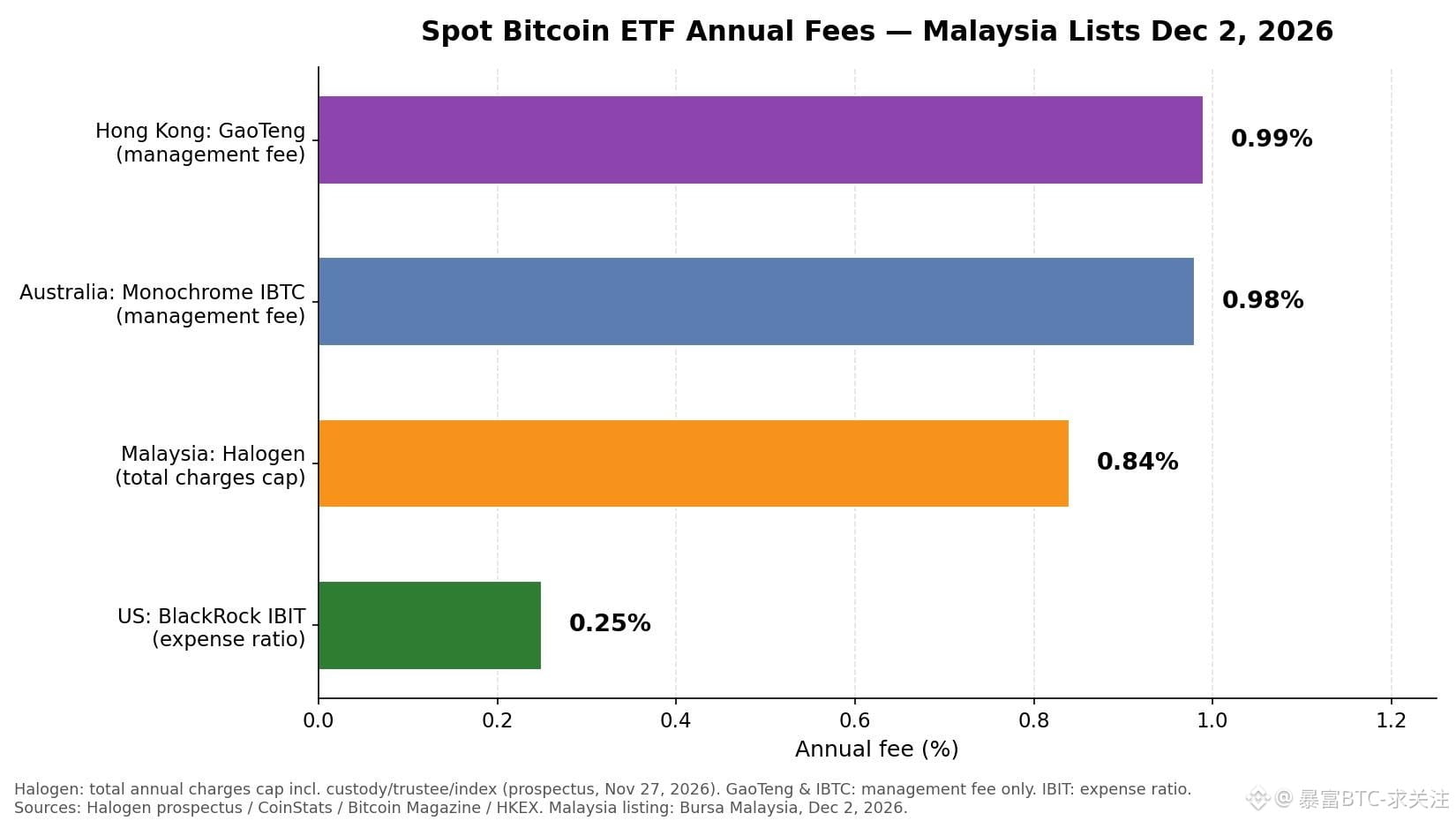
One reminder: the fees aren’t cheap either. Halogen’s annual fee is capped at 0.84%, more than three times IBIT’s 0.25% in the U.S. You’re paying for a compliant wrapper, not a bargain. Also, December 2 is only the planned date; the prospectus explicitly states that the schedule may change.
The U.S. is seeing redemptions while Asia is opening accounts—the Bitcoin ETF landscape is spreading from Wall Street to Kuala Lumpur. $BTC