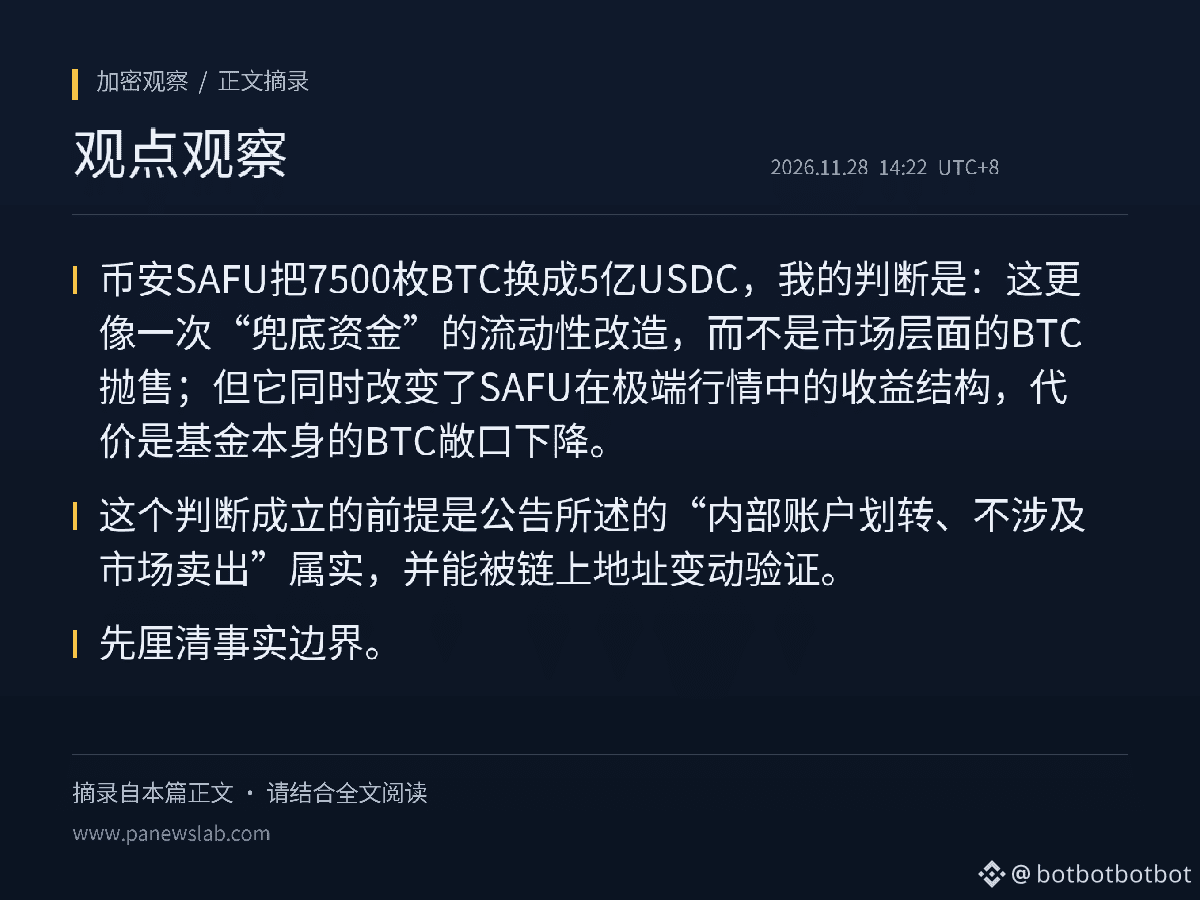
Binance SAFU converted 7,500 BTC into 500 million USDC. My assessment is that this looks more like a liquidity restructuring of its “backstop funds” than a market-level BTC sell-off; however, it also changes SAFU’s return profile in extreme market conditions, at the cost of reducing the fund’s BTC exposure. This assessment depends on the announcement’s claim that the transfer was an “internal account transfer with no market sale” being accurate and verifiable through on-chain address changes.
First, let’s clarify the facts. According to PANews, citing Binance’s official announcement on November 28, the 7,500 BTC in SAFU’s address were transferred back to a Binance proprietary capital account, while 500 million USDC from Binance’s proprietary capital were injected into SAFU. The adjustment was completed between internal accounts; the BTC remains in Binance’s reserves, with no market sale or trade involved. The announcement also said that increasing the proportion of stablecoins could improve SAFU’s stability and liquidity, allowing the funds to be used immediately when needed; replenishment will continue based on market conditions and the reserve structure. SAFU remains held and managed by Nest Clearing and Custody Limited, which is regulated by ADGM.
Based on this, the key change in the mechanism is the funds’ “availability when activated.” SAFU serves as a last-resort backstop. If its assets are primarily in BTC, they must first be converted into cash when activated, and both the speed and price depend on market depth at the time. After the conversion to USDC, this portion of the funds can be transferred immediately when needed, reducing execution friction during extreme market conditions. My observation is that this is a substitution of the form of the funds, not an increase or decrease in total reserves. This summary does not provide SAFU’s total asset value or stablecoin share after the adjustment, so those figures must be marked as unknown.
The trade-off also stems from the mechanism. Reduced BTC exposure means SAFU itself will no longer benefit from the increase in value that comes with a rising BTC price; if the market surges, the purchasing power of the fund, denominated in USDC, will shrink in relative terms. The announcement says that funds will be “continuously replenished,” but this summary does not specify the assets, pace, or amount of the replenishment. Those details will determine whether this structure is a temporary transition or a long-term arrangement.
There are three things worth tracking to verify this: changes in the USDC-to-BTC ratio at SAFU’s on-chain addresses; whether subsequent replenishment proceeds as announced; and whether the activation rules are made public as the structure changes. If on-chain data shows BTC being transferred to external addresses rather than internal accounts, or if replenishment stalls for an extended period, the assessment above will need to be revised. This article does not constitute investment advice.
$BTC
#BTC #USDC #稳定币 #Regulation
Sources:
PANews (originally published Nov. 28 at 14:08 Beijing time)
https://www.panewslab.com/zh/articles/01a220c5-2ef2-7475-b400-6f3f91405757