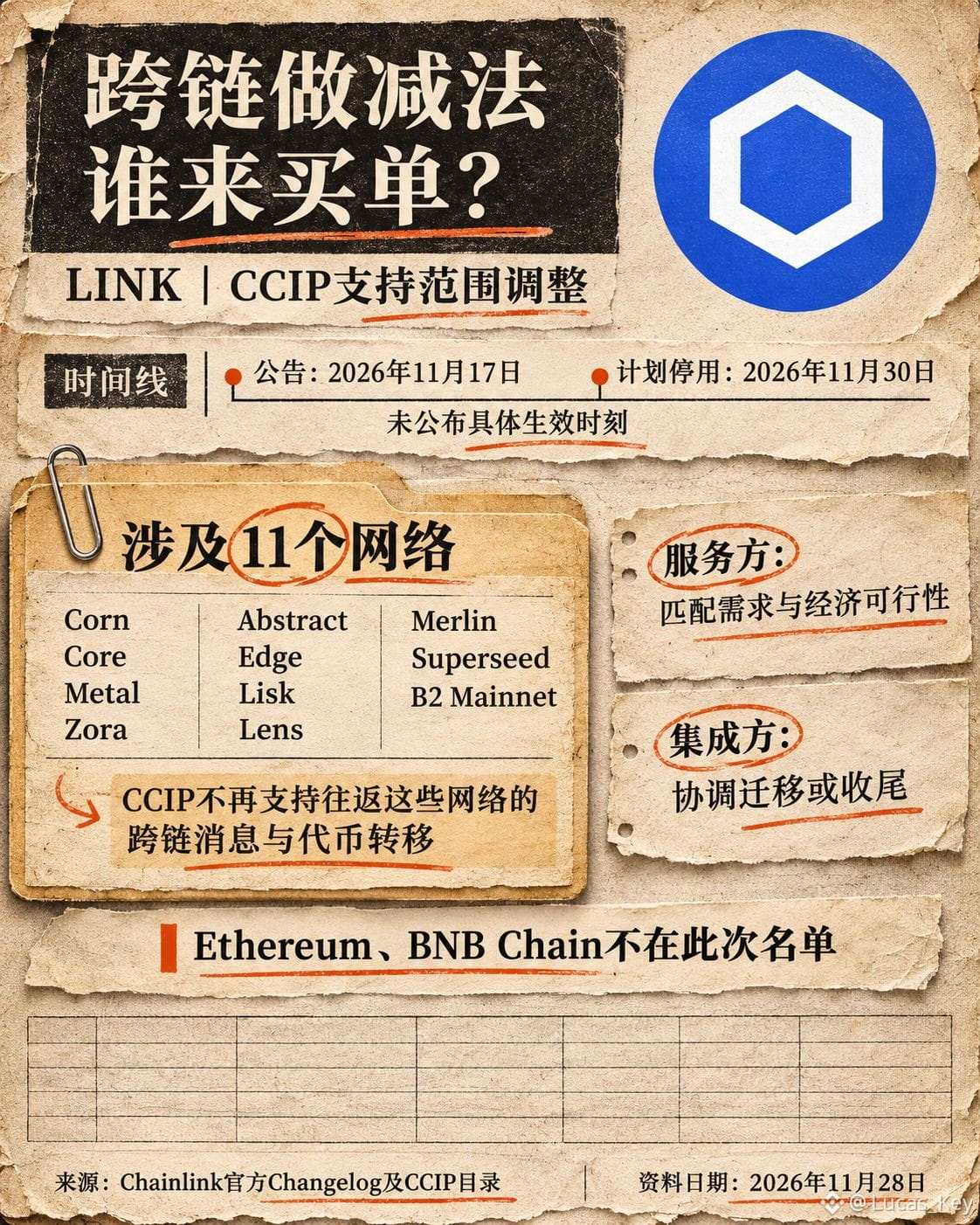
Cross-chain subtraction: who pays the bill?
With November 30 approaching, it’s worth rereading the update behind $LINK , which can easily be drowned out by “new integrations”: on November 17, Chainlink announced that CCIP would stop supporting 11 networks on November 30.
The list includes Corn, Core, Metal, Zora, Abstract, Edge, Lisk, Lens, Merlin, Superseed, and B2 Mainnet. The official announcement makes clear that, after support is discontinued, cross-chain messages and token transfers to and from these networks will no longer be supported. Affected teams should coordinate migrations or wind-downs in advance. The notice does not specify an exact effective time.
The reason given by Chainlink is straightforward: regularly review usage and economic viability so that resource allocation matches user demand. Those in favor of this change have a solid case—infrastructure requires long-term maintenance, and supporting many networks does not, by itself, prove that every connection merits continued investment.
But for projects relying on these integrations, the costs are real too. Call paths, cross-chain messages, frontend entry points, and arrangements for users to exit may all depend on the existing service. An efficiency adjustment for one infrastructure provider can become migration work for another application. Whether it is reasonable cannot be judged solely by how much burden the service provider sheds.
This also concerns the $ETH and $BNB ecosystems. Ethereum and BNB Chain are still listed in the CCIP directory and are not among the networks being discontinued; projects on either chain that interact with networks on the list should still verify their specific routes. The underlying chains may continue to operate, while third-party channels may change the scope of their support.
What matters most to me is the outcome of the change: whether the remaining services become more reliable, and whether the discontinued integrations can be migrated properly. If we treat the number of new integrations as growth while overlooking the networks being dropped, we cannot tell whether the cross-chain network is meeting more real demand or simply cycling through its list of connections.
Source: Chainlink’s official changelog and CCIP mainnet directory.