
Two forms of support in the same week: China brings out the national team, while inflation pushes the U.S. to raise rates
Intraday on November 27, a briefing from the State Council executive meeting was released. Briefings of this kind are usually published only after the market closes.
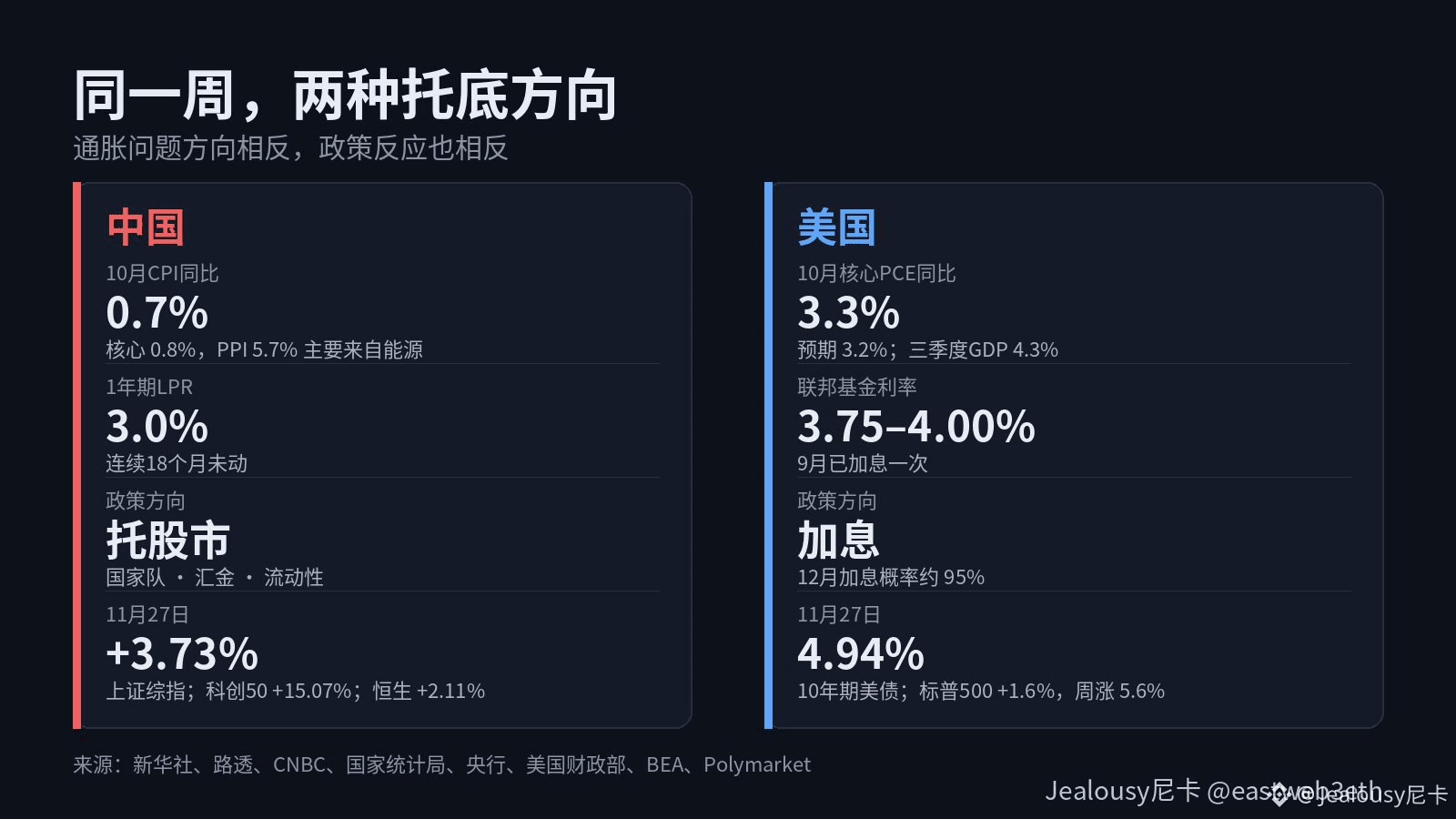
For the first time, the briefing mentioned the “national team,” calling for state funds to play a stabilizing role in the market, for Central Huijin’s quasi-stabilization-fund function to provide ample liquidity, and for long-term funds such as insurers, annuity funds, and social security funds to be guided into the market. It also called for stronger defenses against imported risks. A-shares then surged on heavy trading, with turnover for the day more than 50% higher than the previous trading day. The Shanghai Composite rose 3.73% to close at 3,606.49; the CSI 300 rose 4.17% to 4,063.06. Both posted their biggest one-day gains since October 2024. The STAR 50 jumped 15.07%, the ChiNext Index rose 11.61%, the Hang Seng Index gained 2.11%, and the Hang Seng Tech Index climbed 6.45%.
China is dealing with weak demand.
In October, headline CPI rose 0.7% year on year and core CPI rose 0.8%, while retail sales grew just 0.4% year on year. Fixed-asset investment fell 8.1% in the first ten months of the year, including a 21.6% drop in real-estate development investment. The one-year LPR is 3.0% and the rate for loans of five years or more is 3.5%; both have remained unchanged for 18 consecutive months.
The situation in the U.S. is the opposite.
In October, core PCE inflation was 3.3% year on year, above the 3.2% forecast. Third-quarter GDP growth was revised up to 4.3%. On November 27, the 10-year Treasury yield closed at 4.94%, and the dollar index was near 104. U.S. stocks also rebounded that same week: the S&P 500 rose 1.6% on Friday to close at 7,297.49, gaining 5.6% for the week—its best week since April 2025. The rally was led by AI stocks that had previously been hammered.
The two sides are moving in opposite policy directions because they face opposite inflation problems. China has low prices and weak demand, while asset prices are also falling, so the government is willing to step directly in front of the stock market. The U.S. economy is still running hot, and core inflation is rising again, so the central bank can only keep tightening. But government debt continues to swell, and interest payments have become a heavy fiscal burden. The U.S. also faces plenty of difficulties.