【The mistake retail investors make most often: assuming a big drop means a bargain】
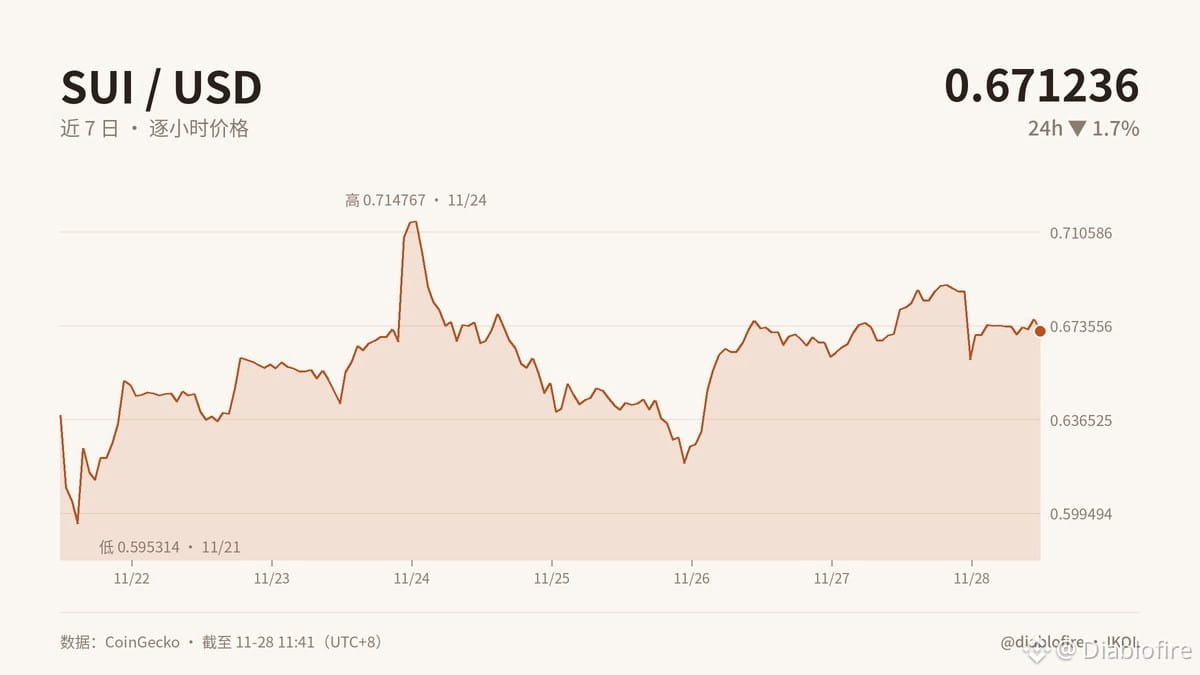
SUI is now at $0.6712, down 87% from its all-time high. It fell 1.7% in 24 hours, but is up 5.2% over the past 7 days. The Fear & Greed Index is just 10, while trading volume has climbed to more than 5% of its market cap. It’s easy to read these figures as a sign that an oversold bounce is coming.
When I look at the market, I don’t jump to that conclusion. The price is fluctuating around support near 0.643213, and it would need to break above 0.70588 to move higher. The direction hasn’t been decided yet. Higher trading volume only shows that traders are becoming active again; it doesn’t mean new capital has entered the market.
More importantly, there are three on-chain metrics to watch: are large holders increasing their positions or distributing their holdings? Is the net flow to exchanges an outflow or an inflow? Are active addresses growing at the same time? If the price rises while large holders reduce their positions and net inflows to exchanges increase, it may just be short-term traders passing tokens around. Only if all three improve at once can we call it a genuine recovery in supply and demand. Without that data, I won’t make up a story about “whale accumulation.”
Bluefin’s move to close perpetual futures trading and shift its focus to spot trading and tokenized RWAs also shows that trading infrastructure in the Sui ecosystem is contracting. That doesn’t mean the entire ecosystem has lost its value. In practice, the first to be affected are trading platforms and market makers that rely on Sui trading volume and derivatives activity, as well as teams that treat short-term trading volume as a measure of the ecosystem’s fundamentals.
Does the business model make sense? Spot trading, RWAs, and genuine user activity need to gain traction for there to be long-term value. As perpetual trading shrinks, business models built on transaction fees need to be reassessed. My view: SUI could recover over the medium term, but it’s too early to confirm a reversal. On-chain data doesn’t lie. Which will turn first in the next cycle: large holders, net flows, or active addresses?