Here’s a hard truth. Before I started trading futures, I saw far too many people staring at the candlesticks and ignoring the fine print: the funding rate.
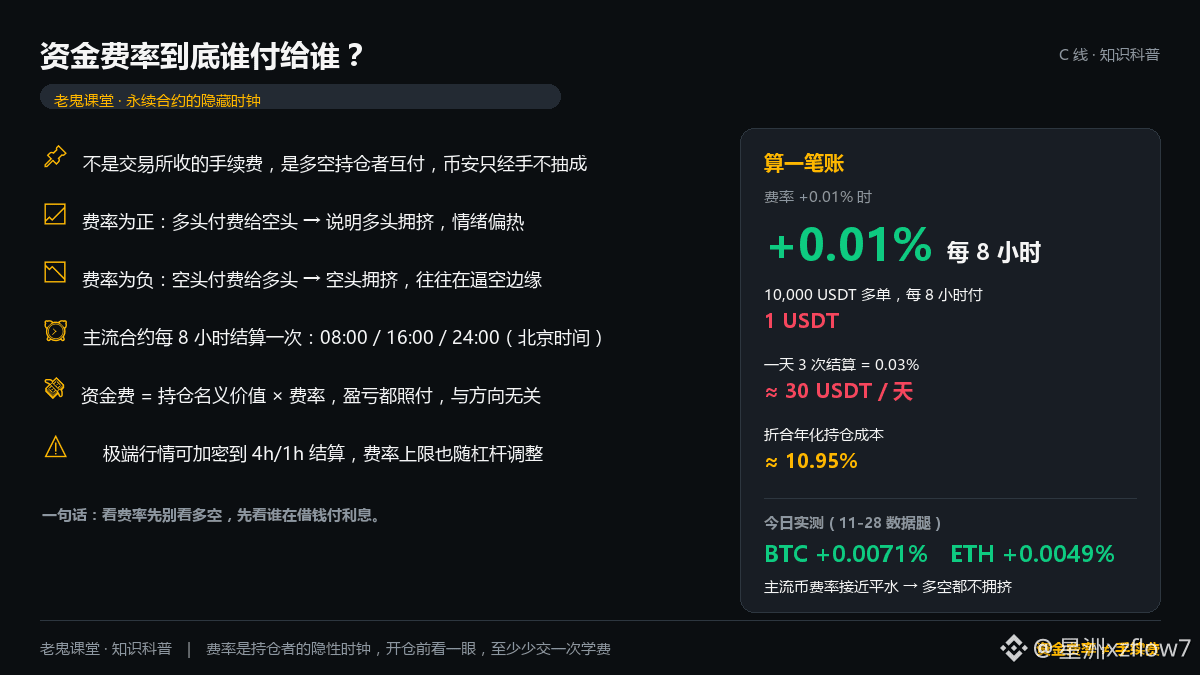
Retail traders often assume the funding rate is a “futures trading fee” charged by the exchange. That’s simply wrong. It’s a periodic transfer between long and short position holders. Binance only processes the payment; it doesn’t take a cut. When the rate is positive, longs pay shorts; when it’s negative, shorts pay longs. Essentially, it’s an invisible clock that ticks every 8 hours—at 08:00, 16:00, and 24:00 Beijing time. If you keep your position open, the payments keep coming.
The math makes it clear: a funding rate of +0.01% on $BTC may look insignificant, but a $10,000 long position pays $1 every 8 hours. With three settlements a day, that’s 0.03% daily, equivalent to an annualized holding cost of nearly 11%. If you hold for a week without making a move, the funding rate alone will eat up 0.2%. When the rate is extremely high (say, +0.1%), that’s 0.3% a day and 2.1% a week—and that’s before counting your opening and closing fees.
So here’s Old Ghost’s rule: check the funding rate before opening a position. If it’s close to neutral (like BTC at +0.0071% and ETH at +0.0049% today), it means neither side is overcrowded, so you can hold as usual. If the rate spikes, one side is overheated. You’re paying the other side while standing with the wrong crowd. In extreme market conditions, settlements may also be shortened from every 8 hours to every 4 hours or even every hour, and the funding rate cap may be adjusted too. Don’t rely on outdated assumptions.
Learn this, and you’ll avoid paying tuition at least once. Follow Old Ghost—every Saturday, I’ll break down something you do every day but have never really understood.
Old Ghost’s perspective; not investment advice. Think through your stop-loss before opening a position.