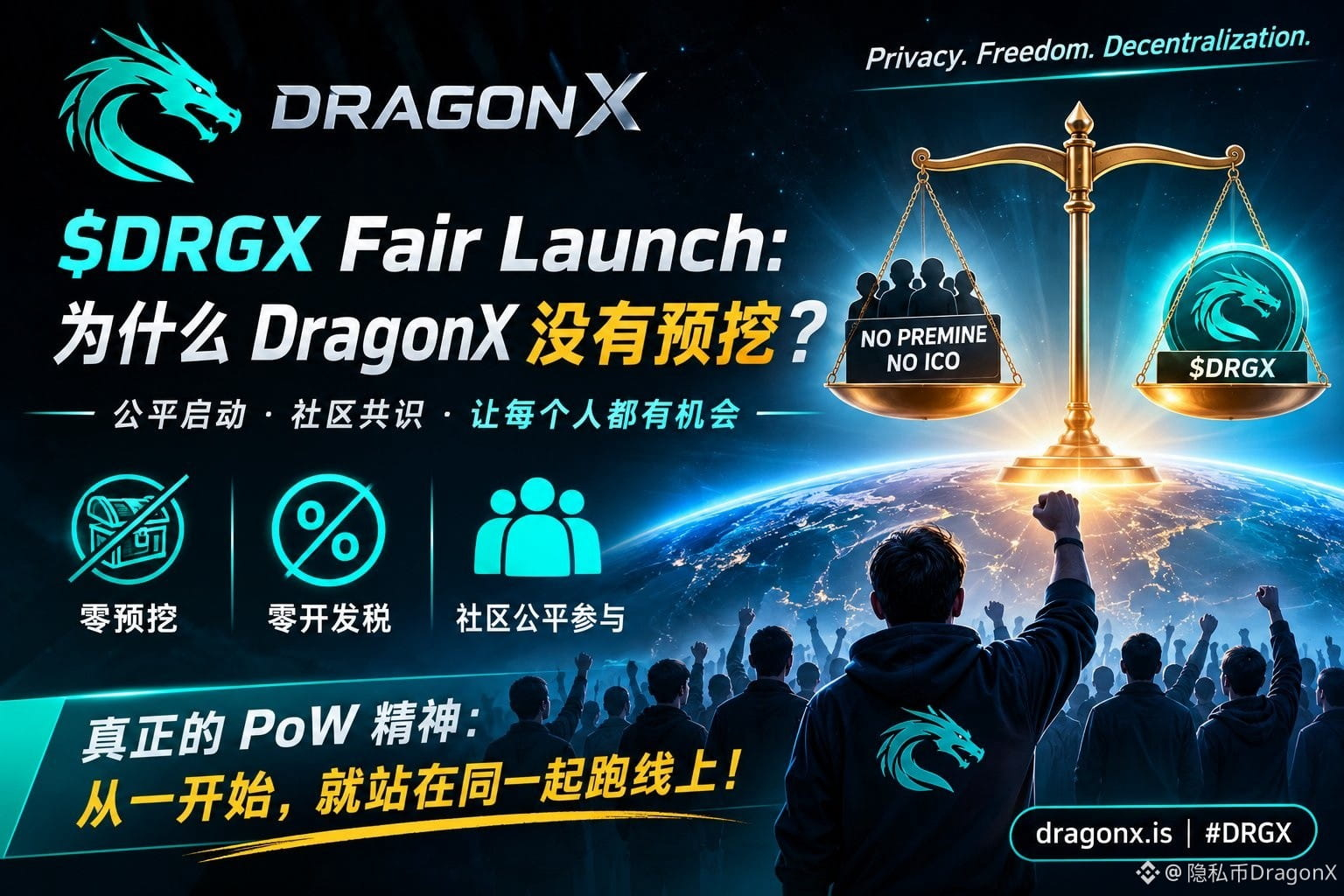
Should privacy coins prioritize protecting users’ financial sovereignty, or enriching insiders and early investors?
There’s a strange contradiction in today’s crypto market. Countless projects promote decentralization, privacy, and financial freedom, but few bother to examine how their tokens were initially distributed.
Was there a premine? Were tokens reserved for the team? Is there a developer tax? Was there a private sale? Are ordinary participants and early investors really on equal footing?
That’s one of the reasons I’m paying attention to $DRGX (DragonX).
According to its whitepaper, DragonX launched without a premine or founder rewards, while its official website states that there is no developer tax. It uses RandomX proof of work, allowing new coins to be earned through CPU mining, and integrates Sapling zero-knowledge privacy into the protocol.
A fair launch isn’t established simply by a project claiming to be “fair.” Its issuance rules should be open to independent verification.
Of course, a fair launch doesn’t guarantee future success. But if we truly believe in the cypherpunk ethos, we should start by examining how a currency is created, how power is distributed, and who controls the rules—not obsessing over price charts and market caps.
Privacy should never be reduced to a marketing gimmick, and decentralization should never become another disguise for enriching insiders.
If you’re curious about DragonX’s technology and philosophy, explore the project and read its exclusive interview.
$DRGX — Back to cypherpunk.
Official website:
dragonx.is
Exclusive interview:
crypto-lowcap.com/dragonx-cpu-mineable-zk-snarks-privacy-coin-interview/
#BTC #ETH #zec #PrivacyCoin #altcoins