"War spreads to Kuwait, but oil prices still close lower"
Several drones attacked military facilities at multiple locations in Kuwait on Thursday. An air-defense surveillance station was hit, and two Italian technicians maintaining a detection antenna died from their injuries. A Kuwaiti captain and a Pakistani national were injured. Kuwait’s Ministry of Defense confirmed the deaths. Reuters reported that this was the second report this month of targets inside Kuwait being attacked.
Responsibility remains disputed: Italy’s foreign minister said the drones were made in Iran; Iran denied involvement, saying it had conducted no military operation, and said it was willing to help determine their origin. There have been no reports of energy facilities being hit, and Kuwaiti exports have not been disrupted.
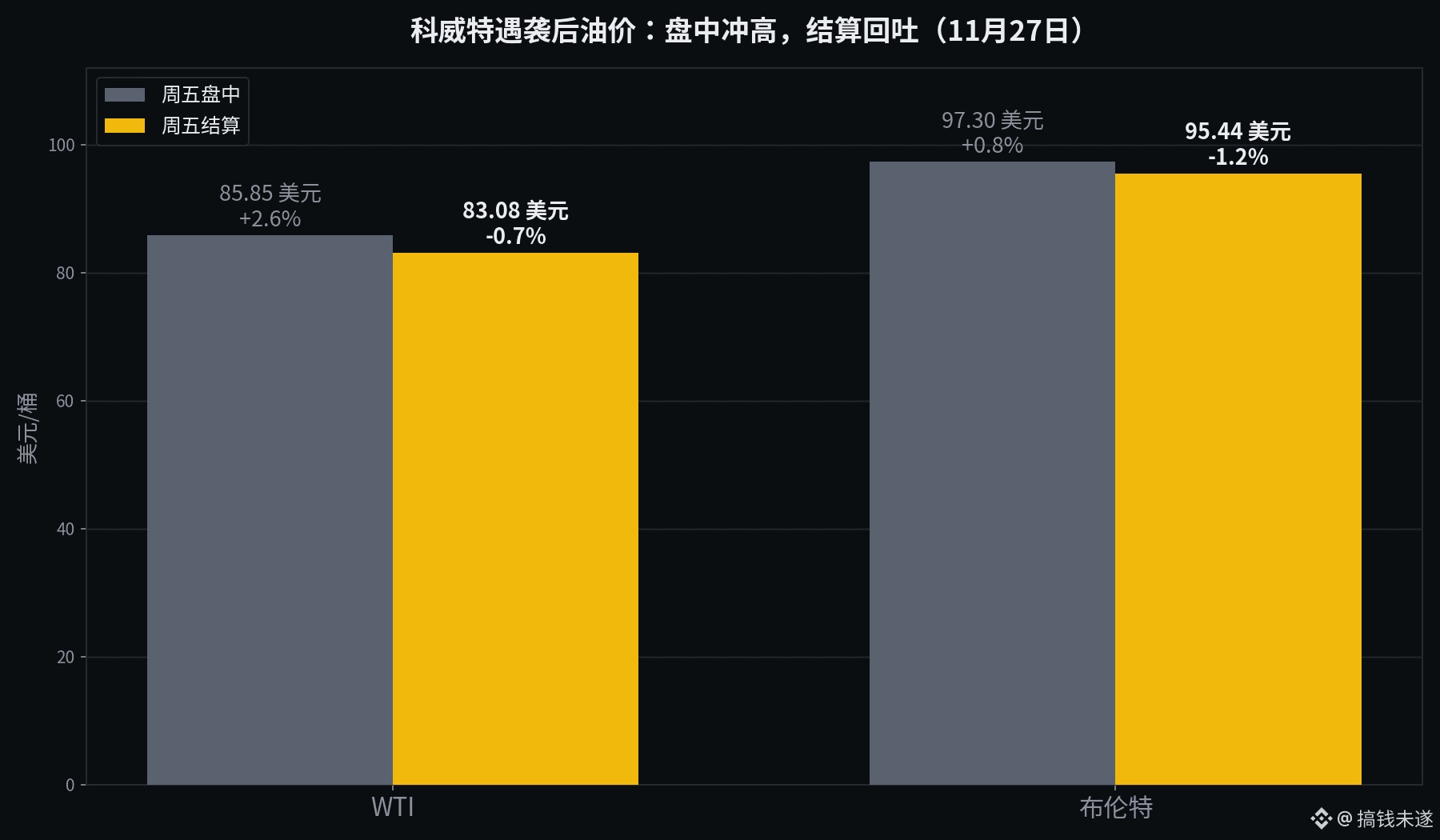
Oil prices first heated up, then cooled: during Friday’s session, WTI briefly rose 2.6% to $85.85 and Brent gained 0.8% to $97.30. At settlement, WTI closed at $83.08, down 0.7%, while Brent closed at $95.44, down 1.2%—giving back all of their intraday gains.
Within two days of attacks on the Ras Tanura and Jizan refineries, the war has spread to Kuwait. The attacks are escalating, yet oil prices closed lower, suggesting that the war premium has become desensitized to “attacks without supply disruptions.” For the premium to return, export facilities would need to be hit or shipping through the Strait of Hormuz materially disrupted. Until then, similar attacks will only trigger intraday spikes followed by losses by settlement. If WTI again climbs above $85 next week but fails to hold there, this view remains intact.
$CLUSDT $BZUSDT #原油 #Kuwait