
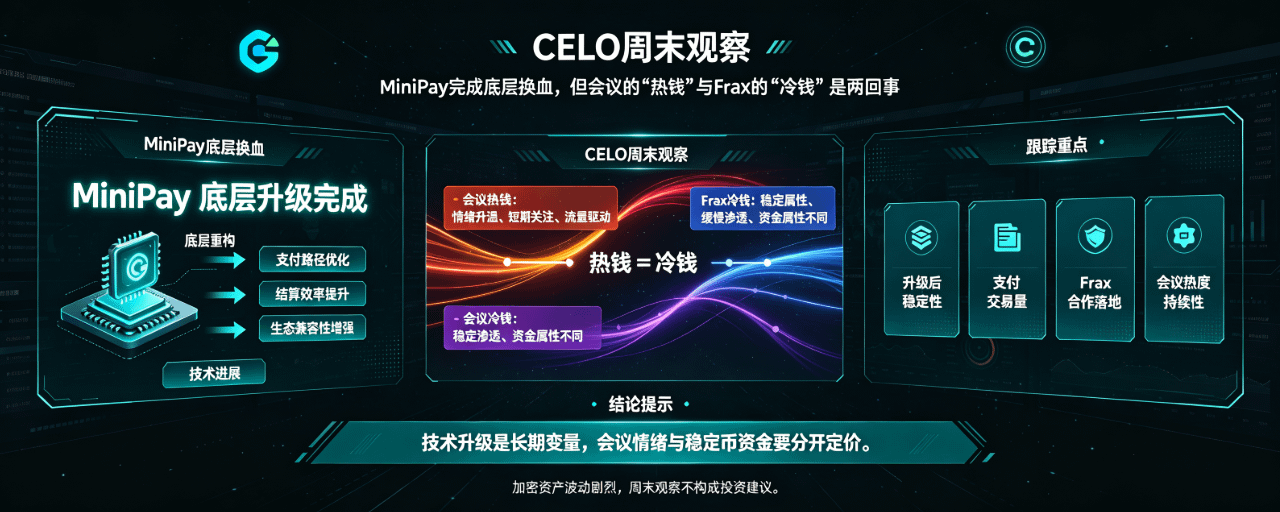

CELO Weekend Watch: MiniPay Completes an Under-the-Hood Overhaul, but Conference “Hot Money” and Frax’s “Cold Money” Are Two Different Things
This weekend coincides with Binance Blockchain Week (November 28–29 in Bangkok), where Celo is a title sponsor. Market attention to CELO doubled within 24 hours. CELO rebounded from a low of $0.0526 on November 25 to around $0.0567, a gain of about 9.4%. But beneath the appearance of “conference buzz,” MiniPay has completed an underlying infrastructure migration—far more significant than short-term price action—and the two developments mean very different things for CELO.
MiniPay’s “under-the-hood overhaul”: From seed phrase wallet to the Stripe ecosystem
On November 19, MiniPay migrated its more than 20 million activated wallets to Privy, Stripe’s wallet infrastructure. This was not a simple UI update, but a fundamental overhaul of key management and login processes. Privy has provided technical support for more than 20 million wallets, with clients including fintech companies such as Klarna, Deel, and Ramp.
The key change is that users no longer need to manage a seed phrase. They can log in using email, a social account, a passkey, or an external wallet, and sync the same wallet’s balance and transaction history across Android and iOS. Privy manages the keys in the background, but the wallet remains self-custodial, and users can export their private keys at any time. Gas fees on the Celo network can be paid in stablecoins, so users don’t need to hold multiple assets.
The significance is not that this is “another partnership,” but that MiniPay has evolved from “a wallet running on Celo” into “an endpoint for Stripe’s settlement and identity infrastructure.” On November 12, MiniPay integrated Link by Stripe’s one-tap crypto purchase feature, allowing users in Europe and the US to fund their wallets with stablecoins in seconds using a bank card, Apple Pay, or Google Pay. Now, with the addition of Privy’s key management and login layer, MiniPay is deeply integrated with Stripe on both the funding and custody sides. For the many users among its 20 million who have little experience with crypto, seamless login and recoverable wallets come closer to the definition of “usable” than any narrative.
But the conference’s “hot money” and Frax’s “cold money” are different in nature
CELO’s short-term rebound has two sources of momentum, but their staying power differs greatly.
Conference sponsorships bring “hot money.” The title sponsorship of Binance Blockchain Week and trading incentives (up to 170 BNB in rewards) generated a lot of discussion and short-term buying over two days. The trading structure reveals how fragile this rally is: open interest across all platforms is only around $4.02 million, the funding rate for OKX perpetuals is neutral at 0.01%, and 24-hour liquidations total just $3,090. Leverage has not participated in this rally, meaning there are not enough short positions to squeeze and no leveraged funds driving the move. Genuine buy orders on a thin order book can push the price up by several percentage points on their own, but once those orders stop, there is also little support to catch the price. The report explicitly notes that the attention generated by the event is expected to fade after it closes on November 29.
Frax brings “cold money.” On November 24, Frax deployed frxUSD, sfrxUSD, frxETH, sfrxETH, and WFRAX as native assets on Celo. Frax also bought and held CELO on the open market, while Celo Core Co. allocated up to $9 million of its reserves to sfrxUSD. This is sustained buying funded by a partner’s own balance sheet, not two days of conference-driven excitement. Among this week’s news, this is the only development explicitly tied to sustained buying.
In addition, a token unlock is scheduled for November 28, adding supply in an already weak liquidity environment. The timing of these overlapping factors makes short-term trading more complicated.
Trading insight: How to approach a “conference rally” in a thinly traded market
CELO’s current market cap is around $34 million to $36 million, and its 24-hour trading volume rose from about $1.4 million on November 23 to around $3.4 million. For an asset of this size, the doubling in discussion volume and price spike driven by conference sponsorship are real, but they represent short-term, event-driven volatility rather than an established trend. Frax’s buying and MiniPay’s Privy upgrade are long-term drivers: they change CELO’s long-term demand structure and the accessibility of its payment network, but they won’t push the price to a new equilibrium in two days.
Within a “long-only, no shorting” framework, the difference lies in the price and position size you choose to participate with. The pre-conference rally has already priced in some of the sponsorship expectations, making the $0.056–$0.057 range the center of short-term trading. Meanwhile, Frax’s continued buying and MiniPay’s infrastructure upgrade offer reference points to watch after a pullback, not reasons to chase the price higher. Near the November low around $0.0526, a slowdown in selling followed by price stabilization would be the first verifiable signal that “cold money” can absorb supply after “hot money” retreats. The $0.060–$0.065 range above is the market’s true pricing boundary once the conference excitement has fully faded.
In a nutshell: MiniPay is turning the wallet into a payment terminal that “you can use without understanding crypto”—Celo’s most solid long-term driver. But conference sponsorships and trading incentives create hot money that moves on a timescale of days. Both are worth watching, but you shouldn’t trade a long-term story at the pace of hot money.

#CELO #minipay #Privy #frax #只做多涨幅榜第一名会怎么
⚠️ The above is an objective summary of public market data and ecosystem information and does not constitute investment advice. CELO is an extremely small-cap asset with very high liquidity risk. Please make decisions with caution based on your own risk tolerance.