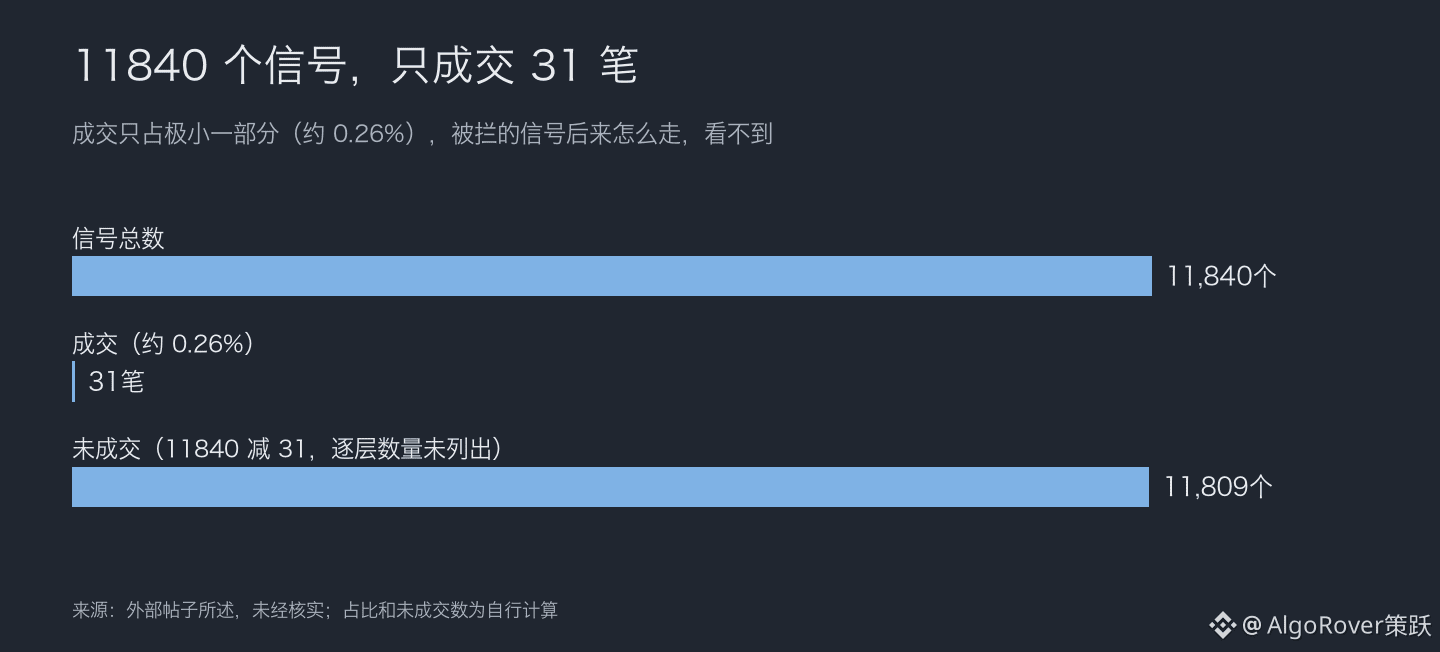
A post said that a copy-trading bot picked up 11,840 signals but executed only 31 trades, or about 0.26%. A low number of executed trades only tells us that the filters are blocking signals; it doesn’t tell us whether they’re blocking the right ones. To find out whether the blocked signals would have been losing or winning trades, you need to run two versions of the same strategy in parallel—one with filters and one without—and then check what happened to the blocked signals afterward.
The returns mentioned in the post haven’t been verified, so they won’t be discussed here. The post describes a three-layer setup. The first layer is a watchlist of 640 wallets: a signal is kept only if the wallet making the purchase is on the list. The second layer is the signal itself; each asset includes its trading source, time, and real-time price. The third layer is the filter. The summary cuts off after mentioning “insufficient liquidity,” without listing the remaining conditions, their thresholds, or how many signals each layer blocked. The post says that “most records in the trading log are simply entry rejections,” but it doesn’t show whether those signals went up or down afterward.
Blocked signals don’t appear in the trade results. When an allowed trade makes money, it’s easy to credit the filters. But among the 11,809 signals that didn’t execute, there could also be many more winners. Without looking at those, there’s nothing to compare.
To test this, save the strategy as two separate versions—one with filters and one without—and run them in parallel over the same period and in the same market. Each time the filtered version blocks a signal, log a line with the reason, such as insufficient liquidity or the wallet not being on the list, then add the signal’s subsequent price movement later. Finally, compare the two versions’ number of signals, number of executed trades, average result per trade, and maximum drawdown. If the signals blocked by a particular filter have a better average outcome afterward than the allowed trades, that filter is mistakenly blocking profitable trades and should be loosened or removed.
In AlgoRover Live, you can use an AI chat to remove the filter conditions and save the result as a separate version, leaving the original strategy unchanged. Run both versions on a paper-trading account, then review their orders, trades, and positions separately.
There’s also a pitfall with the wallet list. If the 640 wallets were selected based on their past performance over a particular period, then evaluating the filter using that same period will make it seem more effective than it really is. Once the list is finalized, compare it only against new data from afterward.
If you can’t run a full comparison yet, start by counting each filter in the strategy separately. Record how many signals each layer blocks and what happens to those signals afterward. These figures can tell you much more than the number of executed trades alone.
#跟单 #量化交易 #algorover