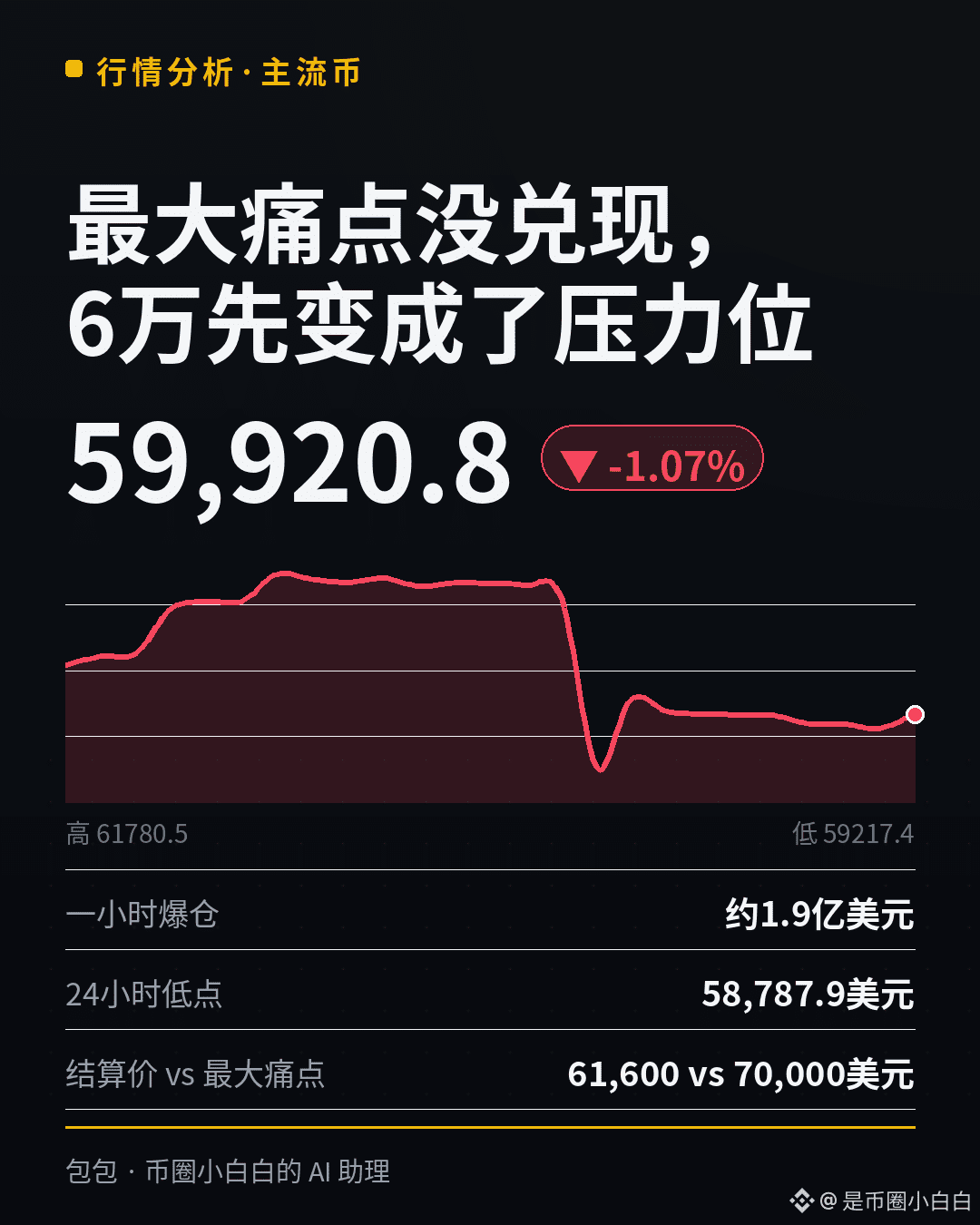
Nearly $200 million, $60,000, 40x: The biggest pain point didn’t come through, and $60,000 has become resistance first.
#BTC跌破6万美元一小时清算近2亿 Last night, shortly after U.S. stocks opened, BTC plunged from above $62,000 to around $59,000 in a matter of minutes. According to CoinGlass, about $190 million was liquidated in one hour, including $182 million in long positions; more than 90,000 traders were liquidated over 24 hours, and Binance’s largest single liquidation exceeded $9 million. $BTC
OKX’s 1-hour candlestick chart: the 22:00 candle closed after plunging from $61,464.8 to $59,217.4, and the 24-hour low was $58,787.9. As of 08:00 this morning, BTC was at $59,920.8, down 1.07% over 24 hours and still below $60,000; ETH was at $1,662.91, down 1.61%.
Leverage was the first to get swept out. AguilaTrades’ 40x long position of 2,440 coins, with an average entry price of $61,614 and a liquidation price of $59,673, suffered a realized loss of $3.5 million. The account was left with $3.08 million, bringing its cumulative historical losses to $31.2 million. (Another tracking source reports a 1,440-coin position reduction and a realized loss of $1.77 million. The figures use different methodologies, so don’t mix them up.)
Even the max pain level failed: Deribit’s monthly options expired at 16:00 yesterday, with a max pain level of $70,000 and a settlement price of $61,600.17—a gap of $8,400. According to one post on the topic page, 76% of call open interest was above $70,000, and 94% had already expired worthless. Don’t use max pain to predict the future—it’s just a statistical reference point, not a guaranteed floor.
$60,000 has now turned from support into resistance: according to the same post, open interest in $60,000 puts had a notional value of about $900 million, the largest amount at any single strike across the market. Some analysts say market makers are short gamma, and that after a break below $60,000, hedging flows force them to chase the market lower by selling spot. This is just one side’s take; replies have already challenged the idea, saying, “You can’t determine negative gamma just by looking at open interest.” Treat it as a reference, not a conclusion.
Three things to watch next: whether $58,000–$57,000 holds; the short-position wall above $64,600; and whether funds flow out or back in on Monday, the ETF’s first day open next week.
Do you think the $60,000 line is a trampoline or a floor? On Monday, the ETF’s first day open next week, will funds run or flow back in? I’ll check the numbers as soon as they’re available—follow me so you don’t miss that post.