

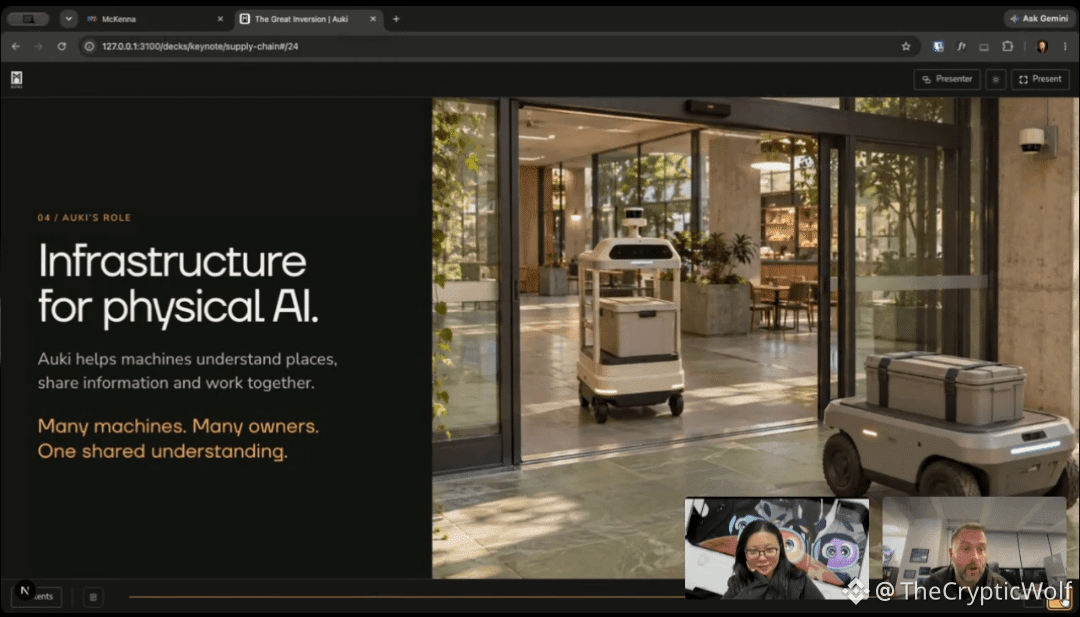
The latest $AUKI community update got me thinking about how physical AI and DePIN could fundamentally change the economics of our everyday lives. In his presentation “The Great Inversion,” Nils explored how the costs of transportation, handling and coordination have historically favored centralization. Bigger farms, bigger stores and bigger distribution centers became economically advantageous. What happens through when physical AI brings all three costs down simultaneously? • Smaller farms could compete by sharing robotic equipment. • Neighborhood stores could offer greater variety with less shelf space. • Lower operating costs could create opportunities for new businesses, entrepreneurs and jobs. Delivery could become retrieval, with robots collecting goods on our behalf. Even our homes could become part of the infrastructure supporting physical AI, providing landing pads, charging stations and robotic capacity within our communities. This is where I see enormous potential for DePIN. Individuals and businesses could collectively fund, own and contribute to the infrastructure supporting the robotic economy without everything needing to be owned by a handful of corporations. @AukiNetwork real world web is going to become increasingly important and we're already seeing the foundations of this vision through Cactus. By combining spatial intelligence, digital twins, business data and AI reasoning, Cactus is helping retailers improve physical operations today while laying the groundwork for a collaborative human and robotic workforce tomorrow. Auki is already addressing real business problems while building the decentralized infrastructure that could support physical AI at a much larger scale. Imagine a future where physical AI makes smaller businesses more competitive, DePIN enables broader ownership of robotic infrastructure, and Auki provides the shared spatial understanding that allows it all to work together.
Join global crypto users on Binance Square
⚡️ Get latest and useful information about crypto.
💬 Trusted by the world’s largest crypto exchange.
👍 Discover real insights from verified creators.
Email / Phone number