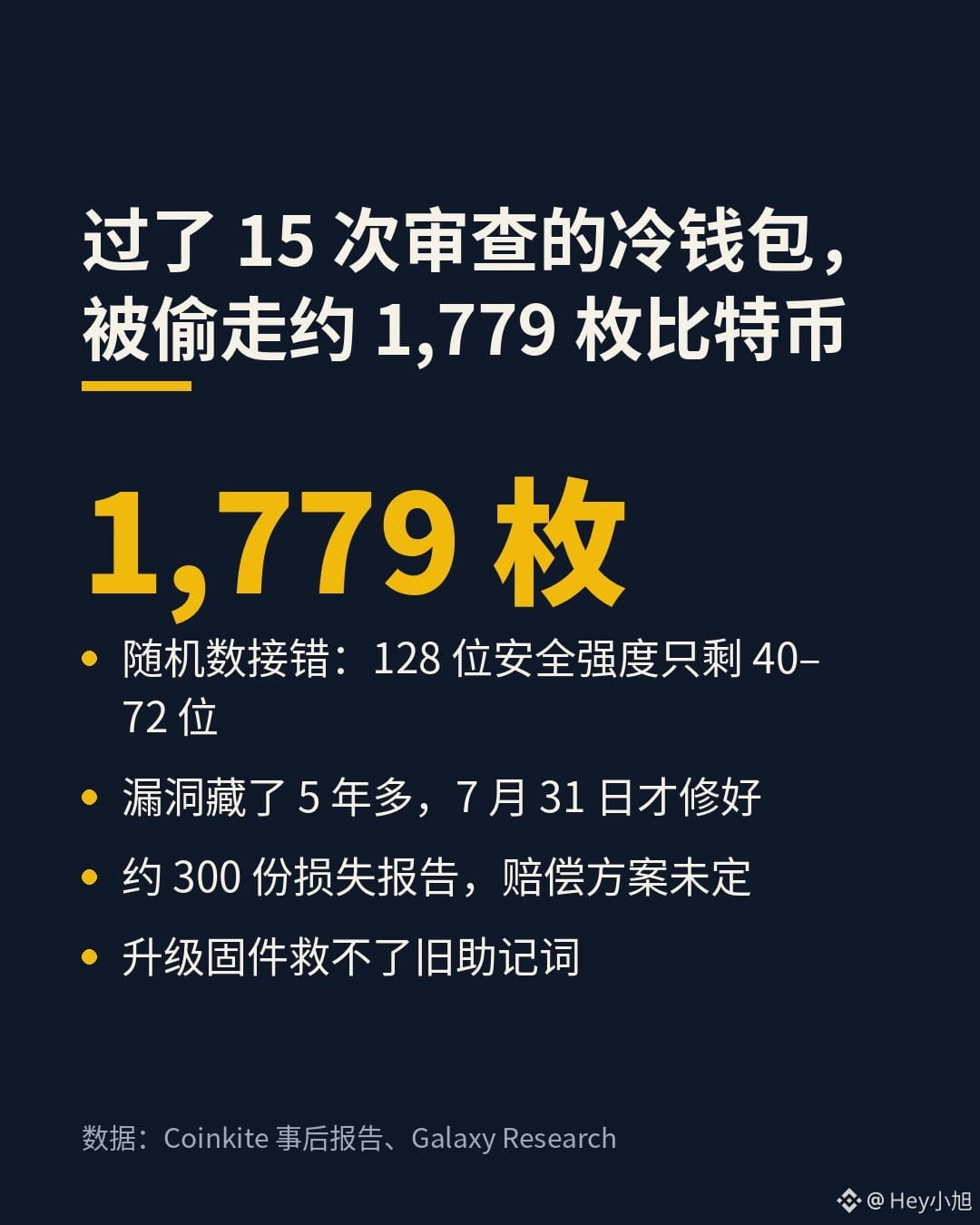
A hardware wallet touted as “safest when offline” had about 1,779 bitcoins stolen from it on-chain—and nobody spotted the vulnerability despite 15 security reviews 🥲
This week, hardware wallet maker Coinkite published an 18-page postmortem explaining exactly what went wrong with its Coldcard wallet:
1. The device was supposed to use the chip’s hardware random number generator to create seed phrases, but the firmware was wired up incorrectly and actually used a very weak software random number generator.
2. The original 128-bit security strength was reduced to about 40 bits on older Mk2/Mk3 models and about 72 bits on newer Mk4/Mk5/Q models. Hackers could calculate the private keys offline, without ever touching your device.
3. The issue went unnoticed from March 2021 until July 2026, and was only fixed on July 31. During that time, there were at least 15 independent reviews. Everyone confirmed that “a secure generator was included,” but nobody checked whether it was actually being used.
4. According to Galaxy Research’s figures through mid-August, about 1,779 bitcoins were stolen—worth more than $100 million at today’s price of around $60,000 per coin. Coinkite received about 300 loss reports involving 242 accounts, and no compensation plan has been finalized.
The most painful part: updating the firmware won’t save seed phrases that have already been generated. Anyone who used an affected version needs to generate a new seed phrase on the patched firmware and transfer their coins to it.
The takeaway for everyday users is simple: even the most “hardcore” tools are built from code written by people. Don’t put all your high-value assets on a single device or behind a single seed phrase.
Do you keep your coins in one place, or spread them out? 👇
Sources: Coinkite postmortem, Galaxy Research, Cointelegraph, Decrypt
#比特币 #钱包安全 #CryptoMarket