
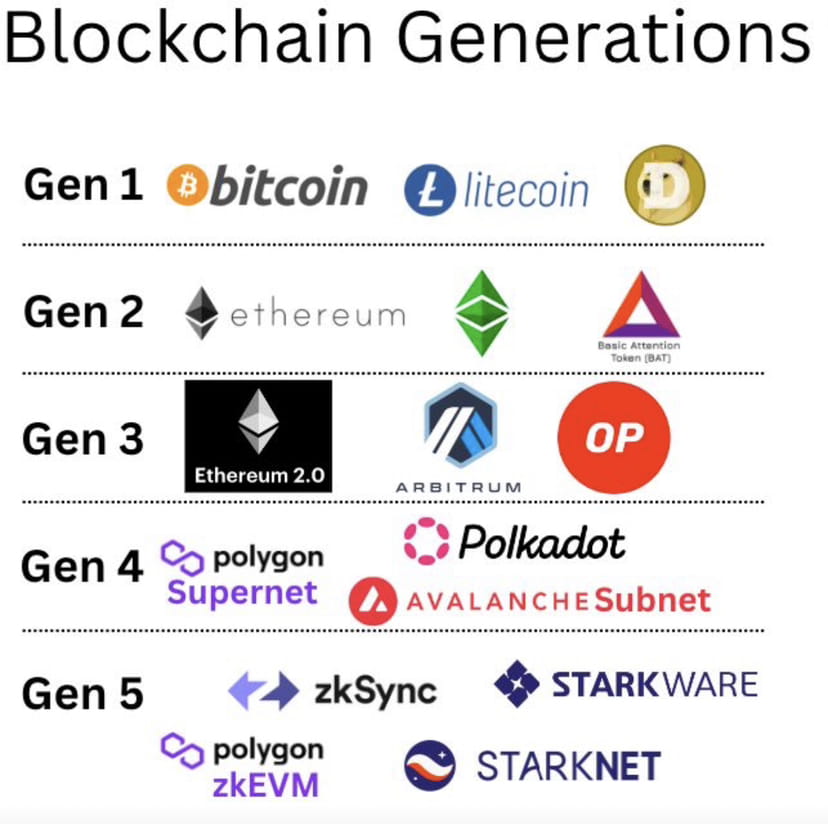
🟢 Generation 1: Bitcoin, Litecoin, Dogecoin
Goal: improve the monetary system
Function: send, receive, transaction
Bitcoin was the first cryptocurrency to demonstrate that decentralized financial consensus is possible with an efficient implementation.
Early forks used and still growing: Litecoin, Dogecoin, etc.
🟣 Thế hệ 2: Ethereum, Eth Classic, Basic Attention Token
Objective: decentralized terms and conditions based on 1st generation functionality
Function: smart contract
Self-executing agreements are made between the two parties. The participating parties agree on the conditions and the contract activates once they are met
🔵 Generation 3: Eth 2.0, Decision, Optimism
Goal: 2nd generation expansion
Function: moves computation off-chain, while minimally storing transaction data on-chain
Scalable in many different ways, one way is to handle all the tangled data, allowing many times more smart contract transactions to be clustered in a block
🟠 Generation 4: Avalanche subnets, Polygon supernets, Polkadot
Goal: sovereign blockchain network, defining its own rules, membership, token economics
Function: collections of interconnected networks, holding and organizing large amounts of data and facilitating communication between users
🟡 Generation 5:
The goal: infinite scalability
Function: process thousands of transactions in one batch and then only post some minimal summary data to mainnet
One generation is not necessarily "better" than the previous generation, they are arranged in order of general reception.
Additionally, this understanding is not exhaustive, it is a way of looking at the ecosystem.
There are others being thought about and built, mostly with the same goal: secure, decentralized technology built for all humanity to use.
(Translated from: Glenn Rachlin)