Good SOL

Post

宸恺
·
--
November 27–28 Crypto Briefing | Technical Rebound · Structural Divergence · Short Squeeze Unwinds
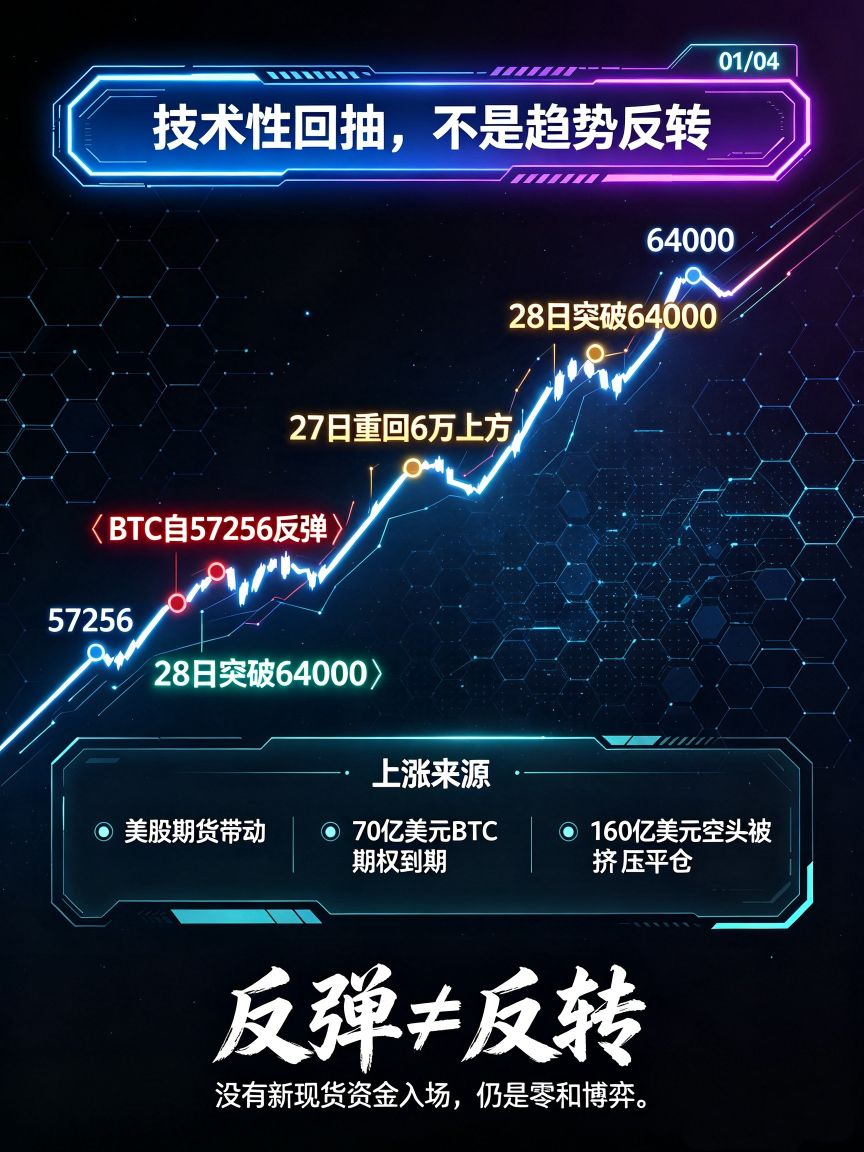
BTC rebounded from 57,256, climbed back above 60,000 on the 27th, and broke through 64,000 on the 28th. But the rebound on the 27th came on the day $7 billion in options expired, fueled by a reversal in U.S. stock futures. OKX explicitly characterized it as a “technical rebound, not a trend reversal.” The further rise on the 28th was driven by the squeeze on the $16 billion in short positions that CryptoQuant had flagged earlier—not spot buying, but shorts closing their positions.
Prices are rising, but the market structure is deteriorating. Three data points on the same day pointed in opposite directions: whale addresses holding 10,000–100,000 BTC shed about 150,000 BTC over a month (roughly $9.1 billion), though these addresses still account for 67.55% of the circulating supply; ETFs saw more than $5.3 billion in net outflows over seven days; and the derivatives market had accumulated about $16 billion in short positions.
Bitcoin ETFs saw $5.39 billion in net outflows in November, exceeding June’s $4.51 billion and setting a record for the worst single month since launch. Net outflows continued for seven consecutive trading days from November 17 to 25, totaling about $3.05 billion, with IBIT alone seeing $2.46 billion in outflows. On the 25th, none of the 12 products recorded net inflows. If the slump continues through year-end, Bitcoin ETFs will see net outflows for the first full year on record.
ETH’s $1,680 level is “thin support”: 1.14 million ETH changed hands around that level, but below it, down to $1,584, lies an on-chain vacuum. If the price breaks below, there are no dense on-chain holdings to catch it. Meanwhile, an ICO whale who had held ETH for ten years sold 32,010 ETH, realizing a return of about 5,372x.
Two asymmetries will shape the volatility ahead: above BTC, $16 billion in shorts could fuel a sharp squeeze once buying starts, but demand indicators are still negative, and a squeeze cannot replace real buying; below ETH, there is a vacuum at $1,584, and a break below could send the price down quickly.
The relationship between price and structure is like the difference between “bustle” and “prosperity.” A rally driven by a short squeeze turns shorts’ pain into longs’ profits. It is a zero-sum trade, not the creation of new value. A truly symbiotic rally requires new buyers, new narratives, and new participants to enter at the same time. A rally where shorts are hurting but no new money is coming in is a last gasp for the market structure.
Position management isn’t being conservative; in an asymmetric market structure, it’s the only rational choice.
That’s all for this edition. I’m Chen Kai—see you next time.