
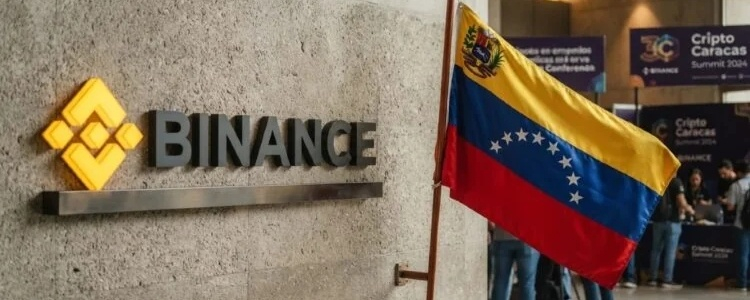

The platform handles foreign exchange transactions, connects bolívares with crypto assets, and is beginning to offer financing alternatives.
Venezuela has found in Binance a platform capable of solving some of its financial problems.
Between 40% and 46% of Venezuela’s foreign exchange transactions would go through Binance, according to Ecoanalítica.
Binance now allows users to deposit and withdraw bolívares via Pago Móvil and bank transfers.
Something is changing in the relationship between Venezuelans and Binance. And it goes far beyond the exchange’s popularity among those who buy and sell bitcoin (BTC) and cryptocurrencies.
The platform is beginning to perform functions that, in any economy with a functioning financial system, would be distributed among banks, currency exchange offices, payment providers, and financing institutions.
I don't think Binance is indispensable to Venezuela's economy. Nor has it replaced the banking sector. But I do believe it has become one of the country's most important parallel financial infrastructures.
And it is achieving this because there is demand that traditional institutions have been unable to meet, and because its services increasingly help people take care of everyday needs without leaving the app.
The scale of this phenomenon was laid bare on November 3, when socioeconomic research firm Ecoanalítica published estimates indicating that between 40% and 46% of Venezuela's currency exchange transactions pass through Binance, as we reported at CriptoNoticias.
The firm also estimated that the exchange's P2P market processed USD 5.949 billion between June 11 and October 20, 2026, averaging USD 45.4 million per day.
To put that volume into perspective, the consultancy noted that it is equivalent to 83% of the foreign currency the Central Bank of Venezuela (BCV) injected into the financial system during that period.
We are not talking about an app used exclusively by bitcoin enthusiasts or investors seeking exposure to cryptocurrencies. Binance has a considerable presence among merchants and retail users who need to convert bolívares into hard currency, receive payments, protect their income, or access a reference rate for exchanging currencies.
USD Tether (USDT), in particular, has found fertile ground in Venezuela. The loss of confidence in the bolívar and the difficulty of accessing foreign currency through traditional channels have made stablecoins everyday tools. And Binance provides one of the main platforms for accessing and moving them.
But the real change is happening now: the platform is no longer relying exclusively on the mechanisms that enabled it to build its position. 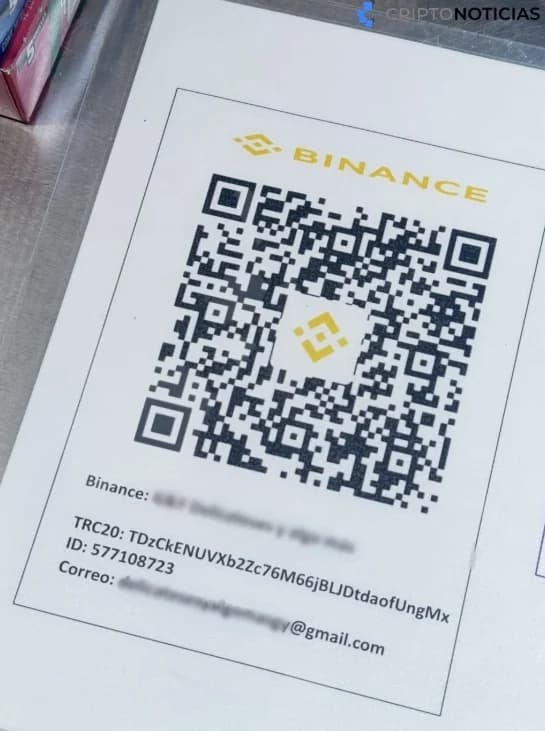
Many USDT payments in Venezuela are made through Binance
From intermediary to on-ramp and off-ramp
Until recently, using Binance in Venezuela's everyday economy could require several extra steps. Users would buy or receive USDT on the exchange, then turn to other apps to connect those funds with payments in bolívares.
Crixto and Kontigo served as part of that bridge. They brought the digital asset ecosystem closer to transactions more familiar to users, such as accessing bolívares or making payments. However, this infrastructure also depended on each company's operational and banking conditions.
The situation at Kontigo, whose license was reportedly temporarily suspended by the Superintendency of the Banking Sector (Sudeban), highlighted the fragility of this arrangement. The measure was accompanied by restrictions on its banking relationships and reports from users unable to withdraw their funds.
Crixto, for its part, has also changed how it operates and, according to recent changes reported by users—and confirmed by CriptoNoticias—has stopped offering the mechanism that directly connected its operations with Binance.
Against this backdrop, Binance's decision to add deposits and withdrawals in bolívares is significant for reasons that go beyond convenience.
On October 15, it began enabling deposits via Pago Móvil and bank transfers. On November 25, it added the option to withdraw bolívares through those same channels. This completed a circuit that lets users enter and leave its ecosystem without necessarily having to use the P2P market or an intermediary app.
One detail is worth clarifying: local currency transactions are processed by Casa de Cambios Insular, a Venezuelan entity supervised by Sudeban and the BCV. Binance does not directly receive or hold bolívares under this arrangement. The local operator manages the settlement of transactions with the banking system.
This structure allows Binance to connect with the national financial infrastructure without thereby becoming a Venezuelan bank.
In my view, it's a smart business move, but also a sign of just how deeply Binance has become integrated into the Venezuelan market. 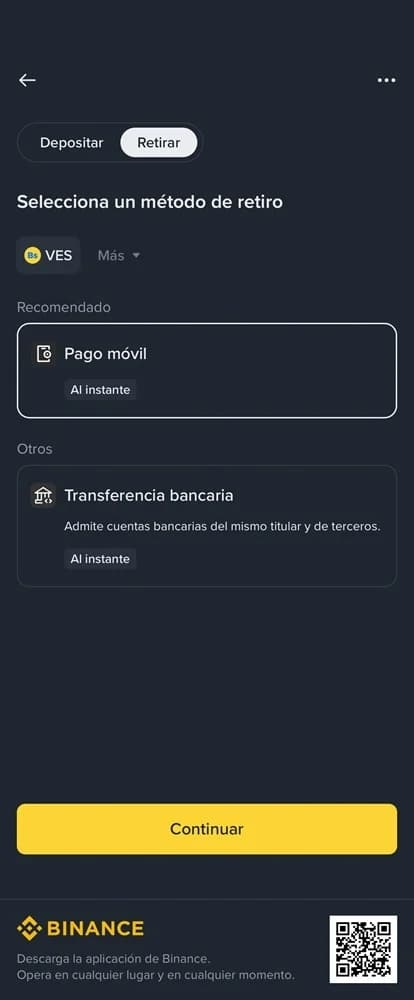
The feature is being gradually rolled out to its users in Venezuela.
When an exchange starts offering credit
The expansion doesn't stop at payments and currency exchange. Binance has also incorporated financing tools that broaden its relationship with users.
The launch of Pay Later in Venezuela is one example. The service allows purchases using credit in USD Coin (USDC), backed by cryptocurrencies such as bitcoin, ether, and BNB. The initial spending limit can reach 1,000 USDC, subject to the value of the assets provided as collateral.
How it works deserves attention because this is not a conventional bank loan. Binance sets an initial loan-to-value ratio of 50%, an alert threshold of 75%, and a liquidation threshold of 90%. If the collateral's value falls or accumulated interest increases the debt, the platform may automatically liquidate the collateral. In addition, the feature does not protect users against a flash crash.
It's not exactly the kind of credit a productive economy needs, but it is another option for those seeking liquidity without selling their cryptocurrencies. And its presence in Venezuela is especially significant at a time when bank financing remains limited by the financial system's structural conditions, and when a familiar option already exists and is embedded in the national economy: Cashea. 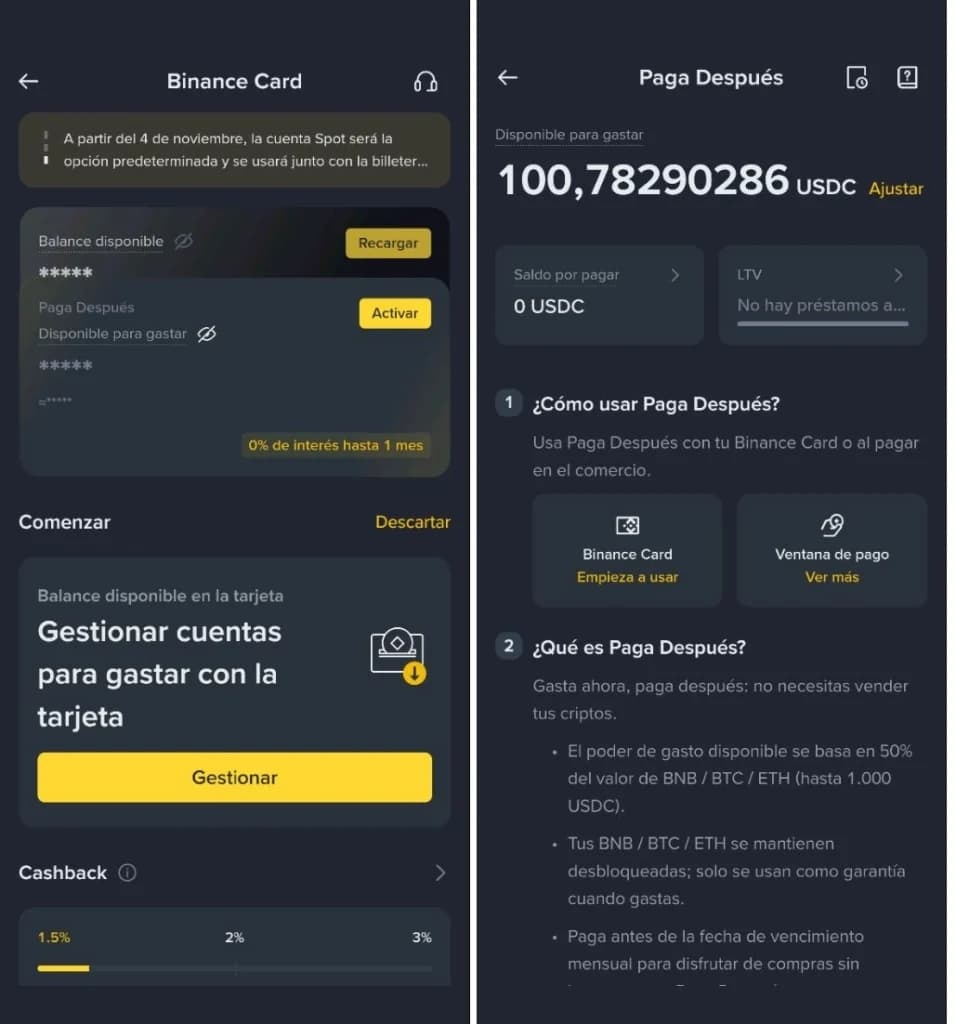
Binance's Pay Later feature is available in Venezuela.
The problem with depending on a foreign company
So far, Binance's expansion can be seen as an effective response to needs that Venezuela's financial system has been unable to address. It would be unfair to ignore the value it offers merchants and individuals by providing a tool that facilitates access to digital dollars and allows money to be moved more quickly.
But we also cannot celebrate this transformation without asking what risks it introduces.
The first is concentration. A significant share of Venezuela's currency exchange transactions depends on a private platform.
When infrastructure becomes this important, any disruption ceases to be an inconvenience for its customers alone and can affect much broader economic activity. Indeed, the cybersecurity incident that affected Binance in October offered a glimpse of this vulnerability.
The second risk is dependence on a foreign company. Binance can change its terms, restrict services, suspend accounts, or adapt its operations to regulatory requirements in other jurisdictions.
Venezuelan users have no ability to influence those decisions, nor any guarantee that the platform will maintain the same access conditions indefinitely.
Bitcoin's decentralization should not be confused with Binance's structure. Using USDT within an exchange is also not equivalent to having sovereign control over funds. These are different things, and that difference matters especially when a platform carries so much weight in a country's economic life.
Venezuela found a bank where it shouldn't have been looking
I don't think Binance is replacing Venezuelan banks. Nor is it indispensable for the economy to function. But its growth shows that there is an enormous gap between citizens' financial needs and what national institutions can offer them.
The platform is filling that gap. It began with the P2P market, then connected with local services, and now offers infrastructure for depositing and withdrawing bolívares directly, as well as financing options.
The result is a kind of parallel economy that does not replace the traditional system, but has already grown large enough to influence how merchants and individuals exchange, save, and move their money.
The concerning thing is not that Binance has reached this position. From a business perspective, its expansion responds to an obvious opportunity. The question is why a foreign company has managed to occupy such a prominent place in Venezuela's everyday financial infrastructure.
The country found a practical solution in Binance to problems its banking system has been unable to solve. But addressing a need does not eliminate the risks of depending on the provider of that solution.
And if that door closes tomorrow, Venezuela will have to ask itself what alternatives it built while entrusting a large part of its parallel economy to a single platform.
#venezuela #BinanceVenezuela #binancevenezuela🇻🇪 #BinanceSquare #BinanceSquareFamily $BTC $BNB $ETH