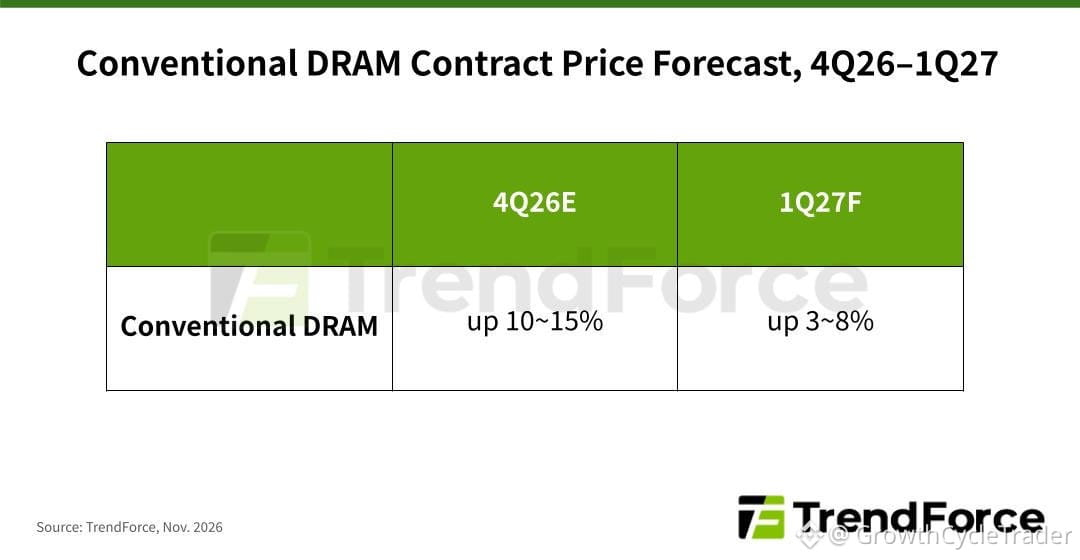
DRAM pricing risk is shifting forward. TrendForce sees limited demand visibility through 2028 and flags two paths — neither is bullish.
Base case: Contract price gains narrow through 2027, flatten in H2, then decline in 2028. The logic is straightforward. Consumer electronics demand is soft. Chinese CSPs pulled back on server DRAM in Q4, though U.S. hyperscalers absorbed the slack. But policy headwinds are building — midterm outcomes, potential cuts to Nvidia neocloud financing, new BIS restrictions on advanced chips and leased compute to Chinese firms. Power constraints and a more cautious Washington could reshape 2028 data center builds.
Meanwhile, global DRAM bit supply is ramping hard from 2026 through 2028 as fabs add capacity and migrate to advanced nodes. If server shipment growth slows in 2028, the market flips from tight to oversupplied. Prices fall across all categories starting Q1 2028.
Bear case: Server OEMs cut procurement sooner. Inventory reductions cascade through the chain. Neocloud investment stalls, consolidation accelerates, BIS export controls tighten further. Server shipment growth could decelerate as early as 2027. In that scenario, conventional DRAM contract prices reverse in Q4 2027, with sharper declines in 2028.
The question is timing. If the bear case on server shipments and neocloud financing materializes, how much of the 2028 price decline gets pulled forward into late 2027?
Memory cycles are brutal when they turn. Watch procurement momentum, hyperscaler capex guidance, and any policy shifts around AI chip financing or export controls. The setup is fragile.