$BTC $ETH $BNB
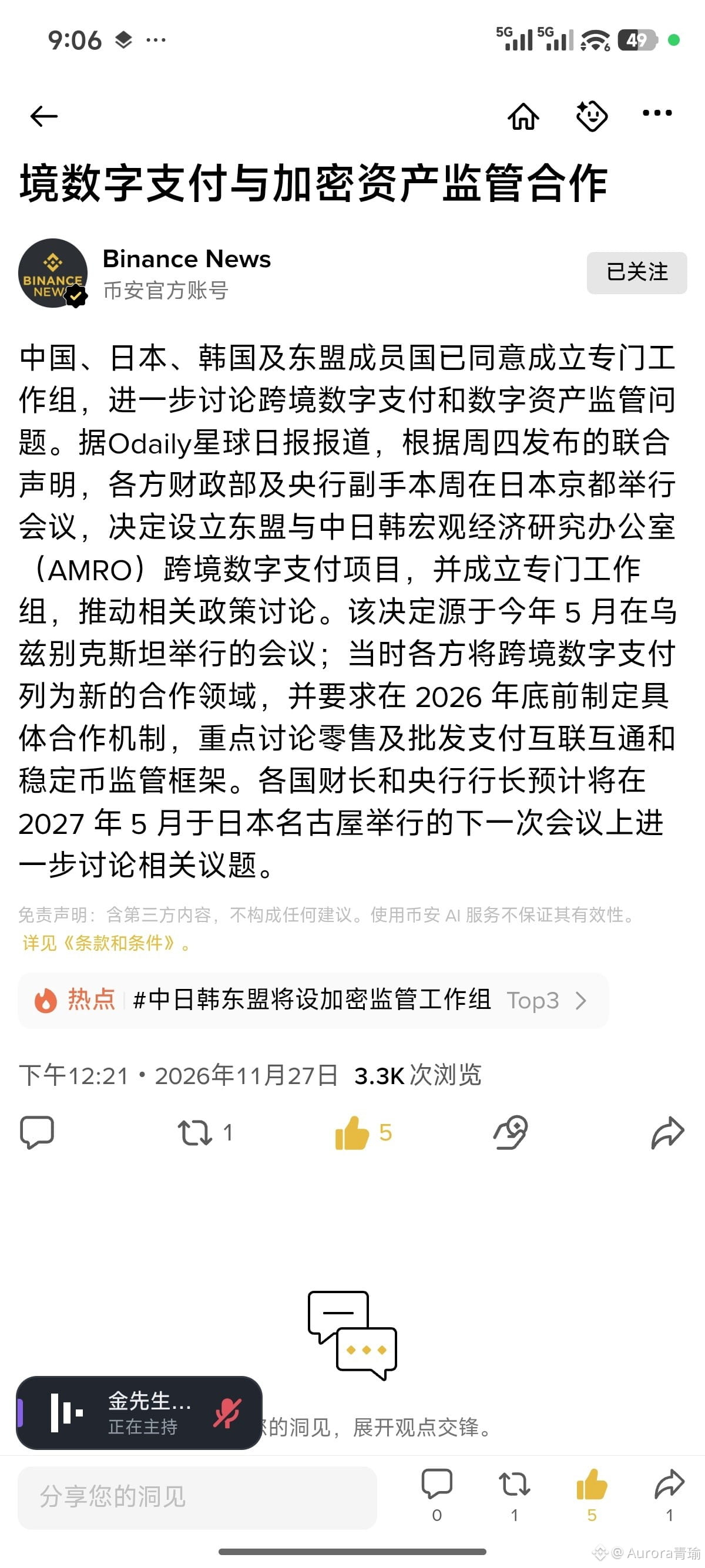
“China, Japan, South Korea and ASEAN agree to establish a dedicated working group to promote cooperation on cross-border digital payments and crypto-asset regulation”
[Analysis]
The news centers on “regional coordination.” Finance ministers and central bank deputies from China, Japan, South Korea and ASEAN (10+3) reached a consensus in Kyoto to make cross-border digital payments a new area of cooperation. Two key priorities were identified: payment connectivity (retail and wholesale) and a regulatory framework for stablecoins. A clear timeline was also set: develop concrete mechanisms by the end of 2026, with further progress at the May 2027 meeting in Nagoya.
[Potential benefits]
1. Payment efficiency and costs: Breaking down barriers to cross-border payments could significantly reduce the high fees and time costs associated with the traditional SWIFT system.
2. Faster compliance: Establishing a regulatory framework for stablecoins will bring an end to “unchecked growth,” benefiting compliant stablecoin projects and the development of RWA (real-world asset) tokenization.
3. Market confidence: Cooperation at the official level reduces regulatory uncertainty and provides policy dividends for Asian Web3 and digital finance companies.
[Broader implications]
1. De-dollarization and local-currency settlement: Greater connectivity between digital payment systems could encourage the use of local currencies in regional trade, reducing reliance on dollar dominance and traditional financial infrastructure.
2. Competition to shape global standards: By joining forces to establish rules, Asia’s major economies aim to counter regulatory standards from Europe and the US (such as MiCA) and increase Asia’s international influence in digital assets.
3. An opportunity for the digital yuan to expand overseas: China’s participation provides an excellent multilateral testing ground for the cross-border use and internationalization of the digital yuan (e-CNY).
[Summary]
This is an important milestone in the integration of Asian digital finance. It marks a shift for digital assets from “going it alone” to “multilateral regulatory coordination,” and will profoundly reshape the future global landscape of cross-border payments and finance.