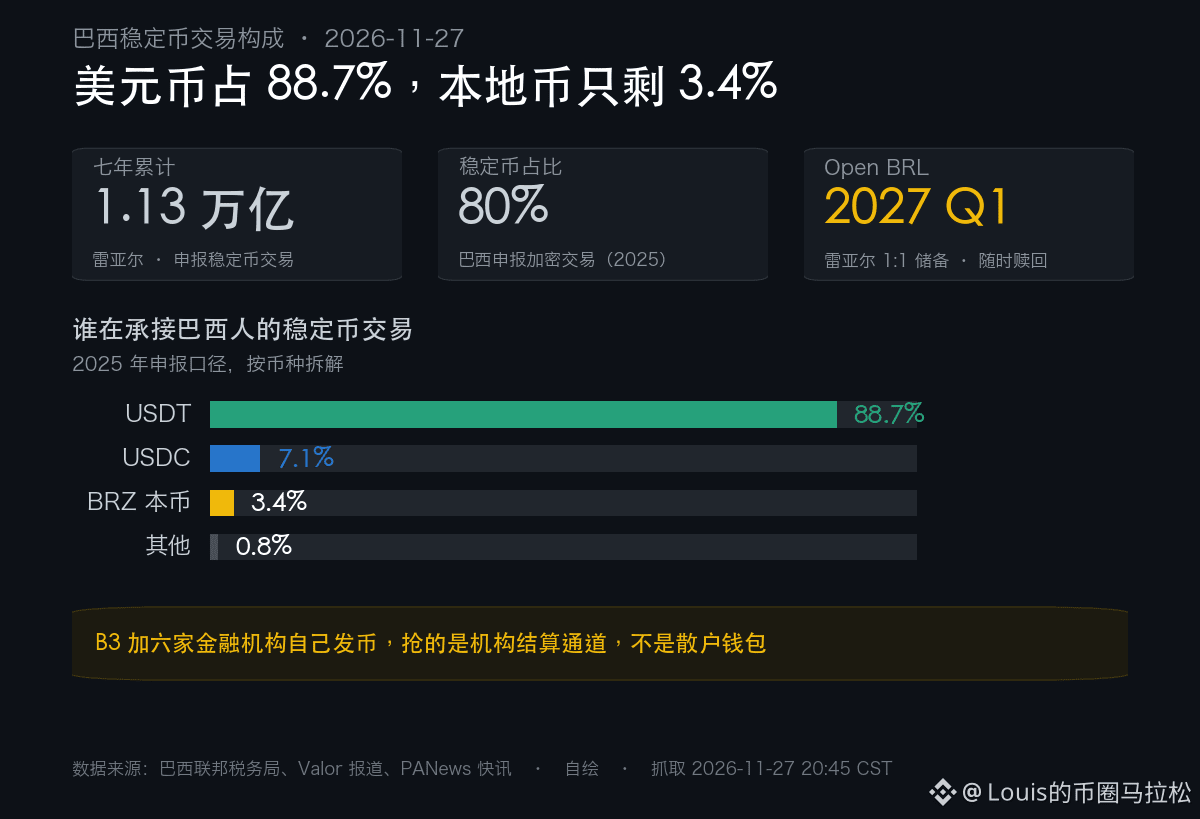
88.7% is in dollars; local currency accounts for just 3.4%
Of the stablecoin transactions reported locally, dollar-pegged coins made up 88%, while Brazil’s own BRZ accounted for just 3.4%.
On November 27, B3, Brazil’s only stock exchange, and six financial institutions announced Open BRL. Issued by a B3 subsidiary bank, it will be backed 1:1 by reais and redeemable at any time. It is set to launch in the first quarter of 2027, with other institutions able to connect from day one. B3 also plans to use it to settle tokenized stocks.
The real shift is happening at the clearing layer. From August 2019 through the end of 2025, stablecoin transactions reported locally totaled 1.13 trillion reais. The market was already there; what it lacked was a settlement asset recognized by all institutions. The six institutions spent three months in talks before sitting down together, prompted by the fact that their individually issued coins couldn’t settle with counterparties. A day later, the next European Central Bank president nominated by the European Council, De Cos, put it more bluntly: stablecoins still lack the fundamental properties of money, and payments and settlement should be handled by tokenized bank deposits.
The two sides offer opposite answers, but point to the same thing: the right to issue stablecoins is shifting from crypto-native companies to licensed banks and exchanges. For existing dollar stablecoins, that means a diversion of flows; for the industry, it means gaining regulatory legitimacy.
If Open BRL only handles institutional transfers in the first quarter of 2027 and isn’t integrated into tokenized stock settlement, it’ll be just another BRZ. If it is integrated, that’s when the 88.7% starts to leak away. What do you think is the sticking point in taking on that 88%: redemption or settlement?
*Contract volatility is high; manage your position size carefully.
$BTC $BNB