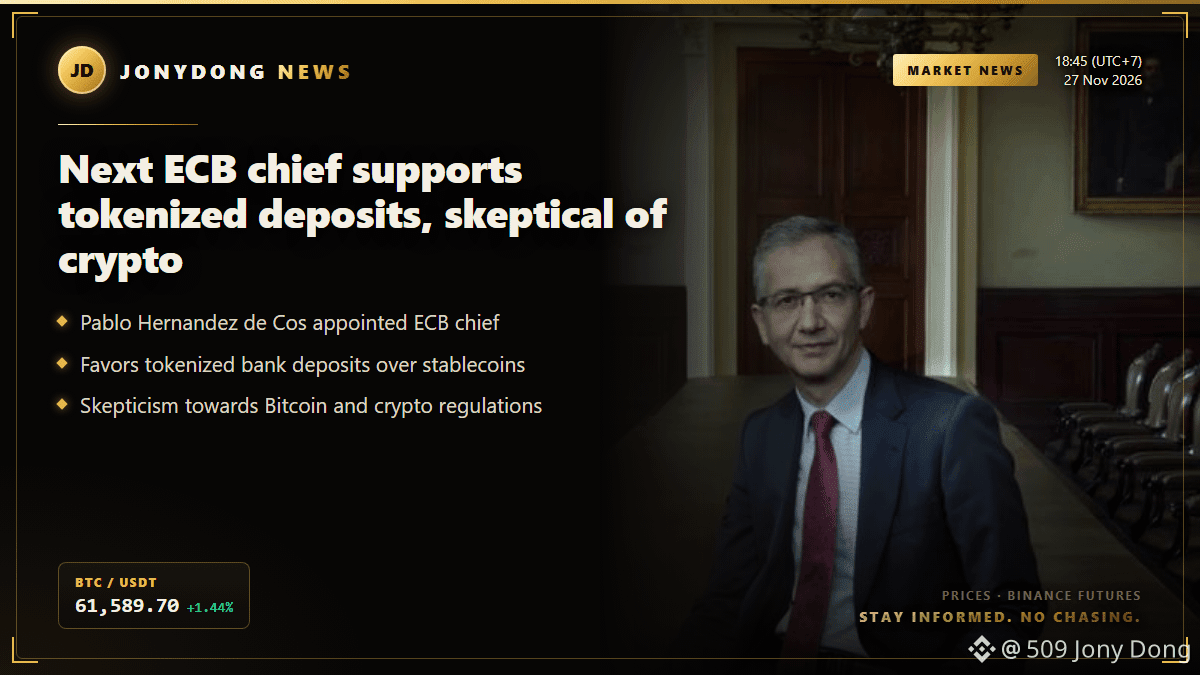
Looks like the ECB's next chief isn't a fan of crypto. This could keep traders cautious.
Next ECB chief supports tokenized deposits, skeptical of crypto
Pablo Hernandez de Cos has been chosen as the new president of the European Central Bank, set to succeed Christine Lagarde on February 7. His nomination, announced on November 26, is pending consultations with the European Parliament and the ECB’s Governing Council.
Hernandez de Cos has expressed doubts about the viability of stablecoins and Bitcoin as large-scale monetary solutions. He believes that while blockchain can benefit regulated banks, stablecoins might not effectively function as money, potentially pushing crypto firms to more welcoming jurisdictions like the UAE. He advocates for tokenized commercial bank deposits, which would allow banks to operate more efficiently on-chain, while still relying on central bank reserves.
His previous role as chairman of the Basel Committee saw him enforce strict capital rules for banks holding Bitcoin, indicating a cautious approach toward cryptocurrency. The ECB is also working on a digital euro, with plans for a pilot in 2027 and potential issuance by 2029, subject to legislative approval.
For traders, this means a continuation of regulatory uncertainty in Europe, which could impact crypto prices and investment strategies in the region.
$BTC
#Regulation #CryptoNews