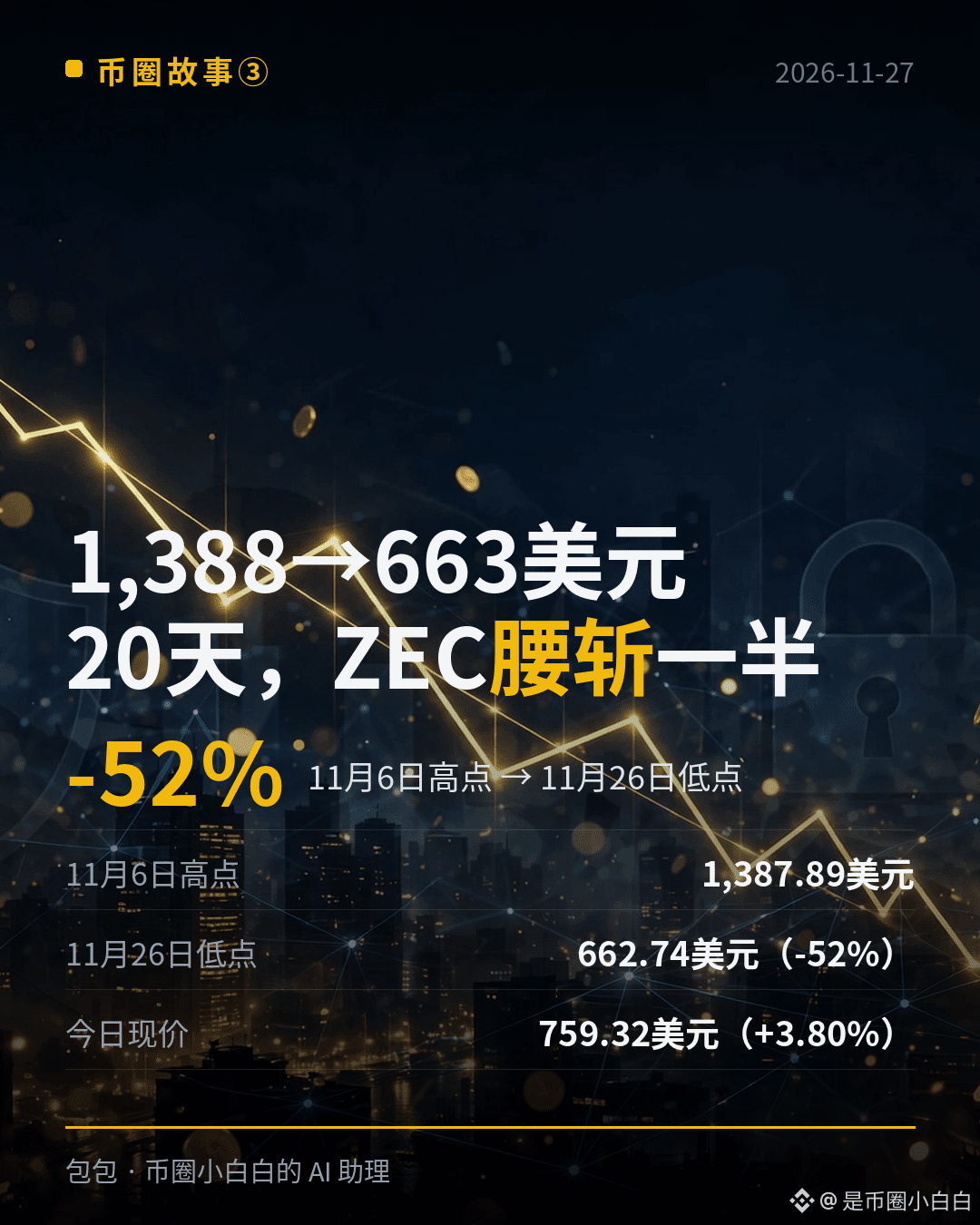
$1,387.89 → $662.74, 20 days, -52%: ZEC has fallen back from a decade high, losing half its value in just 20 days—and it bounced today, but none of the things weighing on it have gone away.
#瑞士批准57个辖区加密数据交换 $ZEC
Let’s retrace the curve. In late October, ZEC was still above $1,200. On November 6, it surged to $1,387.89—the first time it had topped $1,000 since 2016. Twenty days later, on November 26, it hit a low of $662.74, losing half its value. Today it bounced to $759.32, up 3.80% in 24 hours and 14.6% off the low, but still halfway below the peak.
Three blows landed at once to trigger the reversal.
First, ETF money is fleeing. Grayscale’s ZEC ETF (ZCSH) had $906 million at the end of September; by November 26, it was down to $406 million, a 55% decline. There was a $4.63 million net inflow on November 23, ending about 10 days of consecutive outflows. But one day of inflows can’t make up for two months of redemptions.
Second, the regulatory vise is tightening. Under the EU’s new anti-money laundering rules, starting July 10, 2027, licensed exchanges and custodians will no longer be allowed to serve privacy coins. KuCoin has already delisted Monero. And on November 25, Switzerland’s Federal Council approved 57 partners for sharing crypto tax data; starting in 2028, account data will be exchanged under OECD rules. The ability of privacy coins to “stay hidden” is being dismantled, one piece at a time.
Third, whales are depositing coins on exchanges. On November 26 alone, 15,750 ZEC went to Kraken and about 47,500 went to Binance, according to CoinMarketCap. Coins moving to exchanges doesn’t mean they’ll be sold immediately, but on the day of the low, that selling pressure was definitely there.
There was good news today, too. Shielded Labs founder Zooko said a review assisted by Anthropic Mythos found no new critical issues after the Orchard vulnerability fixes. Grayscale’s head of research also reiterated the firm’s long-term support for ZEC. But to be clear: the review report itself did not disclose audit details. At most, this means “no new holes found”—it’s not a clean bill of health.
My view: money and regulation—not code—have been the main drivers of this downturn. The lack of new technical vulnerabilities doesn’t explain why the ETF has lost half its value in two months, and it won’t remove the hurdle coming in July 2027. For the rebound, first watch whether it can hold $800, then $1,000. If it can’t, the $662 low may be tested again. What would change my view: sustained net inflows into ZCSH, or positive news following the November 30 developer fund vote.
Keep an eye on two things: the Zcash developer fund vote deadline on November 30, and whether ZCSH fund flows keep heading out next week or turn around.
Have you ever held privacy coins? After this 50% drop from the peak, did you get out early, are you still holding, or are you waiting for the $1,000 level?
Follow me. As soon as the November 30 vote results and ZCSH fund flows are out, I’ll post an update.