Nvidia at $155—would you buy the dip?
A week ago, he was forced out of the company and the stock plunged to $124. The whole internet was shouting, “Faith in AI has collapsed.” A week later, the board begged him to come back, earnings blew past expectations, and the stock bounced back to $155. Those who sold at $124 are now staring at their screens and slapping themselves. Is this rebound a last gasp—or the king’s return?
First, the headlines: he was forced out and then brought back; the market crashed and then rallied.
In mid-November, Jensen Huang briefly stepped down amid rumors related to an investigation, and the stock plunged from $243 to a 52-week low of $124.5. The whole internet was shouting, “Nvidia is finished” and “The AI bubble has burst.”
Then what? The board brought him back. Combined with strong earnings, the stock bounced from $124 to $155.
First: earnings were unbelievably strong, but nobody dared to believe them.
Q3 revenue was $11.58 billion, up 103% year over year and 20% quarter over quarter. Data center revenue was $10.76 billion, up 110% year over year. The Vera Rubin platform contributed nearly $2 billion in its first quarter—the fastest ramp-up ever. Gross margin was 75%. Q4 guidance was $13 billion, and FY28 revenue growth guidance was raised to 75%.
In any other year, numbers like these would send the stock limit-up.
But the stock fell from $243 to $124—nearly cut in half. Why?
Because two things terrified the market: first, he was gone; second, interest rates could rise further.
Second: the valuation is ridiculously cheap, but cheap alone isn’t a reason to buy.
The stock is currently at 16 times trailing-twelve-month earnings; some estimates put its FY28 forward P/E at just 9–13 times.
The fastest-growing AI company on the planet has a lower P/E than bank stocks.
More than half of its $150 billion buyback authorization remains, and free cash flow is strong. Analysts’ price targets are generally above $200; some have been lowered but are still well above the current price.
But cheap alone isn’t a reason to buy. Cheap—and knowing where the bottom is—that’s the reason.
The CEO has just weathered a storm, shipments to China are restricted, export controls are hanging over the company, and macro interest rates are weighing on it. Four risk factors, and not one has been resolved.
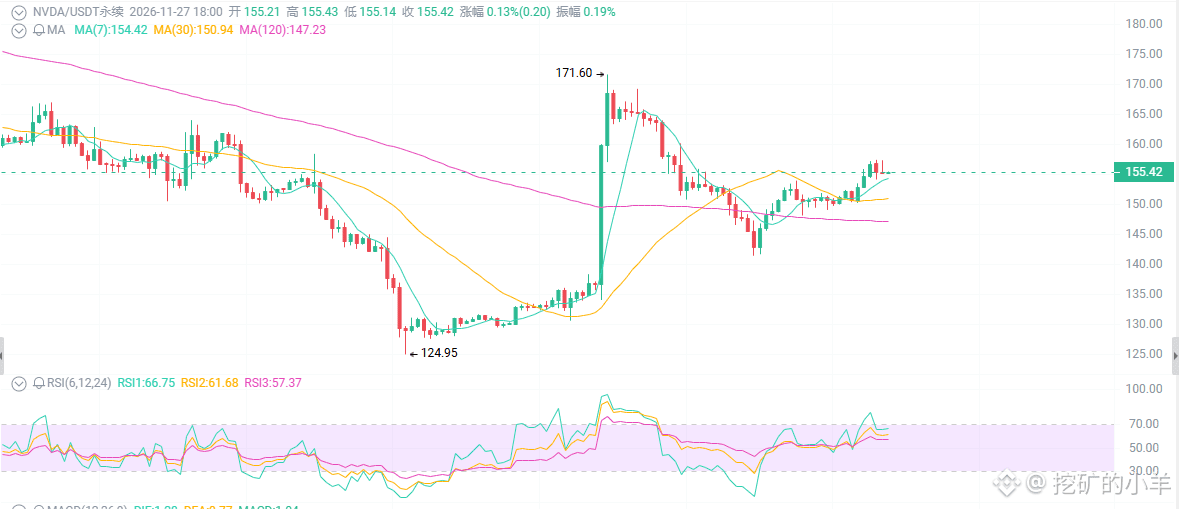
Third: the chart tells you that $155 is the battleground.
From $243 down to $124.5, the stock broke below all major moving averages, with the 50-day moving average overhead at $180–200. The RSI once fell below 20 and has now bounced out of oversold territory. The MACD shows signs of a bullish divergence, and volume picked up near the lows, suggesting buyers are stepping in.
Support: $150–152 (recent consolidation zone) → $145–148 → $130–125 (previous low)
Resistance: $158–160 → $165–170 → $180–185 (moving-average congestion zone)
At $155, there’s a wall of selling pressure above at $158–160, and a support zone below at $150–152.