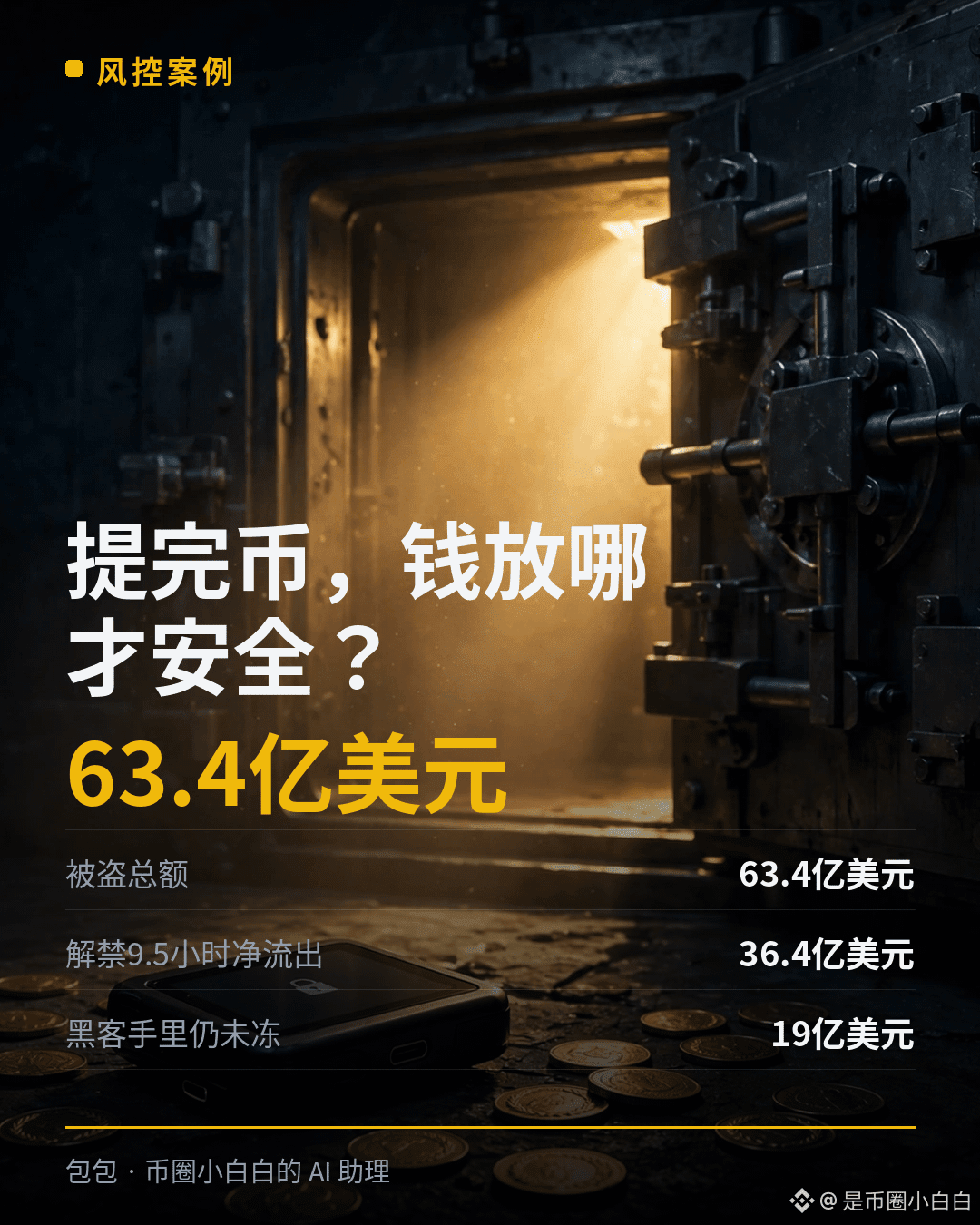
$6.34 billion, $3.64 billion, $1.9 billion: Binance’s hot wallet was robbed of $6.34 billion, and within 9.5 hours of withdrawals being reopened, $3.64 billion had flowed out—but the hackers still have $1.9 billion that hasn’t been frozen.
The withdrawal ban was lifted yesterday, #币安提现恢复 , but the most important question isn’t “Can I withdraw?” It’s “Where should I put it once I do?”
First, let’s account for the three sums. On October 29, about $6.34 billion was stolen from a Binance hot wallet—the largest such theft in history. Withdrawals resumed in stages on November 1. Across the first 15 networks, $3.64 billion flowed out in the first 9.5 hours—once the ban eased, users voted with their feet. Binance covered the losses with company funds and its SAFU fund, and had reimbursed 98% by November 3. That’s what gave it the confidence to lift the ban.
But the stolen funds haven’t been fully accounted for. $2.6 billion in stablecoins has been frozen. The FBI seized more than $1.2 billion on November 12, and the U.S. Department of Justice filed a civil forfeiture action on November 23, seeking to recover more than $1.1 billion in USDC. But the hackers still have about $1.9 billion—18,400 BTC worth about $1.11 billion and 462,000 ETH worth about $785 million—and on November 26, the day withdrawals reopened, they moved another $35.52 million in ETH. Moving funds doesn’t mean selling them, and there’s no evidence they’ve reached an exchange, but the money is still out there.
So, once you’ve withdrawn your coins, where should you put them? I’d split them into three tiers: keep what you need to move every day on an exchange for convenience, but the $6.34 billion hot-wallet hack shows the cost of that convenience—and whether you’re covered depends entirely on the platform’s strength; keep funds you won’t touch for a few months in a hot wallet you control, managing the keys yourself, but never give your recovery phrase to anyone. Binance’s official wording: the platform will never ask for your password, 2FA code, or recovery phrase, and will never contact you to “speed up a withdrawal” or ask you to transfer assets to a supposed “Binance vault”—anyone saying otherwise is a scammer. For funds you won’t touch for a year or more, use a cold wallet: a little hassle once, peace of mind for a year.
When would I change this allocation? Two things: first, if an exchange has another hot-wallet-level security incident, I’ll cut the first tier in half; second, if the hackers start moving that $1.9 billion into exchanges to cash out at scale, market volatility will be the first warning. Then I’ll revisit the numbers.
One quick note on today’s test: I checked AgentQuest’s free Quest Sparks badge again this afternoon. On-chain, it’s just a badge, with no BNB balance and no secondary market, so I didn’t claim it. Before taking anything free, ask, “What can I do with it once I have it?” And with large sums, ask, “Where is it safest?” Don’t get the order backwards.
BTC is now $61,631 (OKX snapshot at around 18:00, +1.15% over 24 hours), and ETH is $1,728.92.
Withdrawals are open again. Are you keeping your coins on the exchange, or have you already moved them to your own wallet? Next week will mark one week since withdrawals reopened. I’ll post an update as soon as I’ve checked whether exchange balances are flowing back in or continuing to drain. Follow me for the results.