
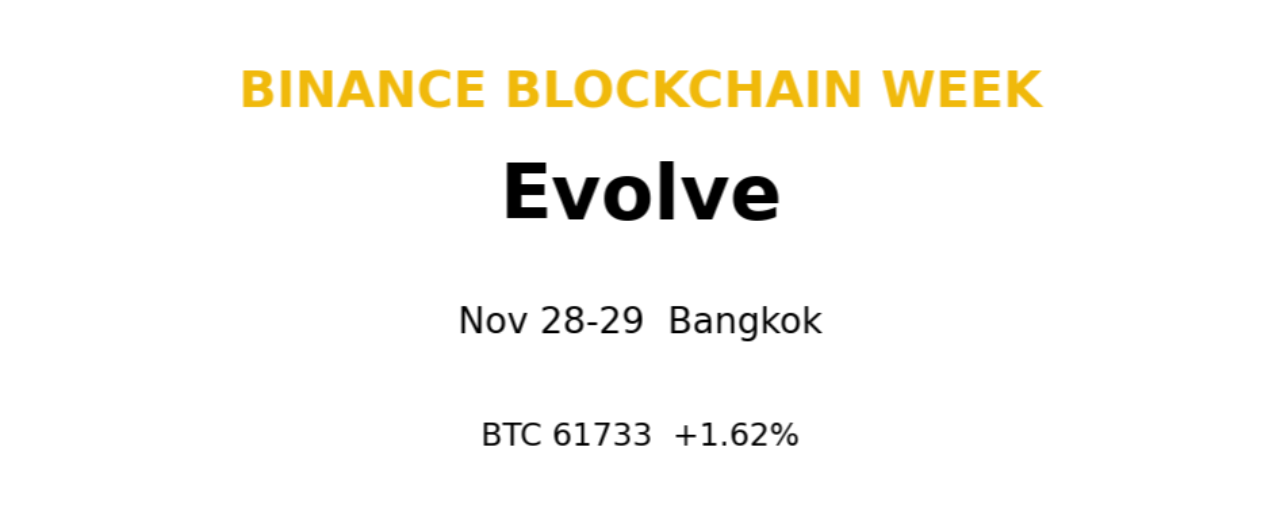

On November 28–29, Binance Blockchain Week is taking place in Bangkok, Thailand. Its theme is “Evolve.” Many people judge an event by its slogans, but I look at three things first: who’s attending, what they’re discussing, and where the money is going. The presence of institutions like BlackRock, Nasdaq, and Visa shows that this isn’t just the crypto world talking to itself—traditional finance is also taking the on-chain path seriously.
When I look at events like this, I don’t just focus on how impressive the speaker lineup is. I also look at whether the topics can lead to products and partnerships. The speakers drive attention, the topics set the direction, and real-world execution determines the value. No matter how good the event sounds, it all comes down to actual use: Are new products launching? Are new partnerships being confirmed? Is capital willing to follow? These three things matter far more than slogans.
The first trend is institutions moving on-chain
Institutions used to talk about crypto cautiously, as if testing the waters. Now they’re talking about RWA, custody, and compliant access—which shows they want to bring real-world assets on-chain. Moving assets on-chain isn’t about putting a PowerPoint presentation on-chain; it’s about bringing real-money processes like bonds, funds, and payments on-chain. Whoever can make these processes reliable will capture the next wave of growth.
Trust and efficiency are key to bringing institutions on-chain. Custody must be secure, compliance must be clear, and settlement must be reliable. What ordinary users notice isn’t technical jargon, but smoother account opening, more transparent assets, and more convenient trading. Whoever gets these fundamentals right will be better positioned to handle the next wave of capital. Institutions entering the market isn’t just a talking point—it depends on whether the whole process can run reliably over the long term.
The second trend is AI managing money
AI in trading isn’t just about chatting. It can monitor data, manage risk, run strategies, and flag risks. What ordinary people lack most isn’t opinions—it’s discipline. If AI can turn discipline into a tool and help retail traders make fewer mistakes, that’s real value.
AI managing money doesn’t mean handing every decision over to machines, either. Machines are good at monitoring markets, sending alerts, and reviewing trades; people are responsible for setting the rules and owning the outcomes. Turn stop-losses, position sizing, and trade reviews into a process, and there’ll be less emotion and fewer mistakes. A tool’s value lies in helping people stick to simple rules. Reducing impulsive trading is real progress.
The third trend is stablecoin payments
Stablecoins aren’t a speculative gimmick—they’re dollars on the blockchain. Once payments work smoothly, cross-border transfers, merchant payments, and payroll will all get faster. Whoever makes payments seamless will control the gateway.
The potential of stablecoin payments lies in everyday use cases. Cross-border remittances, e-commerce settlements, content payments, and payroll are all use cases where delays and high costs are major concerns. Once payments become seamless, on-chain assets won’t just be things to trade—they’ll become everyday tools. Once a gateway is established, user habits will follow. Whoever delivers a smooth experience first will secure their position first.
Now, let’s look at the market. BTC is at 61733 and still moving sideways, up about 1.6% over the past 24 hours. My view is simple: as long as it holds 60000, short-term sideways movement doesn’t mean the trend has weakened; a break below 59915 invalidates my view. Tonight, the first thing to watch is whether it can hold above 62000. If it does, short-term sentiment should continue to recover; if it can’t, the market is still moving sideways, so don’t chase the price.
The biggest risk in a sideways market is overtrading. When the price moves back and forth near key levels, chasing a rally can leave you stuck, while selling into a dip can mean missing the rebound. First, write down the conditions that would invalidate your view, then decide on your position size and timing. That gives your judgment clear boundaries. If a key level holds, treat it as a range-bound market; if it breaks, accept that your view was wrong—don’t stubbornly hold on. Put your plan in writing beforehand so you won’t be led by emotion when the market moves.
We need to look at the event and the market together. The event is about evolution; the market is about capital. If capital doesn’t respond, even the loudest slogans mean nothing. When capital does respond, ordinary people get a chance. My view: first, watch 60000; then 62000; and finally, see whether any new products or partnerships launch during the event.
So I’m not rushing to a conclusion this time. I’ll first see which of the three trends delivers something real. For institutions, watch partnerships; for AI, watch tools; for stablecoins, watch payment use cases. Whoever delivers first will be the first to attract the attention of capital and users. Evolution isn’t just a slogan—it’s about real-world use. It’s only real evolution when ordinary people can use something easily and smoothly.
Which trend do you think will deliver first: RWA, AI, or stablecoins? Share your reason. Vote and tell me why, and I’ll summarize the results tomorrow.


