The Bank of Korea’s latest rate hike wasn’t because the economy was weak, but because it was too strong. That’s the exact opposite of the scenario many people had in mind.
On Thursday local time, the Bank of Korea raised its benchmark interest rate by 25 basis points to 3.25%. It was the third hike in the second half of this year. But something else is even more noteworthy: at the same time, it raised its growth forecast for next year from 2.9% to 4.1% in one fell swoop.
Rate hikes are usually seen as a brake. This time, though, the central bank acted only after sharply upgrading its growth outlook. In other words, the AI chip export boom has made the economy run so hot that the central bank has had to step in and cool it down.
Export figures support this view. South Korea’s cumulative exports for the year have already topped $1 trillion, making it the fourth economy to reach that milestone, after Germany, the United States, and China. Memory chips are driving the surge: chip exports in the first 20 days of the month were nearly three times higher than a year earlier, accounting for almost half of total exports.
A Reuters poll also offers a telling figure. The median forecast from eight economists puts November export growth at 96.8% year over year, the fastest pace since 1974. The actual figures won’t be released until 9 a.m. on Tuesday, December 1.
The catch is that the rate hike did not have unanimous support. In the central bank’s published dot plot, only six of the 21 projections point to rates staying at 3.25%; another eight point to 3.5%, and seven to 3.75%. The vast majority of policymakers believe this tightening cycle is far from over.
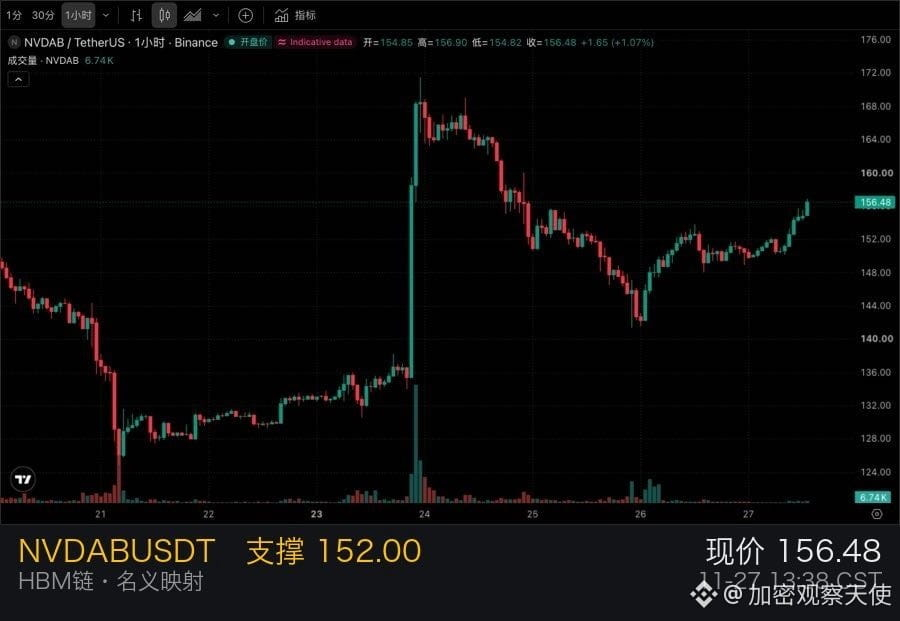
That brings what might otherwise seem like distant macroeconomic news right to the attention of anyone holding risk assets. South Korean memory chips supply data centers around the world, and $NVDAB and $AMDB are both downstream in this supply chain. A rate hike in South Korea means the cost of capital across this supply chain is rising, not falling. The market’s assumption that “an AI boom means easy liquidity” doesn’t hold up against these figures.
What I’m unsure about is whether the rate hike will actually cool export growth. Chip orders are determined by global demand, not domestic interest rates. That makes sense, but it’s hard to verify.
The export report due next Tuesday morning will be the first test of this view. It will be more useful to watch than the size of this rate hike.
(Data sources: Bank of Korea rate decision on November 26; reports by East Money and Xinhua Finance on November 27. Export forecast is the median of a Reuters poll of eight economists, republished by Tencent News on November 27. This is not investment advice.)