ZEC at $740—can you still hold on?
It’s fallen from $1,690 to $740, more than halving. It’s down 40% in 30 days, and everyone online is saying “privacy coins are finished.” But just as you’re getting ready to sell at a loss, Grayscale is still buying, Gemini has just enabled shielded withdrawals, and 400,000 ZEC are sitting in an old pool waiting to be migrated. Is this plunge a signal to run—or the market maker’s final shakeout?
First, the surface picture: price has been hammered down from its high, but buyers stepped in around $660–700.
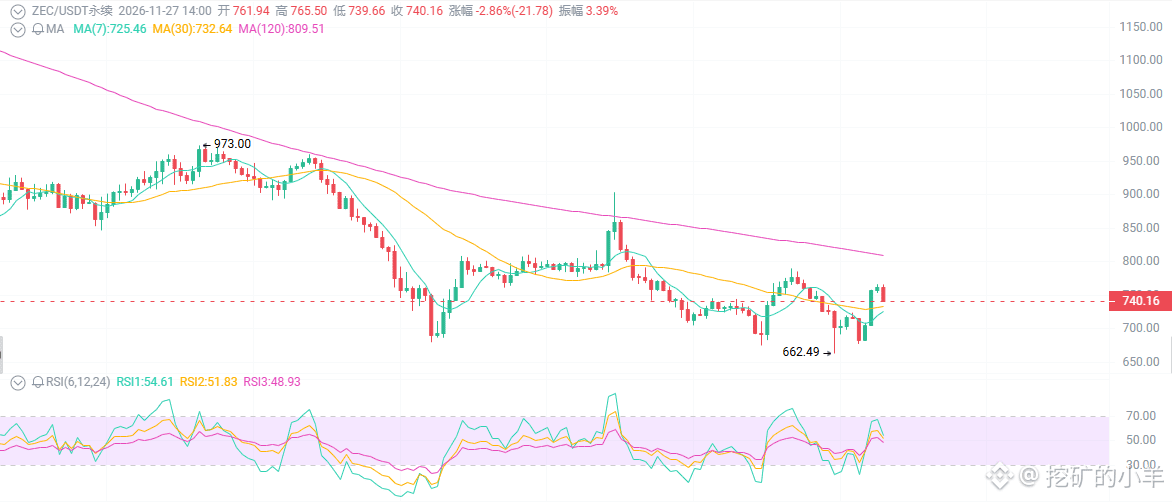
It’s down 40–45% in 30 days and 12–13% in 7 days. The 24-hour range is $660–765, trading volume is active, market cap is $12–13 billion, and its ranking is 10–11. The candlestick chart tells you this: price has fallen below the 50-day and 200-day moving averages, so the medium-term trend is bearish. But clear buying support has emerged in the $660–700 zone, followed by a rapid rebound—that’s not a free fall; there’s money coming in to catch it.
First thing: the “security alert” was treated by the market like a death sentence.
The Zakura team, including core developers, has publicly urged users to migrate as soon as possible from the old Sapling privacy pool to pools associated with Ironwood/Orchard. The reason is concern about theoretical risks posed by potential future breakthroughs in AI- or quantum-related cryptography—note, these are theoretical risks; there has been no actual attack.
About 400,000 ZEC remain in the Sapling pool, worth roughly $300 million. After the news broke, short-term sentiment turned bearish, and some holders began panic-selling or ran into friction during migration.
A “precautionary security alert” was interpreted by retail traders as “ZEC is going to zero.”
Second thing: institutions haven’t left—you have.
There have been fluctuations in inflows and outflows for products such as Grayscale’s; leveraged ETFs have seen pullbacks, and Bitwise has made moves related to its spot ETF. Institutional interest is still there, but recent flows haven’t been one-way.
Institutions are rebalancing, not liquidating.
Early whales moving funds, mining company earnings, and Fortitude’s progress toward going public—these neutral-to-positive developments are getting no attention. Everyone is fixated on the words “migration panic.”
Third thing: macro conditions are weighing on the market, but they can’t kill a coin with a compelling narrative.
U.S. economic data is relatively strong, and inflation remains sticky (CPI/PCE are still above target). Markets are pricing in a relatively high probability of a Fed rate hike in December. Treasury yields and the dollar remain relatively firm, and liquidity conditions aren’t particularly loose. BTC is fluctuating in the $61,000–62,000 range after retreating from its highs, while altcoins are falling more sharply.
Macro conditions are suppressing risk appetite in the short term, and as a high-beta privacy coin, ZEC is more prone to amplified volatility.