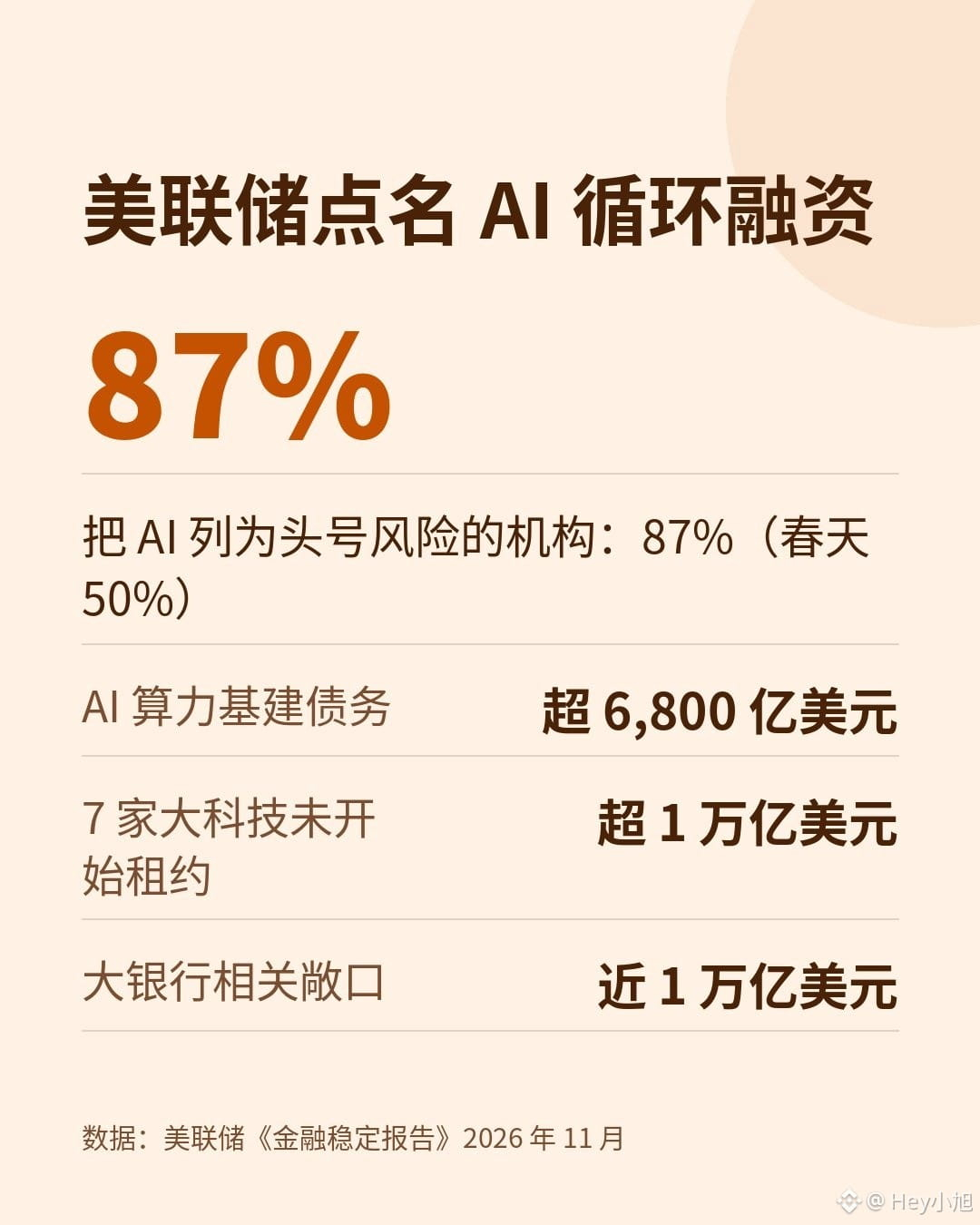
The Fed flags “circular financing”: Big Tech lends to smaller companies, which then turn around and buy Big Tech’s products
The Fed’s report has recently resurfaced on X, where a popular post has drawn hundreds of thousands of views. It looks at how the money behind AI actually moves.
The Fed’s Financial Stability Report, released on November 13 (with data through October 28), includes several figures:
1. The New York Fed surveyed 23 banks, brokerages, and funds. 87% ranked AI as the top risk to the financial system, up from just 50% in the spring.
2. Debt issued to fund AI computing infrastructure had topped $680 billion by October, compared with just $130 billion for all of 2023.
3. Amazon, Google, Broadcom, Meta, Microsoft, Nvidia, and Oracle have more than $1 trillion in leases that have yet to commence, and over $2 trillion in guarantees and other contractual commitments—most of which are not on their balance sheets.
4. The largest U.S. banks have nearly $1 trillion in exposure to tech companies, data center developers, related financing vehicles, and utilities.
What does “circular financing” mean? Large companies invest in, lend to, or guarantee loans for smaller, riskier AI companies. The smaller companies then use the money to buy chips and cloud services from the larger companies, making the larger companies’ revenue look even stronger. The report’s point is that if market conditions weaken, the larger companies’ actual risks “could be far greater than their reported liabilities suggest.”
This pattern isn’t new. During the dot-com bubble in 2000, equipment vendors lent money to customers to buy their equipment, and then bad debts surged across the board.
U.S. stock markets close early tonight, at 2:00 a.m. Beijing time on Saturday. AI stocks have been repeatedly battered over the past few weeks, and this report points to one of the underlying reasons many people are worried.
Do you think AI looks more like a bubble right now, or like the infrastructure boom in railroads and fiber optics back then?
Source: Federal Reserve Financial Stability Report (November 2026), Stock Analysis, CNBC
#美股 #AI #FederalReserve