
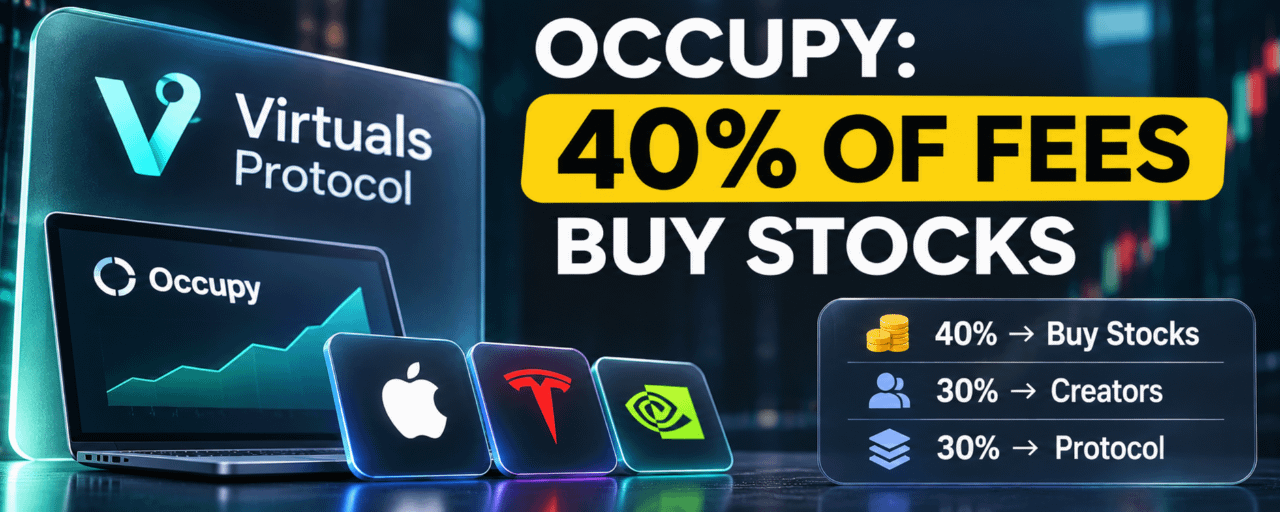


Virtuals Protocol has introduced a launchpad where new tokens trade against tokenized stocks instead of VIRTUAL.
The product is called Occupy, and its September 15, 2026 launch introduces a rather different economic model for one of the largest AI agent platforms in crypto.
What changes with Occupy?
Virtuals' original whitepaper describes VIRTUAL as the primary liquidity and routing currency for agent tokens. Buying those tokens generates transactional demand for VIRTUAL, while liquidity pools hold it alongside individual agent tokens.
Occupy removes that requirement.
According to the EconomyOS developer documentation accessed on November 27, Occupy uses tokenized equities as its quote assets. VIRTUAL, USDC and WETH are excluded from the supported trading pairs.
Developers can also launch tokens through Occupy without paying the standard VIRTUAL-denominated launch fee.
The distribution of trading fees is particularly interesting. According to the September 16 coverage by RootData, 40% goes toward accumulating the associated tokenized stock, 30% goes to creators and the remaining 30% goes to Virtuals Protocol.
For every $100,000 in fees generated under this arrangement, $40,000 would fund stock accumulation. None of that allocation explicitly requires VIRTUAL purchases.
Occupy also introduces AI-managed treasuries. Token holders elect members of a ten-seat AI Senate, which can decide whether to retain the accumulated assets, distribute them or repurchase tokens associated with the treasury.
Owning VIRTUAL alone does not establish a claim on those stocks.
Why introduce an alternative liquidity model?
The original launchpad's financial performance provides some context.
DeFiLlama's data, retrieved through MemeFees on November 27, recorded approximately $96,500 in tracked fees over the preceding 30 complete UTC days.
The figure covers the activity captured by its Virtuals launchpad methodology. It should not be treated as a complete account of income from newer products or AI agent commerce.
Occupy gives Virtuals access to traders interested in tokenized equities who might otherwise have little reason to participate in AI agent markets.
The protocol could earn additional income from these customers without requiring them to hold its native token.
Does VIRTUAL still have an economic advantage?
The original VIRTUAL-paired launchpad remains available. Its liquidity requirements continue to create a direct connection between agent-token trading and VIRTUAL.
Staking also provides access to certain agent-token distributions through veVIRTUAL, according to the project's official documentation.
These mechanisms remain relevant. However, Occupy introduces the possibility that a growing proportion of future token launches could operate outside the original VIRTUAL liquidity model.
I haven't found independently verified figures separating Occupy's trading volume, treasury accumulation and protocol income from the rest of Virtuals' operations.
That breakdown would be particularly useful now. If Virtuals attracts substantial trading activity through stock-denominated pairs, the protocol could become a more successful business while VIRTUAL captures a smaller proportion of its economic activity.
The launchpad that generates the most revenue may eventually be different from the one that generates the most demand for VIRTUAL.
