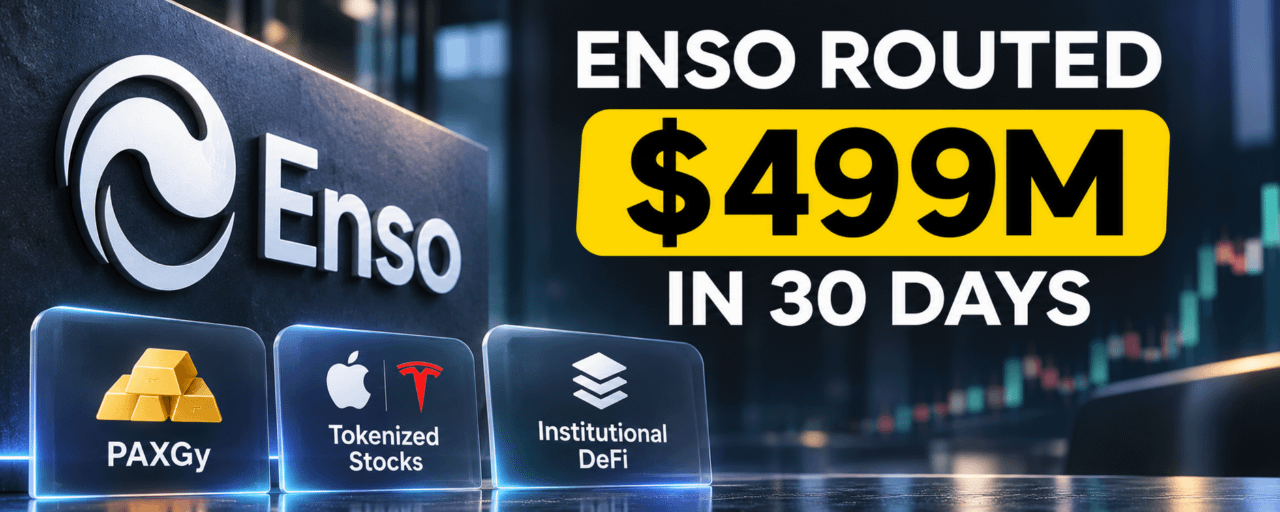


Enso is becoming part of the infrastructure behind tokenized stocks, institutional DeFi and digital gold. According to DeFiLlama's November 27 data, it routed approximately $499.09 million in swaps over the preceding 30 days.
What remains considerably harder to measure is the financial benefit reaching ENSO holders.
Where is the business growing?
On November 11, Enso announced an integration with ether.fi that enables users to access PAXGy, a yield-bearing gold token developed by Paxos Labs.
Enso handles the transactions needed to move between assets, while the customer interacts with ether.fi. Most users may never encounter the Enso brand during that process.
Two days earlier, Enso announced its role as the official bridge provider for Elysium, Kinetiq's new Layer 2. The announcement disclosed that Enso had already routed more than $1 billion for Kinetiq and Markets.xyz.
Its distribution network also includes integrations with Ondo, xStocks and Robinhood Chain.
Despite this expansion, Ethereum still dominates actual swap activity. DeFiLlama's November 27 snapshot attributes $357.27 million of Enso's monthly routed volume to Ethereum, representing approximately 71.6% of the total.
New blockchain integrations have expanded the addressable market considerably faster than they have diversified existing trading activity.
Who gets paid when Enso executes a transaction?
Enso's business model has historically included negotiated revenue-sharing agreements and API integration fees, according to research published by Alea Research.
Individual commercial arrangements can differ depending on the customer and its transaction requirements. Consequently, applying a standard exchange fee to Enso's reported trading volume would produce an unreliable revenue estimate.
The token has a separate economic function.
Enso's official documentation requires validators to stake ENSO as collateral when verifying transaction instructions. Holders can also delegate tokens to validators in exchange for a share of their validation revenue.
Governance staking, however, carries no staking reward. The documentation also explicitly excludes decisions concerning the distribution of assets to token holders from the DAO's voting responsibilities.
There is evidence that the validation network operates. Enso's first epoch report, published on November 14, 2025, recorded more than 900,000 ENSO staked and confirmed that rewards had been distributed.
The report did not provide a breakdown separating customer-funded validation income from token incentives.
Why does the distinction matter now?
Enso's official tokenomics specifies an initial supply of 100 million ENSO, with scheduled inflation potentially bringing the maximum supply to approximately 127.34 million.
Investors, team members and advisors collectively received 57.805% of the genesis allocation, subject to a one-year cliff followed by 24 months of linear vesting.
With the first anniversary of Binance's October 2025 listing already behind us, the relationship between commercial growth and additional token availability deserves closer scrutiny.
Enso reported more than $20 billion in cumulative on-chain settlement and over 350 enterprise clients by August 14, 2026. The business has achieved meaningful distribution.
A quarterly disclosure separating API income, validator fees and newly issued staking rewards would help establish how much of that commercial success supports ENSO's economics.
Until then, I would treat the growth of Enso's infrastructure business and the financial performance of its token as two related, but separately measurable, developments.