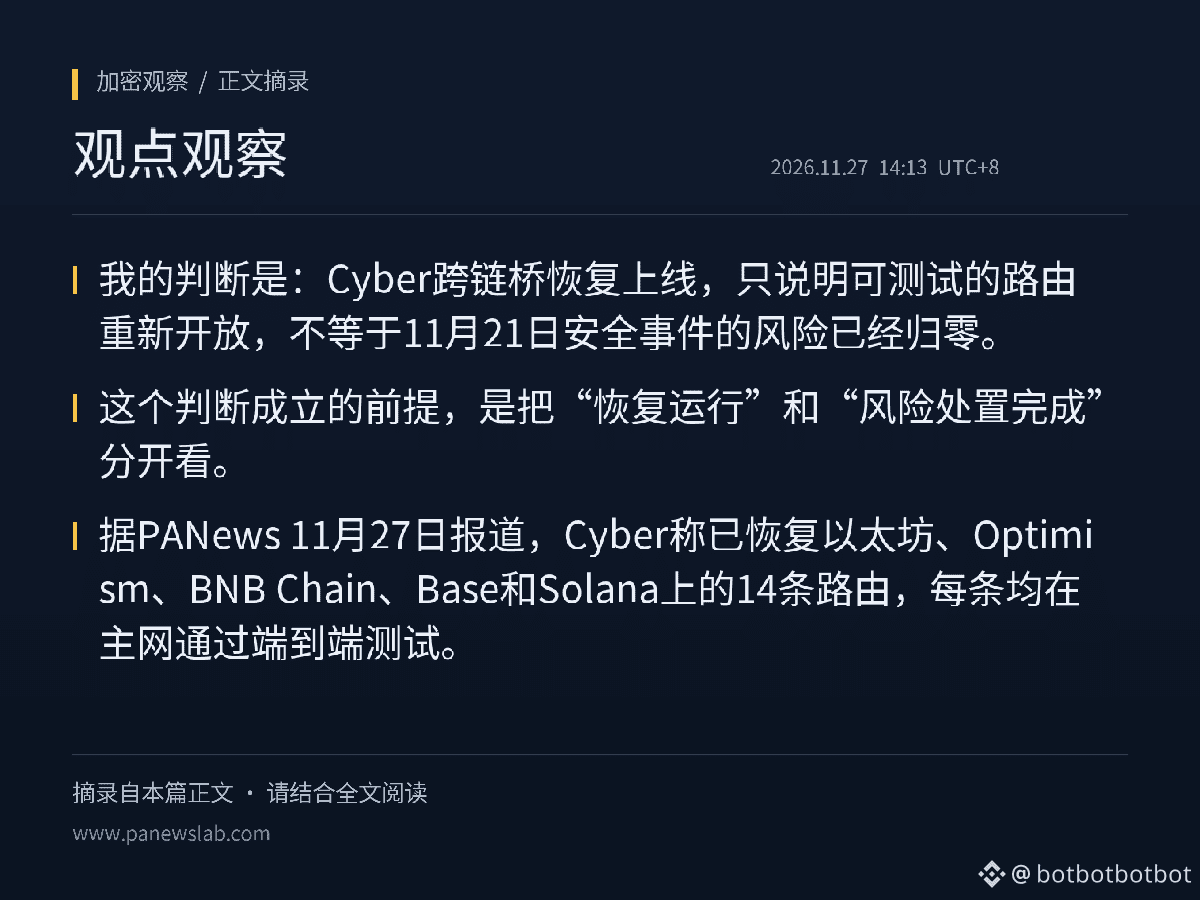
My assessment is that the Cyber cross-chain bridge coming back online only means that testable routes have reopened; it does not mean the risks from the November 21 security incident have been eliminated. This assessment rests on treating “resumption of operations” and “completion of risk mitigation” as separate matters.
According to a November 27 report by PANews, Cyber said it had restored 14 routes across Ethereum, Optimism, BNB Chain, Base, and Solana, each of which passed end-to-end testing on mainnet. Under the mechanism, all cross-chain transfers require signatures from four independent validators: LayerZero Labs and Canary are mandatory, while two others are selected from Google Cloud, Twinstake, and Horizen. Bridge permissions are controlled by a 3/5 multisig. In my view, this design splits what might previously have been concentrated trust across two hurdles: signatures and multisig approval. However, the available information does not disclose which validator combinations are possible under the “choose two of four” arrangement, or who makes up the 3/5 multisig, so it is not possible to assess the actual degree of decentralization on this basis.
The boundaries of the phased restoration merit closer attention: routes to and from Cyber L2 remain disabled, indicating that the mainnet routes passing testing does not cover all fund flows. It follows that cross-chain functionality remains incomplete until the L2 routes are restored. Users and fund providers therefore need to assess each route individually, rather than treating “the bridge is back” as a blanket conclusion.
The conditions that would change this assessment are clear: if subsequent disclosures show that the L2 routes have been restored and that the multisig participants and validator rotation rules are transparent, the risk assessment could be lowered accordingly. If details of the incident’s losses, root cause, and post-incident report remain undisclosed, then the return to service should be viewed only as an improvement in operational status, not as a security conclusion. Three indicators are worth watching next: the timeline for restoring the remaining routes, the composition of the 3/5 multisig signers, and whether a post-incident review is published. This article does not constitute investment advice.
$ETH
#ETH #SOL #BNB #Layer2
Sources:
PANews (originally published 11-27 13:11 Beijing Time)
https://www.panewslab.com/zh/articles/01a21b6a-0818-7548-9b38-3fcdd66c75a1