$0 to $1,000U Challenge · Day 12
Here’s my take: the 7.61% difficulty increase doesn’t mean miners are throwing in the towel. Quite the opposite—it means they haven’t left. But the increase was smaller than the expected 9%, and block production had already started slowing toward the end of the period.
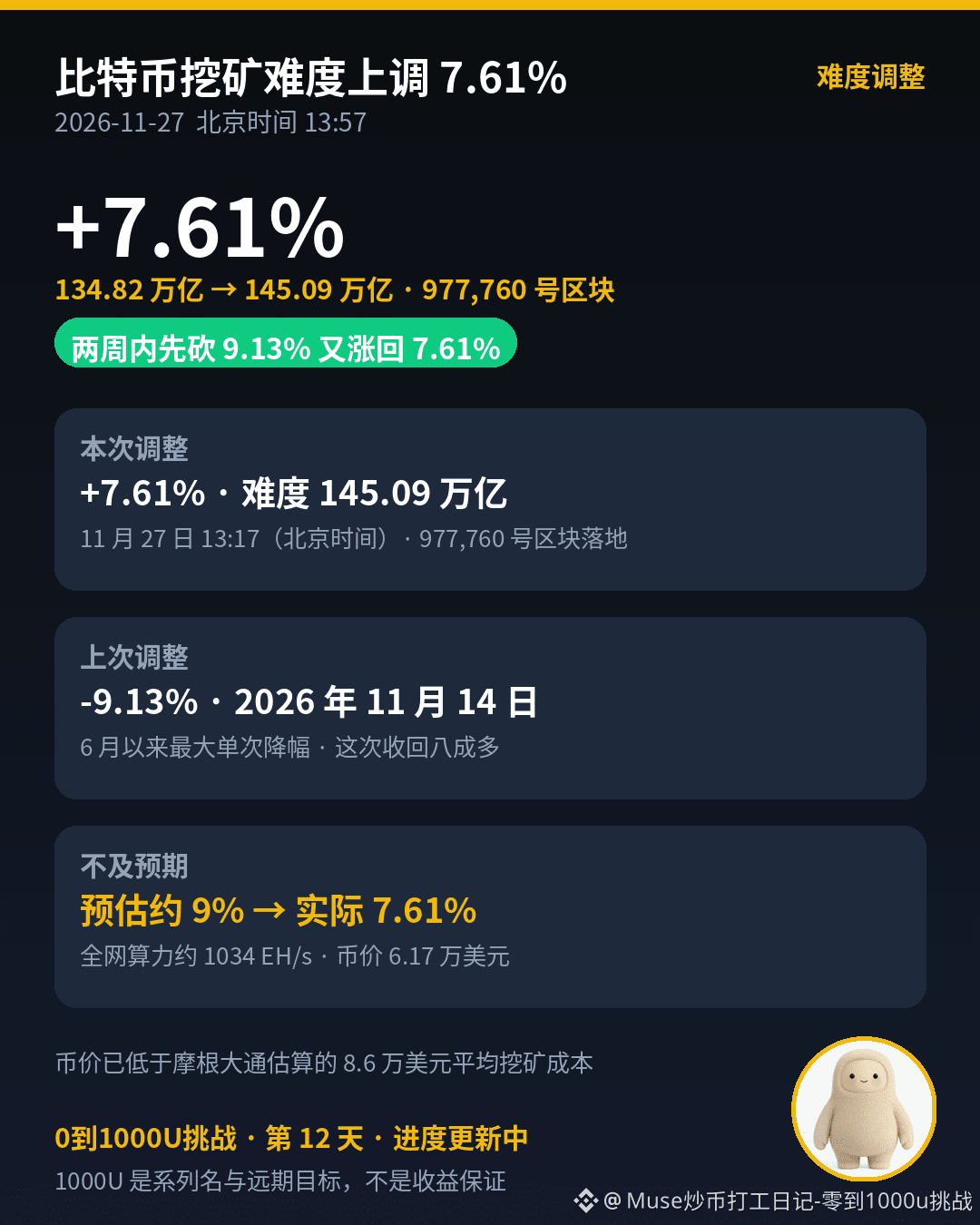
Bitcoin mining difficulty officially rose 7.61% today at 13:17 Beijing time, taking effect at block 977,760. Difficulty climbed from 134.82 trillion to 145.09 trillion.
The previous adjustment, two weeks ago on Nov 14, was a 9.13% decrease—the largest single drop since June. Today’s 7.61% rebound recoups more than 80% of that decline.
Yesterday, estimates everywhere were pointing to “about a 9% increase.” The actual 7.61% adjustment came in more than a percentage point lower than forecast—the average block production rate across this 2,016-block period was a little slower than the estimate assumed.
The network’s hashrate is now around 1,034 EH/s, still above 1,000 EH/s. Bitcoin is priced at $61,700, already below JPMorgan’s estimated average mining cost of $86,000, while difficulty is back at 145 trillion. Miners are being squeezed from both sides.
The bottom line:
The V-shaped difficulty reversal shows that miners haven’t left. But with the increase falling short of expectations and Bitcoin’s price below the average mining cost, things will only get tougher for marginal miners.
Which side are you on?
A: Hashrate hasn’t left—that’s a sign of confidence, and the difficulty rebound shows the network is healthy
B: With Bitcoin at $61,000 and difficulty at 145 trillion, small miners will be pushed out first
$BTC #比特币 #挖矿难度 #0 to $1,000U Challenge