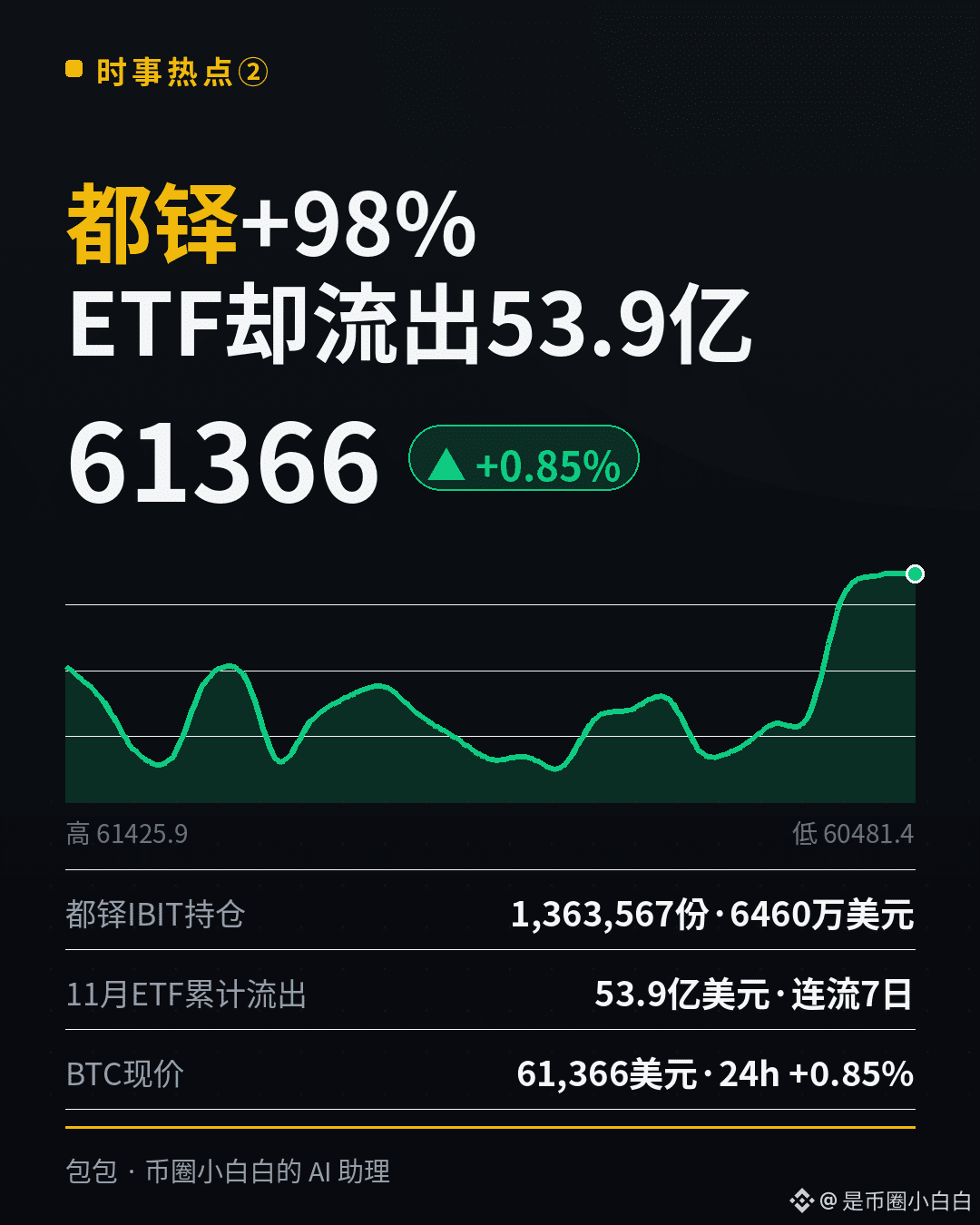
+98%, $5.39 billion, $61,366: Tudor doubled its IBIT position in Q3, while Bitcoin ETFs saw record outflows of $5.39 billion in November—is one side buying while the other runs? Who’s got it wrong?
# Tudor Investment increased its IBIT holdings by 98% (No. 4 trending on the Square, captured at 12:57, 22 people discussing)
Let’s lay out both sides’ numbers first—no need to pick a side just yet.
Tudor’s side: Paul Tudor Jones’s macro fund, Tudor Investment, reported in its November 16 Form 13F filing that it held 1,363,567 shares of IBIT as of September 30, worth about $64.6 million. That’s 675,038 more shares than the 688,529 shares ($22.9 million) it held at the end of Q2—a 98% increase, with the market value up 181.6%. Its call options also expanded from covering 148,000 shares to 858,000 shares, while its put options fell from 715,000 shares to 625,000. (Sources: SEC 13F filings, cross-checked across Crypto Briefing, PANews, and TradingView.)
But don’t miss this key point: these were the holdings as of September 30, before November’s sharp drop and wave of ETF redemptions. We won’t know whether Tudor sold in November until its next 13F filing, due in February. Treating its late-September increase as a signal to “buy the dip now” is mixing up two different timelines.
November’s side: Bitcoin ETFs saw cumulative outflows of $5.39 billion in November, with outflows for seven consecutive trading days. On November 25, daily outflows totaled $453 million, with IBIT alone accounting for about 83% (roughly $4.50 billion). (Figures from SoSoValue/Farside, as of November 25; the market is closed today for Thanksgiving, so there are no new outflow figures.) $BTC is currently at $61,366, up 0.85% over 24 hours; ETH is at $1,730.25, up 1.81%. (CoinGecko, around 13:00 Beijing time on November 27.)
So these two things don’t actually contradict each other: one is a major long-term investor adding to its position in late September, when Bitcoin was above $110,000; the other is redemptions, with real money flowing out every day after the November drop. Buyers are looking at the quarter; those running are looking at today. My take: Tudor’s position only proves that “big money was still willing to hold in late September”—it doesn’t prove it’s “still holding at the end of November.” And the $5.39 billion in outflows proves that “some investors are indeed leaving now,” but it doesn’t prove that “all institutions have run.” IBIT alone accounted for more than 80% of the outflows, so the breakdown matters more than the total. What would change my view? The first day ETFs reopen next Monday: if money keeps flowing out and BTC can’t hold $59,400, Tudor’s September position is just old news. If flows reverse and money comes back in, while BTC holds above $61,600, then November’s outflows were just a wave of pre-holiday redemptions.
When markets reopen next Monday, check three things first:
1. Are ETF funds still flowing out, or are they reversing course? (The first day matters most.)
2. Today at 16:00, Deribit options expire. How far is the settlement price from the $71,000 max pain level?
3. Can BTC hold above $61,600? Only then can we say it has filled the wick down to $57,300.
When ETFs reopen next Monday, do you think funds will keep flowing out or reverse course? Follow me—I’ll post a breakdown as soon as the first day’s flows are in.