

From Ethereum Layer 2 to global stablecoin payments, Celo is building financial infrastructure around a simple idea: technology should disappear behind the experience.
The most successful financial technology rarely asks users to understand how it works.
People don't think about payment settlement when they send money. They don't study network architecture before paying a bill. They simply expect money to arrive, payments to work, and the experience to be affordable.
Blockchain still has a long way to go before it reaches that level of simplicity.
And that's the problem Celo is trying to solve.
Rather than competing purely on theoretical throughput or another impressive technical benchmark, Celo is building around a more practical question:
Can blockchain become useful enough that people use it without needing to understand blockchain?
That question explains much of Celo's strategy today, from its Ethereum Layer 2 architecture and stablecoin-focused infrastructure to mobile wallets, local currencies, payment integrations, and its emerging agentic economy.
1. Celo's evolution: Why Ethereum Layer 2 was a strategic decision
Celo originally launched as an independent Layer 1 in 2020, with mobile accessibility, low transaction costs, and financial inclusion at the center of its design.
But the blockchain landscape changed.
Ethereum's ecosystem continued expanding, and the importance of shared security, liquidity, interoperability, and developer infrastructure became increasingly difficult to ignore.
Celo's transition to an Ethereum Layer 2 was therefore more than a technical upgrade. It represented a strategic repositioning.
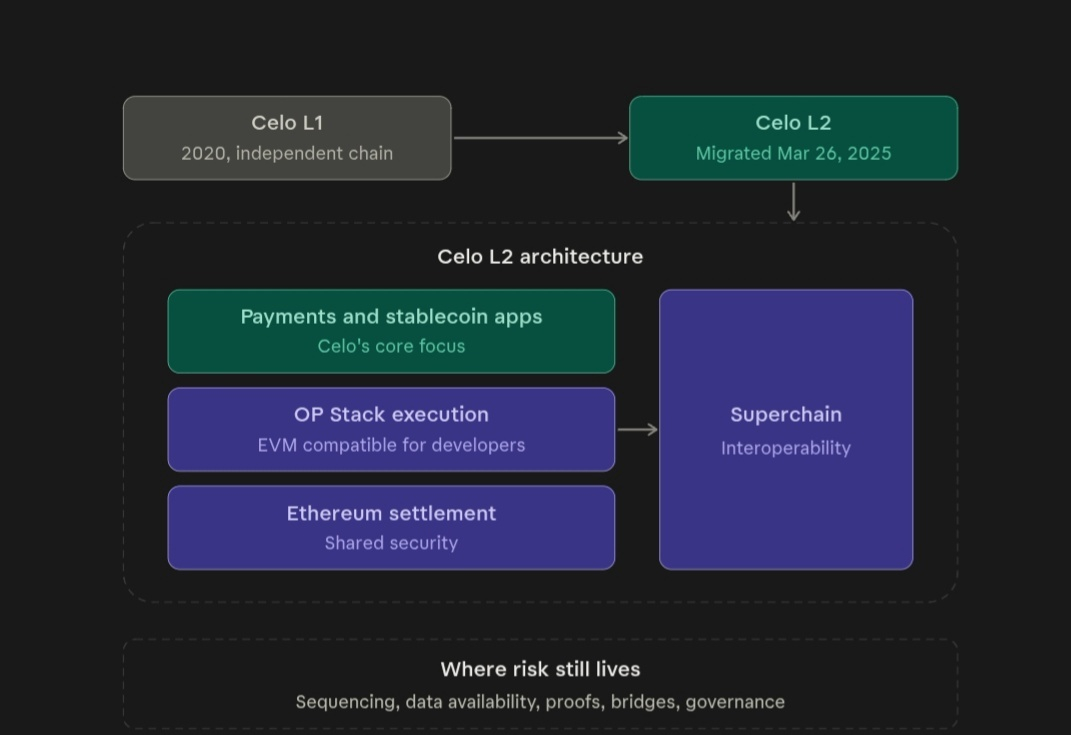
On March 26, 2025, Celo completed its migration to an Ethereum L2 built using the OP Stack, preserving its existing network history while moving closer to Ethereum's settlement ecosystem.
The move gave Celo a different foundation for its ambitions:
• Ethereum settlement infrastructure
• OP Stack execution architecture
• EVM compatibility for developers
• Access to the broader Superchain ecosystem
• Payment-focused optimization rather than simply chasing general-purpose blockchain activity
The important distinction is that Celo isn't abandoning its original identity.
It is attempting to combine Ethereum's ecosystem advantages with infrastructure designed around the specific needs of payments and stablecoin applications.
In my view, that is a more interesting strategy than building another isolated blockchain and hoping developers, liquidity, and users arrive independently.
However, an L2 architecture does not automatically eliminate risk. Security also depends on its implementation, sequencing, data availability, proof systems, bridges, and governance.
The architecture creates an opportunity. Execution determines whether that opportunity becomes durable.
2. The stablecoin thesis: Blockchain utility measured in money moving
For years, crypto adoption discussions were dominated by trading, speculation, and token prices.
But stablecoins are changing the conversation.
A person sending money internationally may not care about a blockchain's native token. They may simply want to transfer $50 without excessive fees, unnecessary delays, or complicated banking access.
A small business may care more about receiving digital dollars than about which consensus mechanism powers the transaction.
This is where Celo's design becomes particularly relevant.
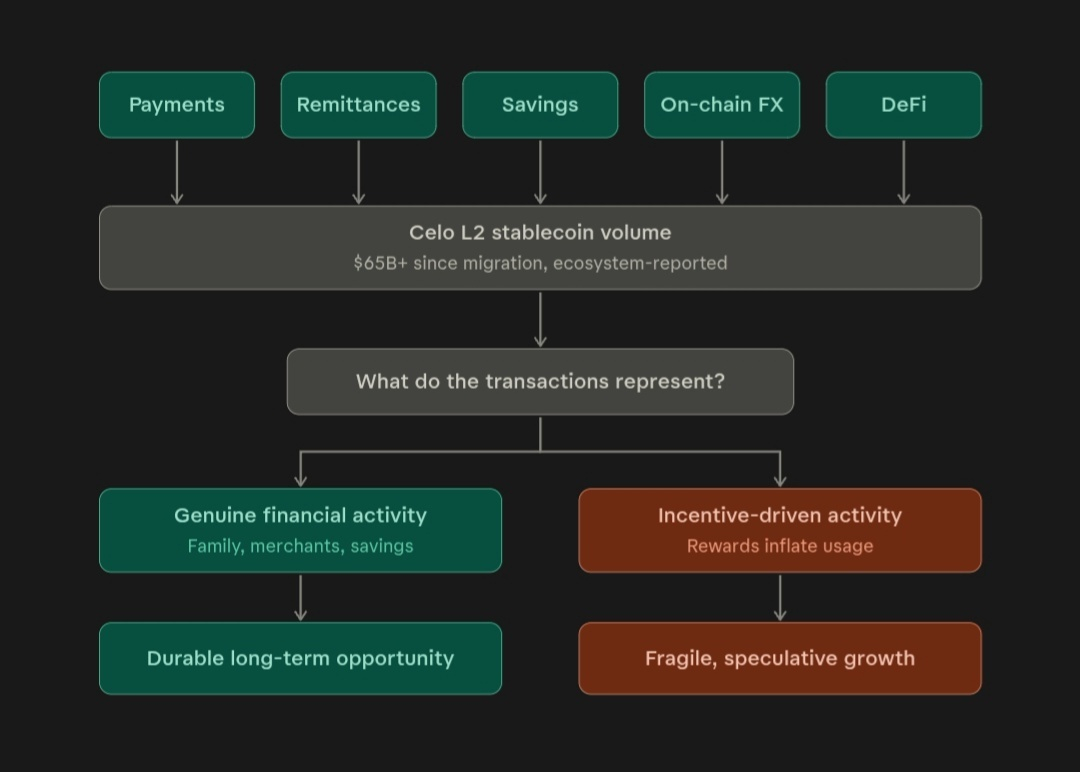
The network supports stablecoin-focused financial activity, including payments, remittances, savings, on-chain foreign exchange, and DeFi.
According to Celo's May 2026 announcement, the network had processed more than $65 billion in stablecoin volume since its L2 migration, alongside over 1.3 billion lifetime transactions and hundreds of thousands of daily active users.
These are ecosystem-reported figures, not independently audited proof of financial adoption. Still, they provide useful context for understanding where Celo is positioning itself.
The more interesting question isn't how many transactions a network can process.
It is what those transactions represent.
Are people sending money to family? Paying merchants? Moving between currencies? Accessing savings products? Or interacting mainly because incentives temporarily make activity attractive?
Those distinctions matter.
A network processing genuine financial activity has a fundamentally different long-term opportunity from one whose growth depends primarily on speculative participation.
Celo's ambition is to make stablecoin infrastructure useful outside crypto-native communities.
3. MiniPay: Distribution may be Celo's biggest advantage
Technology can be excellent and still fail to reach people.
This is one of crypto's biggest problems. Many networks have sophisticated infrastructure, but onboarding remains confusing, wallets require technical understanding, and users must navigate unfamiliar applications.
MiniPay approaches distribution differently.
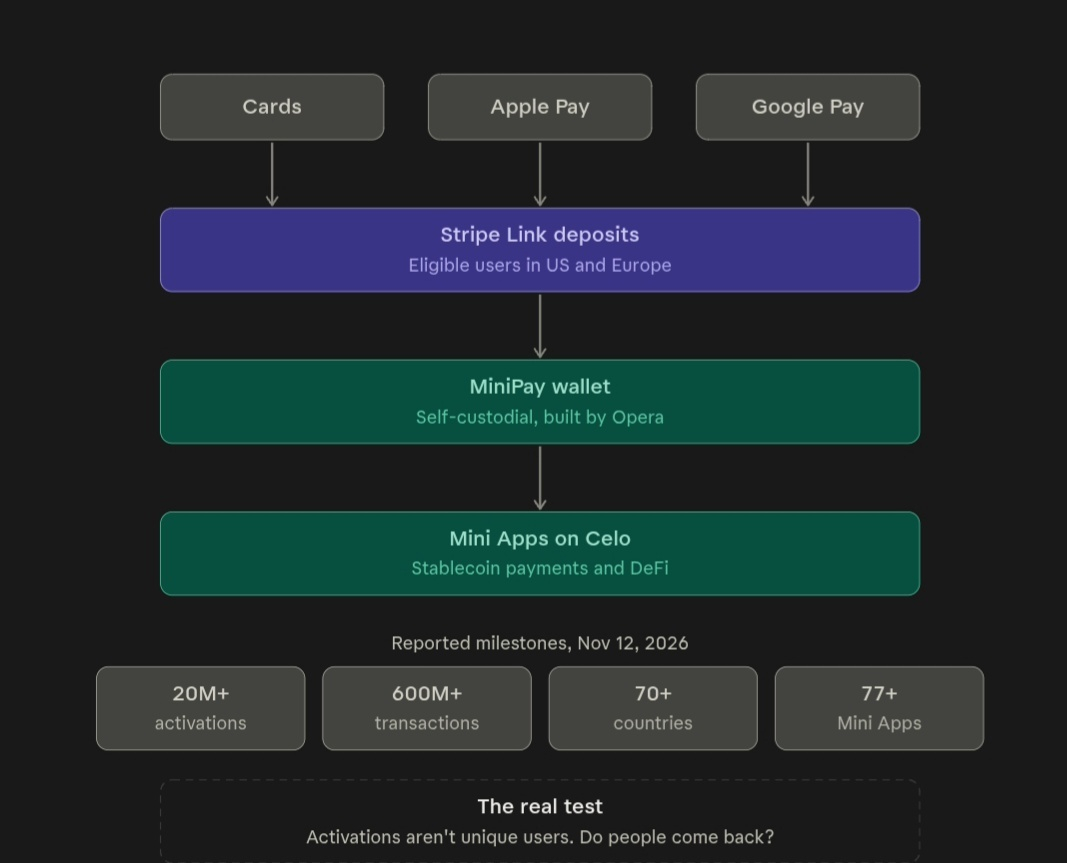
Built by Opera and running on Celo, MiniPay is a self-custodial wallet designed around mobile accessibility and stablecoin usage.
Instead of asking users to understand gas, bridges, networks, and complex wallet interfaces, it attempts to make the experience more familiar.
According to Celo's November 12, 2026 update, MiniPay had surpassed:
• 20 million wallet activations
• 600 million transactions
• 70+ countries
• 77+ Mini Apps
The same announcement introduced Stripe's Link payment integration for eligible users in the United States and Europe, allowing deposits through familiar payment methods, including cards, Apple Pay, and Google Pay.
This development addresses something many blockchain projects overlook:
Getting users onto a network is not only a wallet problem. It is an access-to-money problem.
If adding funds feels complicated, people may never reach the application in the first place.
MiniPay's distribution strategy could therefore be important beyond the wallet itself. It creates a potential bridge between familiar consumer payment experiences and on-chain financial applications.
Of course, wallet activations are not equivalent to unique active users, and transaction totals alone cannot prove product-market fit.
The real test is whether users return because the product solves a problem—not because a campaign or incentive brought them there temporarily.
4. Fee abstraction: Removing one of crypto's most unnecessary barriers
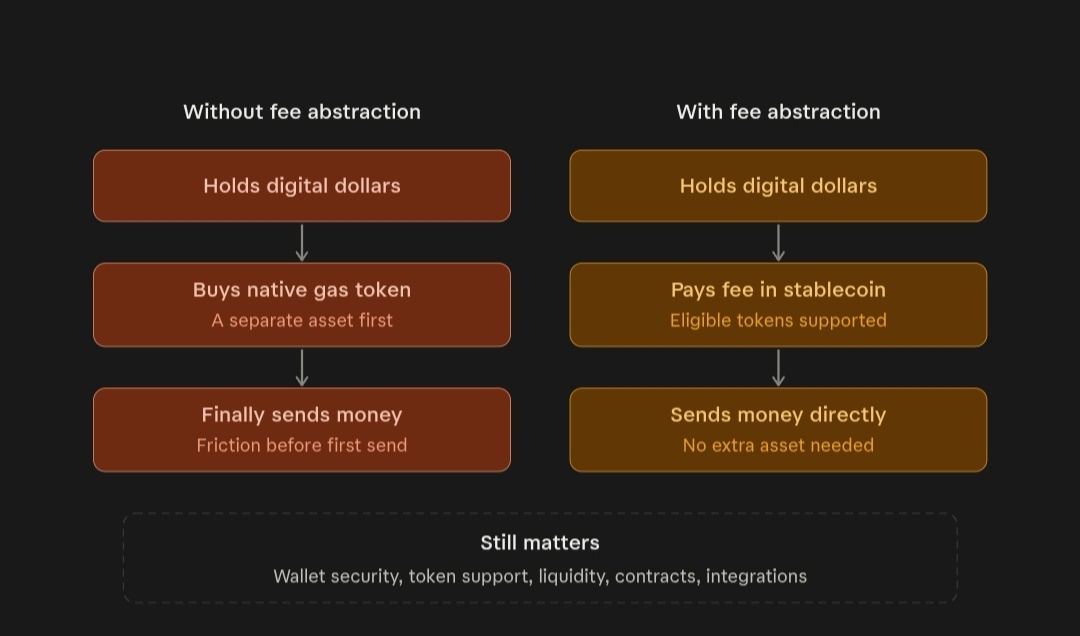
Imagine receiving digital dollars but being unable to send them because you don't own the network's native gas token.
For an experienced crypto user, buying a small amount of gas may be routine.
For someone new to blockchain, it can be confusing.
Celo's fee abstraction allows supported tokens to be used for transaction fees, including eligible stablecoins.
This changes the onboarding experience.
A user holding a stablecoin may be able to transact without first purchasing a separate token purely to pay gas.
That sounds like a small technical feature, but it addresses a very real UX problem.
The broader principle is simple:
If the purpose of a blockchain application is to move money, users shouldn't necessarily need to understand an additional asset just to move their money.
Fee abstraction doesn't remove every complication. Wallet security, token support, liquidity, smart contracts, and application integrations remain important.
But reducing unnecessary friction is exactly the kind of improvement that can make blockchain more accessible.
5. Local currencies: The next stage beyond digital dollars
Stablecoin adoption is often discussed almost exclusively through USD-denominated assets.
But financial access isn't identical everywhere.
A user in Brazil may need Brazilian reais. Someone in Argentina may prefer pesos. A business operating across several markets may need to manage multiple currencies without repeatedly depending on traditional banking infrastructure.
Celo's ecosystem has been expanding its local-currency infrastructure alongside dollar-based stablecoins.
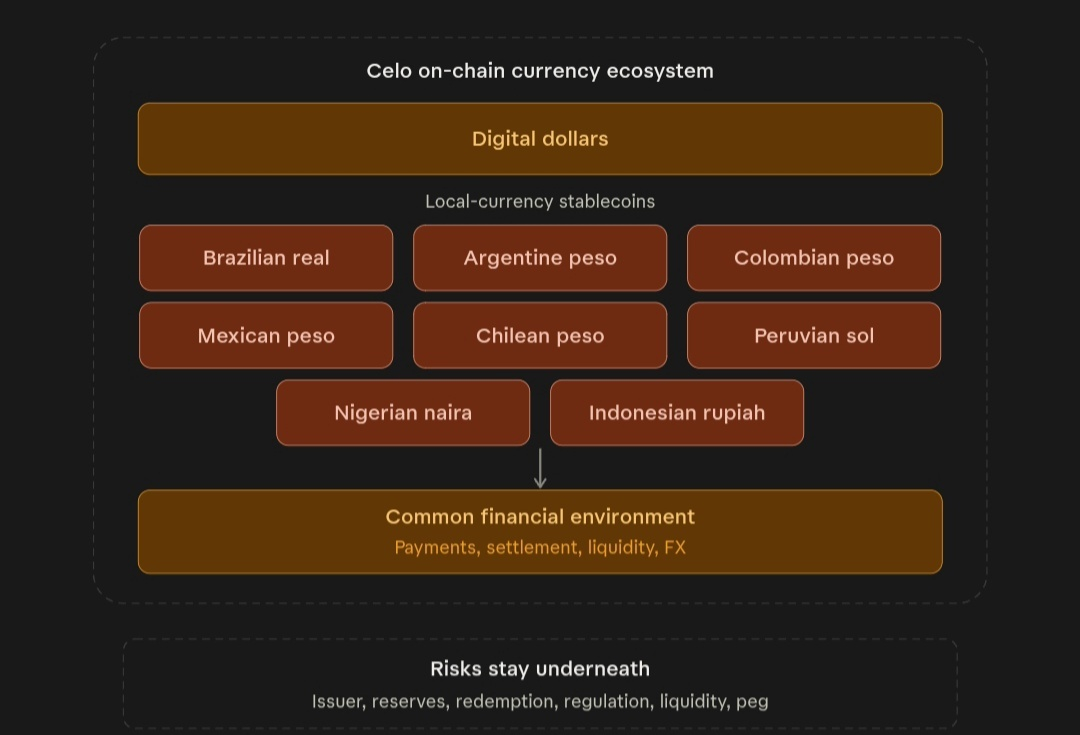
Its ecosystem announcements have highlighted assets associated with currencies such as the Brazilian real, Argentine peso, Colombian peso, Mexican peso, Chilean peso, Peruvian sol, Nigerian naira, and Indonesian rupiah.
This creates a more interesting possibility than simply transferring digital dollars.
An on-chain currency ecosystem could potentially connect local payments, international settlement, liquidity, and currency exchange within a common financial environment.
But local-currency stablecoins aren't automatically risk-free.
Users still need to consider issuer reliability, reserve quality, redemption mechanisms, regulation, liquidity, and the possibility that an asset may fail to maintain its intended peg.
The infrastructure can improve access. It cannot remove the financial risks of the underlying assets.
6. Celo is also preparing for an economy of AI agents
This is the part of Celo's development that I find particularly interesting.
The internet is moving toward software agents capable of performing tasks, accessing services, purchasing information, and interacting with other systems.
But autonomous software also needs a payment mechanism.
Traditional payment systems weren't necessarily designed for machine-to-machine transactions involving tiny amounts, global availability, automated settlement, and continuous interaction.
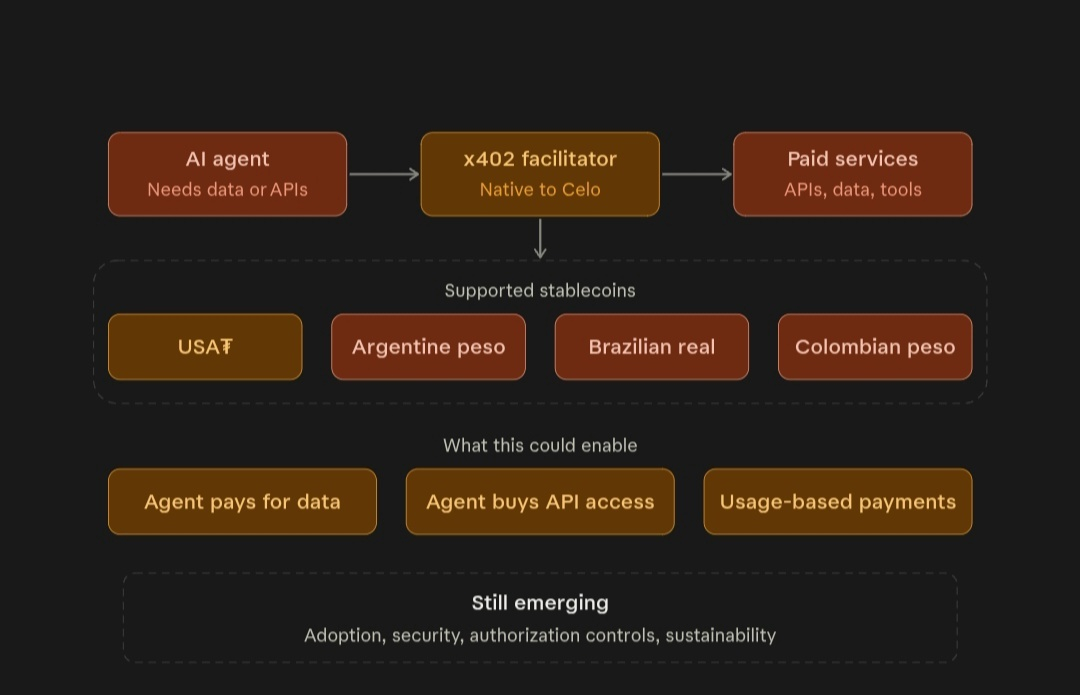
Celo's x402 payment infrastructure is exploring this direction through stablecoin-based payments for agents.
In September 2026, Celo announced support for USA₮ through its native x402 facilitator, enabling agents to pay for APIs, data, and services using supported stablecoins.
The ecosystem has also expanded support for local-currency stablecoins, including assets linked to the Argentine peso, Brazilian real, and Colombian peso.
Think about the possibilities.
An AI agent could pay for data. Another could purchase an API service. Software could settle payments automatically based on usage.
These are not necessarily transactions that require a human to manually approve every small payment.
That creates a potential new use case for fast, low-cost, programmable financial infrastructure.
However, agentic payments remain an emerging field. Actual adoption, security, authorization controls, and economic sustainability will determine whether the opportunity becomes meaningful.
The interesting part is that Celo's payment infrastructure isn't being designed exclusively for today's wallet users.
It may also become relevant to tomorrow's autonomous software.
7. Ecosystem expansion: Infrastructure becomes more valuable when assets and applications connect
A blockchain ecosystem is rarely defined by a single application.
Its strength often comes from the connections between wallets, assets, liquidity, payment services, developers, and financial applications.
Celo's recent integrations demonstrate that direction.
On November 24, 2026, Frax announced that its asset suite had deployed natively on Celo, including frxUSD, sfrxUSD, WFRAX, frxETH, and sfrxETH.
The announcement also stated that Celo Core Co. planned to allocate up to $9 million of reserves into sfrxUSD, while Frax planned to buy and hold CELO.
This is notable because ecosystem expansion can potentially connect stablecoin payments with savings, liquidity, and broader DeFi activity.
But integrations shouldn't be mistaken for guaranteed adoption.
The long-term value of these developments depends on whether users actually utilize the products, liquidity remains healthy, applications attract recurring activity, and the underlying systems remain secure.
A growing list of integrations is encouraging.
Sustained usage is the stronger signal.
8. Where does CELO fit into this entire system?
This is a question worth asking honestly.
CELO is the network's native token and plays roles in network fees, governance, and participation mechanisms.
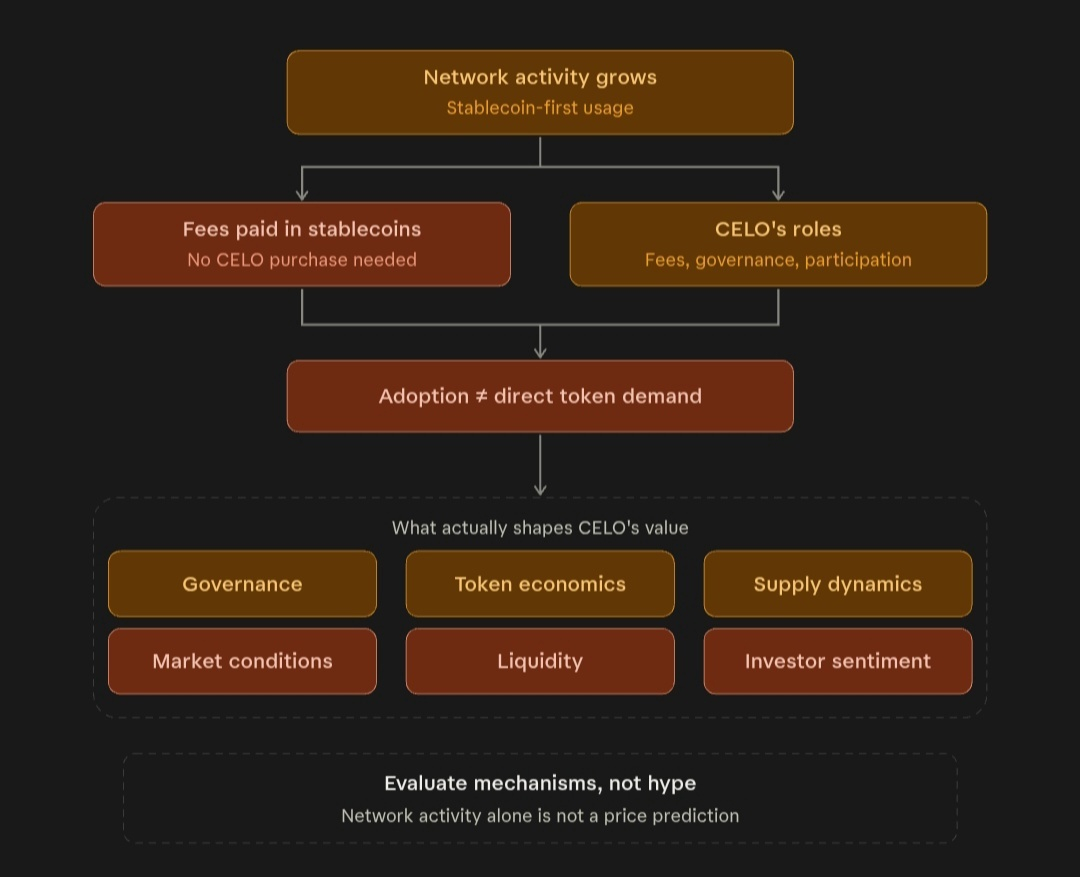
But Celo's stablecoin-first design creates an important distinction between network adoption and direct token demand.
If users can pay transaction fees using supported stablecoins, increasing stablecoin activity does not automatically mean every user must purchase CELO.
That is an important consideration for anyone evaluating the token's economic model.
The relationship between infrastructure growth and token value depends on the mechanisms that actually capture and distribute economic value.
Network activity alone is not a price prediction.
Governance decisions, token economics, market conditions, liquidity, supply dynamics, and investor sentiment can all influence CELO's value.
I would rather evaluate these mechanisms carefully than claim that more transactions automatically mean a higher token price.
That distinction is what separates an infrastructure thesis from a speculative narrative.
9. The risks Celo still has to overcome
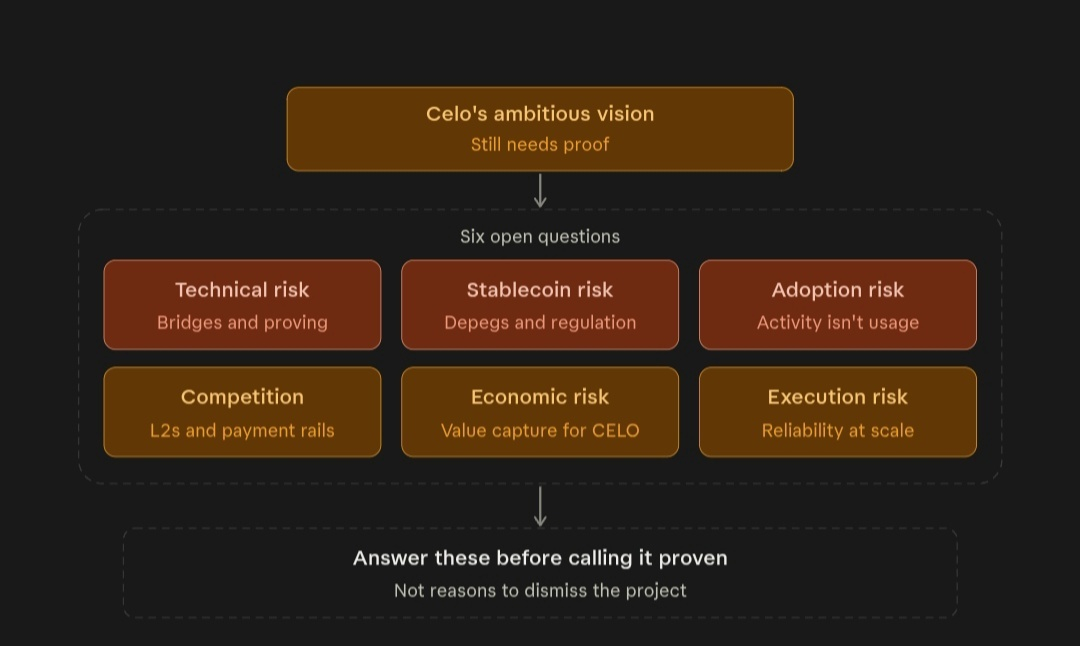
No serious analysis should discuss adoption without discussing what could go wrong.
Technical risk: Layer 2 infrastructure, smart contracts, bridges, sequencing, and proving systems can introduce vulnerabilities.
Stablecoin risk: Assets may experience depegging, liquidity problems, issuer failures, or regulatory restrictions.
Adoption risk: Reported activations and transaction numbers do not guarantee consistent real-world usage.
Competition: Celo competes with other Ethereum L2s, payment-focused networks, traditional financial infrastructure, and emerging stablecoin platforms.
Economic risk: The growth of the ecosystem does not necessarily translate into proportional value capture for CELO.
Execution risk: Building infrastructure is one challenge. Making it reliable, intuitive, secure, and financially sustainable at scale is another.
These aren't reasons to dismiss the project.
They are the questions that need to be answered before an ambitious vision can be considered a proven success.
My final perspective: The best infrastructure might be the infrastructure users never think about
What stands out to me about Celo is the connection between its different layers of strategy.
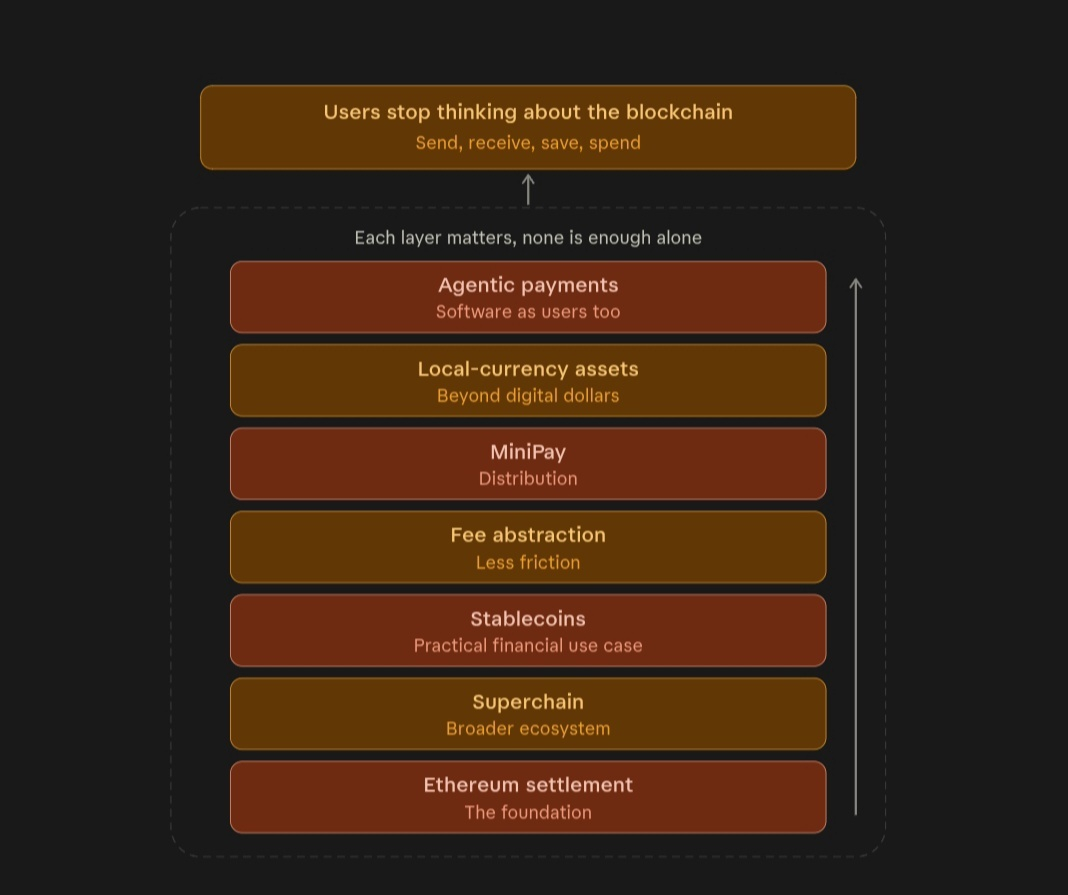
Ethereum provides the settlement foundation.
The Superchain direction connects its infrastructure with a broader ecosystem.
Stablecoins provide a practical financial use case.
Fee abstraction reduces friction.
MiniPay provides distribution.
Local-currency assets expand the possibilities beyond digital dollars.
And agentic payments explore how this infrastructure might eventually serve software as well as people.
Each component matters, but none is sufficient on its own.
The real opportunity exists when they reinforce each other.
I don't think the most important question for Celo is whether it can produce another record-breaking transaction figure.
My question is more practical:
Can Celo make sending, receiving, saving, and spending digital money so simple that people stop thinking about the blockchain underneath it?
If that happens, adoption could become much more meaningful than a headline metric.
The next chapter of crypto may not be defined by how many people know the names of blockchain networks.
It may be defined by how many people use them without needing to know their names.
And that is the direction I believe Celo is worth watching.

Disclaimer: This article is for educational and informational purposes only and does not constitute financial advice. Digital assets are volatile, and you may lose money. Network and ecosystem statistics cited in this article are based on project announcements and may not represent independently audited figures. Always conduct your own research.