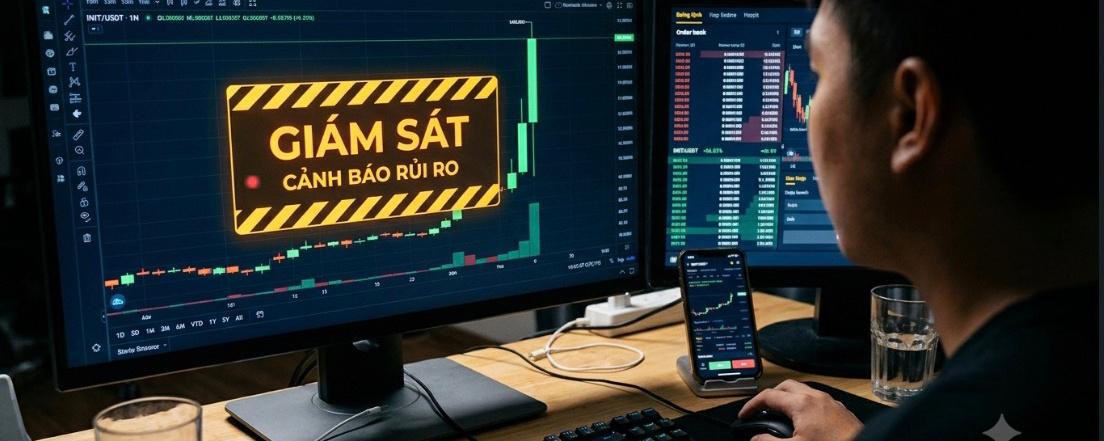

Open today's Top Gainers ranking and spot a name that has just been tagged as under Monitoring yet surged more than 56% in 24 hours—take INIT/USDT, which shot straight up from around 0.08290 to a high of 0.15072, with trading volume exceeding 26.48M USDT.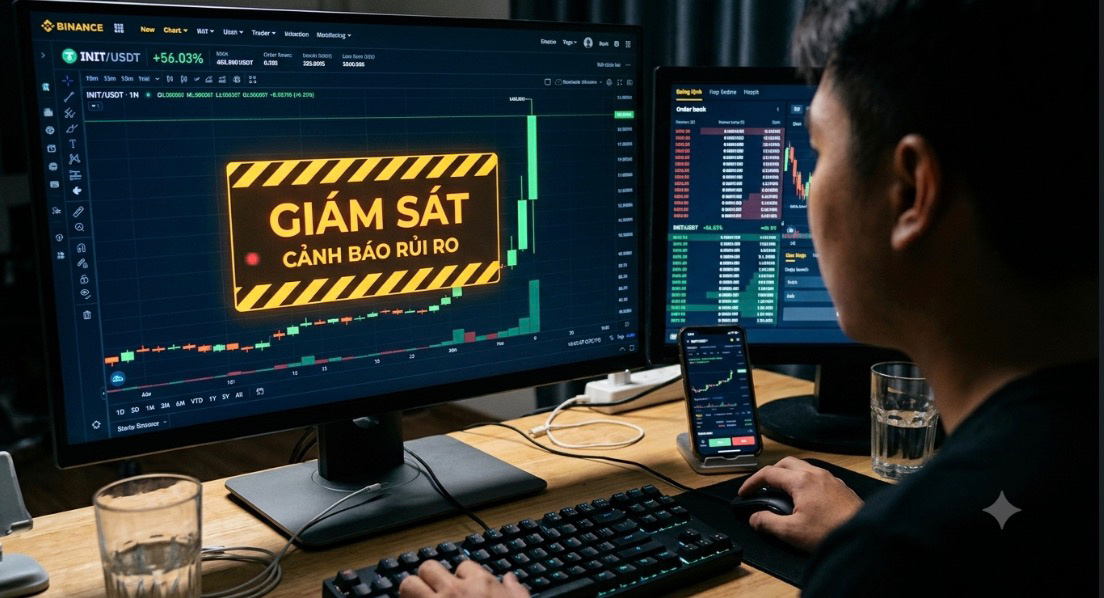
Sounds paradoxical: if the exchange has flagged a project as risky, why is money flowing in and driving the price vertically? Behind these “irrational” green candles are often five very familiar market mechanisms:
1. Thin order books — “Market movers” need very little capital to drive prices up. When a token is tagged for Monitoring, most long-term investors and institutions withdraw their funds or stay on the sidelines out of concern about delisting risk. As market liquidity dries up, the order book becomes extremely thin. At this point, a market maker or whale needs only a relatively small amount of money to push the price up 40% to 100% in just a few short candles.
2. The Short Squeeze Trap (Liquidating Short Sellers) The natural reaction for most people when they see a Monitoring tag is to assume the project is about to collapse and immediately open short positions. When short positions become heavily concentrated, whales need only trigger a move in the opposite direction to force stop-losses. The resulting liquidation cascade forces short sellers to buy back tokens on the market, inadvertently becoming fuel that sends prices even higher.
3. The liquidity equation for keeping a listing The Monitoring tag is not a delisting notice; it is a periodic review stage during which the exchange decides whether to retain or remove a token. Among the review criteria, trading volume and liquidity are always key factors. To improve these metrics and maintain hope of having the tag removed, the project itself or market-making firms have a strong incentive to spark a rally and bring money flowing back in.
4. Creating “Exit Liquidity” In a worse-case scenario—when the risk of delisting becomes increasingly clear—those holding large amounts of tokens need buyers before liquidity disappears from major exchanges. There is no more effective advertising than pushing a coin into the Top Gainers list and stoking FOMO among retail investors who rush in to buy at the peak.
5. Betting on rumors of the tag being removed Some risk-loving traders are always on the hunt for highly volatile coins, betting that a project will pass its review and have its Monitoring tag removed, creating additional short-term speculative demand.
A practical look at the $INIT chart (15-minute timeframe): After a sharp surge accompanied by explosive volume to 0.15072, the price corrected to around 0.13367 as trading volume gradually narrowed, MACD moved into negative territory, and RSI(6) cooled to 36.92. This is a market condition where unpredictable swings in both directions are very likely.
Coins under Monitoring are not “cheap gold mines” but extremely high-risk territory. Profits can come very quickly, but liquidity can also evaporate after a single announcement from the exchange. If you trade this group for short-term gains, stop-loss discipline and splitting your capital into smaller amounts matter more than any technical analysis.
What do you think of the pumps in the Monitoring-tagged coin group: a quick trading opportunity or a liquidity trap? Share your thoughts below! 👇
#INIT #MonitoringTags #CryptoAnalysis