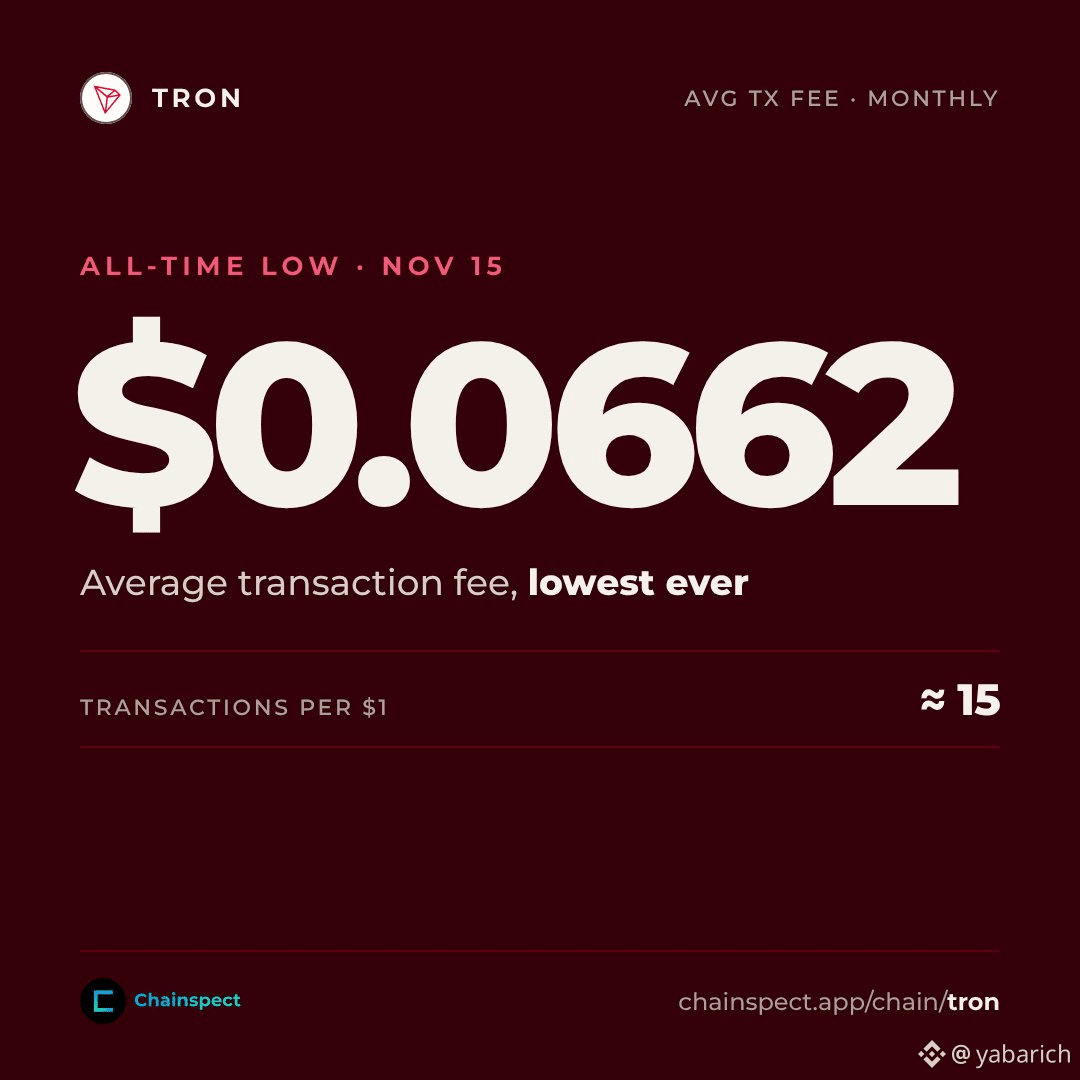
𝗧𝗥𝗢𝗡'𝗦 𝗔𝗟𝗟-𝗧𝗜𝗠𝗘 𝗟𝗢𝗪 𝗧𝗥𝗔𝗡𝗦𝗔𝗖𝗧𝗜𝗢𝗡 𝗙𝗘𝗘 𝗢𝗙 $𝟬.𝟬𝟲𝟲𝟮: 𝗖𝗔𝗡 𝗟𝗢𝗪𝗘𝗥 𝗖𝗢𝗦𝗧𝗦 𝗨𝗡𝗟𝗢𝗖𝗞 𝗧𝗛𝗘 𝗡𝗘𝗫𝗧 𝗪𝗔𝗩𝗘 𝗢𝗙 𝗕𝗟𝗢𝗖𝗞𝗖𝗛𝗔𝗜𝗡 𝗔𝗗𝗢𝗣𝗧𝗜𝗢𝗡?
Transaction affordability is one of the most important factors determining whether blockchain technology can evolve from a specialized financial infrastructure into an everyday economic utility.
According to Chainspect, TRON's monthly average transaction fee has reached a reported all-time low of $0.0662, meaning that one dollar can cover approximately 15 transactions at the reported average rate.
While this milestone may appear modest when viewed from the perspective of a single transaction, its economic significance becomes considerably greater when applied to businesses, payment providers and applications processing thousands or millions of transactions.
In my assessment, TRON's declining transaction costs represent an opportunity to expand the range of economically viable blockchain applications, particularly in emerging markets where affordability directly influences financial accessibility.
The real competitive advantage is not simply making existing transactions cheaper.
It is making previously uneconomical transactions possible.
𝗨𝗡𝗗𝗘𝗥𝗦𝗧𝗔𝗡𝗗𝗜𝗡𝗚 𝗧𝗛𝗘 𝗘𝗖𝗢𝗡𝗢𝗠𝗜𝗖 𝗦𝗜𝗚𝗡𝗜𝗙𝗜𝗖𝗔𝗡𝗖𝗘 𝗢𝗙 $𝟬.𝟬𝟲𝟲𝟮 𝗣𝗘𝗥 𝗧𝗥𝗔𝗡𝗦𝗔𝗖𝗧𝗜𝗢𝗡
Using Chainspect's reported monthly average transaction fee as a reference, the estimated transaction expenditure at different activity levels would be:
• 15 transactions: $0.993. • 100 transactions: $6.62. • 1,000 transactions: $66.20. • 10,000 transactions: $662. • 100,000 transactions: $6,620. • 1 million transactions: $66,200.
These calculations demonstrate how transaction affordability can influence operating expenditure at scale.
However, TRON's monthly average transaction fee should not be interpreted as a guaranteed fixed fee for every transaction.
TRON operates through a resource-based architecture involving Bandwidth and Energy.
Bandwidth supports transaction data processing, while Energy is consumed during smart contract execution.
Depending on resource availability, staking, resource delegation, contract complexity and network parameters, individual users may experience substantially different effective transaction costs.
A simple TRX transfer and a complex decentralized finance transaction do not necessarily consume equivalent resources.
Similarly, the reported network-wide average should not be confused with the specific cost of transferring USDT or USDD through a particular wallet.
For additional context, a Chainspect dashboard snapshot also displays:
• Daily average transaction fee: $0.0454. • Daily on-chain revenue: $555,000. • Cumulative transactions: 16.3 billion. • Observed hourly throughput: 147.5 transactions per second.
These figures represent different measurement periods and should not be directly substituted for the reported monthly average of $0.0662.
Nevertheless, they provide additional context for evaluating TRON's transaction activity and network economics.
Official data source: https://chainspect.app/chain/tron
𝗠𝗬 𝗣𝗘𝗥𝗦𝗢𝗡𝗔𝗟 𝗩𝗜𝗘𝗪: 𝗟𝗢𝗪𝗘𝗥 𝗙𝗘𝗘𝗦 𝗖𝗔𝗡 𝗖𝗛𝗔𝗡𝗚𝗘 𝗧𝗛𝗘 𝗘𝗖𝗢𝗡𝗢𝗠𝗜𝗖𝗦 𝗢𝗙 𝗗𝗜𝗚𝗜𝗧𝗔𝗟 𝗣𝗔𝗬𝗠𝗘𝗡𝗧𝗦
I believe the most overlooked consequence of declining transaction fees is their potential to reduce the minimum economically viable payment size.
Consider a hypothetical payment provider seeking to maintain blockchain transaction expenditure below 1% of the transferred amount.
At a transaction fee of $0.0662:
• $1 payment: 6.62% fee burden. • $5 payment: 1.324%. • $10 payment: 0.662%. • $50 payment: 0.1324%. • $100 payment: 0.0662%. • $1,000 payment: 0.00662%.
The minimum payment size required to maintain a transaction fee burden of 1% would be $6.62.
By comparison, a hypothetical network charging $0.50 per transaction would require a minimum payment of $50 to achieve the same fee percentage.
Under these assumptions, TRON's reported average fee reduces that minimum economically viable payment threshold by 86.76%.
Now consider a digital business processing 500,000 monthly payments.
Scenario A — Hypothetical $0.50 transaction fee:
• Monthly transaction expenditure: $250,000. • Annualized expenditure: $3 million.
Scenario B — TRON's reported $0.0662 average:
• Monthly transaction expenditure: $33,100. • Annualized expenditure: $397,200.
Potential difference:
• Monthly savings: $216,900. • Annualized savings: $2,602,800. • Transaction expenditure reduction: 86.76%.
These calculations are illustrative scenarios rather than measured payment provider results. They assume consistent transaction fees and exclude resource acquisition, exchange spreads, application charges and other operational expenses.
Nevertheless, the example demonstrates how affordable blockchain settlement could improve the economics of:
• Cross-border remittances. • International freelancer payments. • Digital commerce. • Subscription services. • Merchant settlements. • Automated AI service payments. • High-frequency financial applications.
Lower transaction costs can provide businesses with greater flexibility to experiment with payment models that would otherwise be commercially unattractive.
𝗖𝗔𝗡 𝗟𝗢𝗪𝗘𝗥 𝗙𝗘𝗘𝗦 𝗔𝗡𝗗 𝗛𝗜𝗚𝗛𝗘𝗥 𝗨𝗧𝗜𝗟𝗜𝗭𝗔𝗧𝗜𝗢𝗡 𝗖𝗥𝗘𝗔𝗧𝗘 𝗦𝗨𝗦𝗧𝗔𝗜𝗡𝗔𝗕𝗟𝗘 𝗧𝗥𝗢𝗡 𝗡𝗘𝗧𝗪𝗢𝗥𝗞 𝗘𝗖𝗢𝗡𝗢𝗠𝗜𝗖𝗦?
Although lower fees benefit users, their implications for network revenue deserve equally careful consideration.
A decline in average transaction fees does not necessarily produce sustainable network growth unless increased utilization compensates for lower revenue per transaction.
Consider two hypothetical network activity scenarios.
Scenario A:
• Daily transactions: 10 million. • Average transaction fee: $0.10. • Aggregate daily transaction fees: $1 million.
Scenario B:
• Average transaction fee: $0.0662. • Daily transactions required to generate equivalent aggregate fees: approximately 15.11 million.
Under these assumptions, transaction activity would need to increase by approximately 51.06% to offset the reduction in average fees.
This illustrates the importance of demand elasticity: whether users and businesses increase their transaction activity sufficiently when settlement costs decline.
These are simplified economic calculations, not actual TRON revenue forecasts or validator income estimates.
For the broader TRON ecosystem, affordable transaction execution could complement several existing infrastructure services.
JustLend DAO provides Energy Rental and liquid staking mechanisms that can help users manage blockchain resources.
USDD and USDT support stablecoin-based financial activity, while GasFree solutions can reduce the operational complexity of maintaining native tokens for eligible transfers.
SUN.io provides decentralized exchange infrastructure, and WINkLink supplies oracle services supporting data-dependent blockchain applications.
B.AI introduces another potential dimension through intelligent applications that could eventually require frequent, low-value programmable payments.
Such AI payment scenarios remain potential applications rather than confirmed integrations.
The indicators I would prioritize when evaluating TRON's declining transaction fees include:
• Monthly average and median transaction fees. • Transaction fees by contract category. • Daily active accounts and recurring user activity. • Stablecoin transfer volume and transaction size distribution. • Energy consumption and rental expenditure. • Aggregate network fees and TRX supply dynamics. • Merchant adoption and recurring payment activity. • Network reliability during periods of increased demand.
Public research resources:
https://chainspect.app/chain/tron https://tronscan.org https://developers.tron.network https://app.justlend.org https://defillama.com/chain/tron
In my assessment, TRON's reported $0.0662 monthly average transaction fee is an important accessibility milestone, but the ultimate measure of its success will be the economic activity it enables.
Lower fees reduce barriers to participation.
Affordable settlement expands potential business applications.
Recurring utilization strengthens network demand.
Sustainable network economics support long-term infrastructure development.
Blockchain adoption should not require users to sacrifice a significant portion of their transaction value simply to move money.
Approximately 15 transactions for one dollar demonstrates how affordable digital settlement could become increasingly practical.
The next challenge is converting that affordability into measurable, recurring and sustainable economic activity.
@TRON DAO @Justin Sun孙宇晨 @USDD - Decentralized USD @OfficialSUNio @JUST DAO #TRONEcoStar