Accounting tools can also become the key ring for funds; this time it is not a pricing issue, but an authorization chain issue.
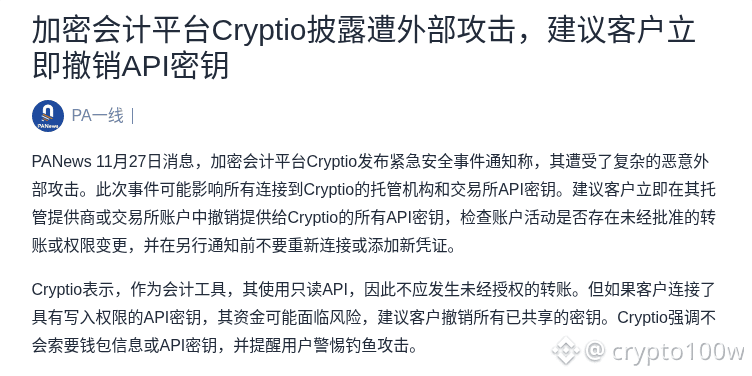
PANews reported on November 27 that crypto accounting platform Cryptio disclosed it had suffered a complex malicious external attack, which may affect all custodian institutions and exchange API keys connected to Cryptio. The official advice to customers is to immediately revoke all API keys provided to Cryptio in custodian provider or exchange accounts, check account activity for any unauthorized transfers or permission changes, and not reconnect or add new credentials until further notice.
Cryptio said that, as an accounting tool, it uses read-only APIs, so unauthorized transfers should not occur; however, if customers connected API keys with write permissions, their funds may be at risk, and it recommends revoking all shared keys. Cryptio emphasized that it will not ask for wallet information or API keys, and reminded users to beware of phishing attacks.
Two observation scenarios: first, the customer originally only authorized read-only access, so the risk is more about exposed credentials and checking for permission changes; second, the customer authorized write access, in which case funds could be moved without authorization, requiring a transaction-by-transaction review of recent permissions and transfer records.
Would you revoke all API keys first, or review transfer records one by one before taking action?
Image 1: Cryptio was attacked externally and customers are advised to immediately revoke API keys · source page screenshot
Image source: https://www.panewslab.com/zh/articles/01a21a45-c010-7638-9e8e-536d5976673c