

I. Market sentiment: Fear & Greed Index
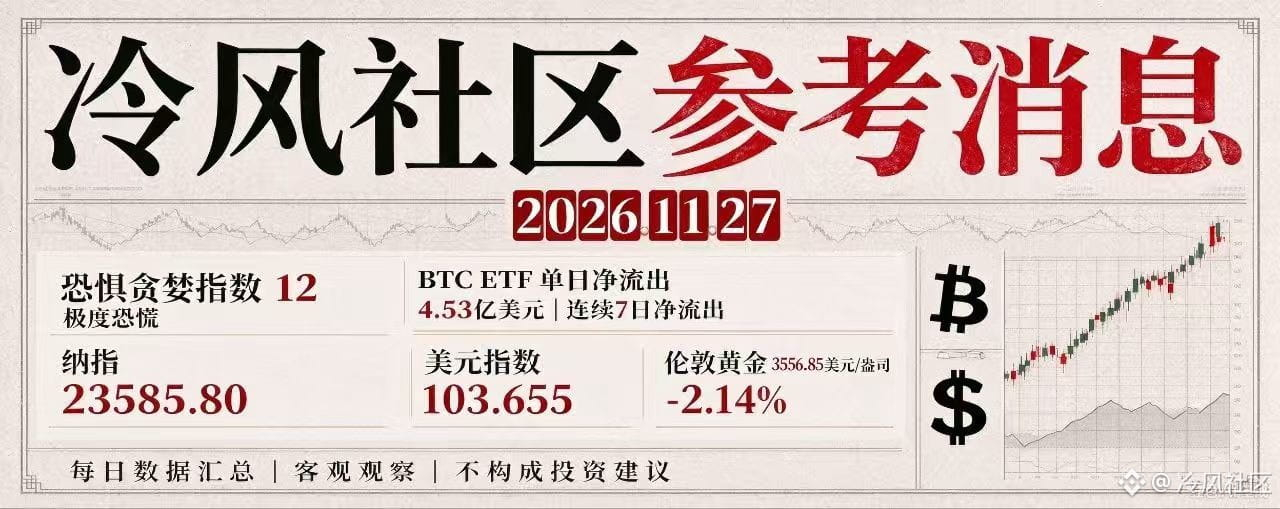
Today’s Fear & Greed Index: 12, in the extreme fear zone.
The index remains at low levels, indicating widespread risk aversion across the market. Short-term selling pressure has not eased significantly. Historically, the extreme fear zone has often seen oversold bounces, but that does not confirm a bottom. For a rebound to be sustained, an improvement in fund flows is essential; for now, this is only an emotionally driven oversold condition.
II. ETF fund flows (SoSoValue figures, excluding GBTC)
Yesterday (November 26), daily figures:
U.S. spot Bitcoin ETFs saw net outflows of $453 million in a single day, extending their streak of consecutive daily net outflows to seven days. BlackRock’s IBIT alone saw $329.7 million in outflows, accounting for 72.8% of yesterday’s total and remaining the main source of redemptions.
Cumulative figures for the period:
Bitcoin spot ETFs saw cumulative net outflows of approximately $4.94 billion over November, setting a new record for the largest monthly outflow since spot ETFs launched. Cumulative outflows over the past 7 days reached $3.05 billion, with institutional withdrawals continuing to accelerate.
Ethereum spot ETFs also remained weak, recording net outflows for 8 consecutive days. Cumulative net outflows for Q4 exceeded $2.84 billion, with BlackRock’s ETHA accounting for the bulk of redemptions. Outflows from ETH were more pronounced, and its decline was steeper, than those of BTC.
Market summary:
Prices edged higher yesterday, but institutional capital did not flow back in at all. This was a typical short-covering bounce, with no new institutional buying. The rebound therefore has a very weak foundation.
III. External Markets: Closed for Thanksgiving; Futures Traded in a Narrow Range, with Gold Market Update
- U.S. spot markets: Closed all day on 11/26 for Thanksgiving, with no spot closing prices. Today, 11/27, markets will close early; liquidity is generally thin during the holiday period.
- Most recent spot closing prices (Wednesday, 11/25):
- Dow Jones: 50,182.95, +0.33%
- S&P 500: 7,182.78, -0.25%
- Nasdaq: 23,585.80, -0.62%
- Overnight index futures during the market holiday (through 2 a.m. on 11/26): Nasdaq futures +0.53%, S&P futures +0.56%, and Dow futures +0.45%. This was a narrow holiday-period recovery, with light trading volume and limited significance as an indicator.
- U.S. Dollar Index: Closed at 103.655 on 11/25, down 0.09%. It edged down from elevated levels but remains broadly range-bound at the upper end.
- London spot gold: Closed at $3,556.85 per ounce on November 25, down 2.14% on the day. The gold market did not close for the entire Thanksgiving holiday; only COMEX gold closed early. Holiday liquidity is tighter, making larger price swings more likely. Gold is also being weighed down by expectations of high interest rates and, like crypto assets, is considered a risk asset, so their price movements are strongly correlated.
A quick reminder: Holiday markets are thin, so small moves in futures and gold should not be taken as a clear trend. We need to wait for actual trading after U.S. markets open early tonight to assess whether risk appetite in external markets is recovering.
IV. Key Macro News
U.S. core PCE inflation for October came in at 3.3% year over year, above expectations, confirming persistent inflation. This comes alongside a sharp upward revision to Q3 GDP and economic data showing greater-than-expected resilience.
CME FedWatch currently prices in a nearly 98% probability of a 25-basis-point rate hike in December—virtually a certainty.
The main thesis remains unchanged:
Persistently high inflation → rate-cut expectations pushed further out → high risk-free yields on U.S. Treasuries continue to attract capital → capital continues to flow out of crypto assets, which offer no interest and are highly volatile.
The next key date is the FOMC policy meeting in the early hours of December 10. The Fed’s latest hawkish or dovish signals will directly determine the overall direction of the crypto market toward year-end.
V. Other Market Data
1. Stablecoin Liquidity (Key Bearish Factor)
USDT supply on the ETH and TRON blockchains continues to contract sharply, down $12.9 billion from its May peak. Total supply has fallen to $174.5 billion, a 6.9% overall contraction. It has shrunk by $8.1 billion over the past 60 days, the largest liquidity decline since August 2022.
Over 46 days, 11.65 billion USDT was returned to Tether’s treasury. 89% came from Binance, Bitfinex, and large OTC holders, indicating a genuine outflow of capital. Trading liquidity on exchanges continues to dry up. CryptoQuant stated that the last time liquidity drained at a comparable pace was at the end of a bear market.
2. Price Action Characteristics
BTC has held above the 61,000 level and made a modest recovery, while ETH’s rebound has been weaker. All current rebounds are driven by existing capital shifting between positions and short covering, with no fresh funds entering to sustain the move. The risk of a pullback after a spike is extremely high.
3. New Market Variables
Binance will officially launch U-margined perpetual contracts for Xiaomi Group and Kingboard Laminates on Hong Kong stocks today at 10:30 and 10:35. Trading will be available 24 hours a day, with leverage of up to 20x. Going forward, volatility in Hong Kong-listed tech and semiconductor stocks will directly divert funds from crypto contracts, further diluting liquidity in the crypto market.
VI. Market Overview Summary
The market is currently facing a convergence of three bearish factors: high macro interest rates, ongoing ETF redemptions, and a liquidity drought in stablecoins.
Yesterday’s price rebound alongside continued capital outflows is the most accurate reflection of current market conditions. Gold, U.S. tech stocks, and crypto assets are all being held back by expectations of high interest rates, and correlations between these assets continue to strengthen.
A trend reversal requires all three of the following signals to materialize:
1. Daily ETF outflows continue to narrow and eventually turn into net inflows
2. USDT liquidity stabilizes and begins to recover
3. The Federal Reserve signals expectations of rate cuts
Until signs of a turning point emerge, all rebounds should be viewed as oversold recoveries, not reversals. The conditions for a reversal are not in place, so prioritize controlling position sizes and staying on the sidelines.
