
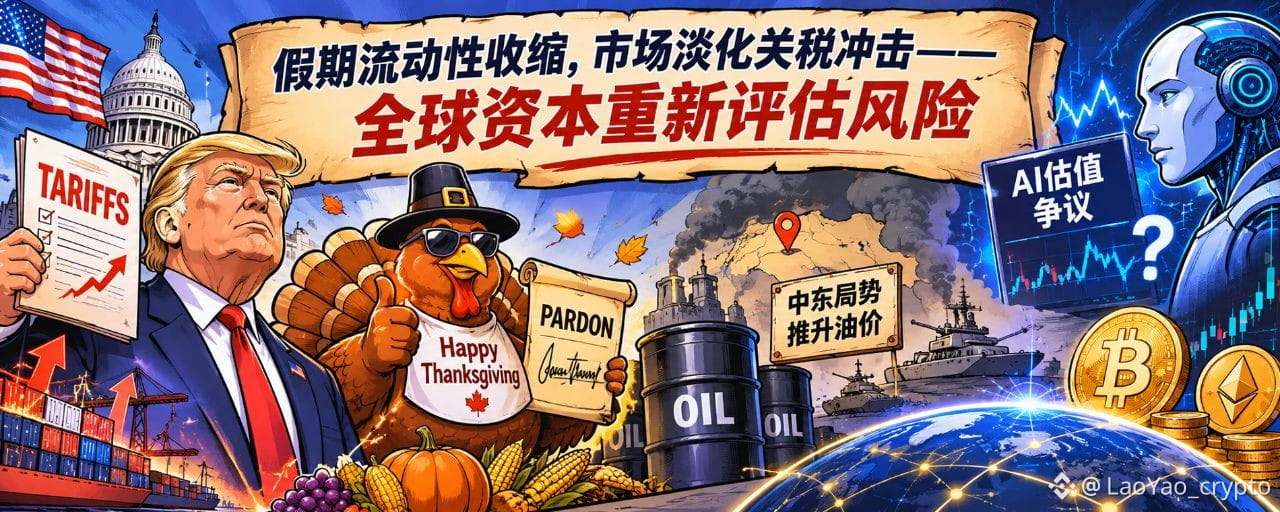

Over the past 24 hours, the U.S. Thanksgiving holiday has significantly reduced trading liquidity in global financial markets.
Asian stock markets rose overall, as investors reacted relatively calmly to the new tariff plan being considered by the Trump administration. Investors seem to believe that the potential policy impact is, for now, less severe than previously feared, and that the negative news on tariffs has not escalated into market panic.
But geopolitical risks are emerging as a new factor in market pricing.
Iran claims to have laid mines in waters near the Strait of Hormuz, while Houthi forces attack Saudi energy facilities, renewing concerns about oil supply disruptions amid rising tensions in the Middle East.
The crypto market remains in a low-volume consolidation phase near the lows, with bulls and bears battling around key price levels.
The market's central tension: tariff risks have temporarily faded, geopolitical risks are rising again, while global liquidity has yet to improve materially.
💹 Capital markets|Global assets enter a period of structural repricing
The central tension in global capital markets is shifting from interest rate expectations alone to a complex interplay of inflationary pressures, policy uncertainty, geopolitical risks, and adjustments to AI valuations.
U.S. markets are closed for Thanksgiving, shifting the focus of global trading today more toward Asian equities, commodities, and forex markets.
Trading depth is limited during the holiday, so some price moves may not fully reflect the true stance of capital. Expectations for Fed policy in December remain an important variable affecting risk assets.
Japanese government bonds:
The yield on 10-year Japanese government bonds is hovering in a narrow range around 2.76%.
The Bank of Japan's cautious tightening stance coincides with pressure from a large supply of long-term government bonds. The normalization of Japanese interest rates remains a factor in global capital allocation that cannot be ignored.
🛢️ Crude oil|Geopolitical risk premium in the Middle East resurfaces
WTI: $84.88/barrel, +1.43%
Brent: $96.14/barrel, +1.62%
Reports of an oil tanker striking a mine in the Strait of Hormuz and Houthi attacks on Saudi Arabia's Ras Tanura refining hub have further heightened concerns about disruptions to Middle Eastern energy supplies.
Combined with this week's EIA inventory build coming in below expectations, the geopolitical risk premium in the oil market has risen.
Two short-term factors to watch:
- Whether shipping security in the Strait of Hormuz deteriorates further.
- Whether the OPEC+ meeting this weekend decides to extend production cuts.
Whether oil prices can continue rising ultimately depends on whether geopolitical risks translate into actual supply shortages.
🥇 Precious metals|Safe-haven demand and profit-taking pull in opposite directions
Gold: $3,571.60/ounce, +0.12%
Silver: $41.65/ounce, 0.25%
Overall, precious metals have seen limited volatility.
On the one hand, tensions in the Middle East are supporting gold as a safe haven;
On the other hand, interest rate expectations and profit-taking after previous gains are limiting upside.
The market has yet to establish a clear directional trend.
💸 Forex|The dollar and non-U.S. currencies continue to vie for dominance
U.S. Dollar Index: 103.78
USD/JPY: 159.25
EUR/USD: 1.097
Offshore yuan: 6.6675
The forex market is still digesting the impact of Fed policy expectations and diverging monetary policies among major economies.
🪙 Web3|Crypto market remains in a deep correction
Over the past 24 hours, the crypto market has been marked by low-volume choppy trading near the lows, with intensifying battles between bulls and bears.
The U.S. Thanksgiving holiday has reduced liquidity in traditional financial markets. Combined with the expiration and settlement of monthly options worth approximately $7.6 billion today, this has left the market cautious and largely on the sidelines after a period of extreme fear.
📌 Key data:
Total crypto market capitalization: approximately $2.08 trillion, up about 0.6% over 24 hours.
$BTC : approximately $60K, trading in a narrow range. It briefly dipped below $59,988 before reclaiming the $60,000 level.
$ETH : approximately $1,680, consolidating weakly. Price action remains relatively soft, capped by the $1,700 level.
Overall, Bitcoin has climbed back above $60,000, but the trend of ETF outflows has yet to reverse. Spot buying is absent, and on-chain activity remains subdued.
This rebound looks more like short covering amid thin liquidity than a large-scale return of institutional capital.
Going forward, key indicators to watch include ETF flows, spot trading volume, and whether BTC can hold firmly above key price levels.
🧘 Crypto insights|Markets trade on the gap between expectations and reality
The performance of global capital markets over the past two days has once again confirmed an important principle:
Markets do not always react to the news itself; they price the difference between the news and prior expectations.
The Trump administration's new tariff plan did not trigger the panic markets had anticipated, suggesting that some policy risks may already have been priced into asset values.
Wall Street traders' expectations for a December Fed policy change may also have been substantially priced in ahead of time.
But whether expectations have been fully priced in still needs to be tested by upcoming inflation data and Fed commentary.
The same applies to the AI industry.
AI's transformative impact on human life and traditional industries is gradually becoming a market consensus. But the industry's prospects and capital valuations are not the same thing.
At its core, the repricing of AI valuations is a process in which capital reassesses investment returns, business models, and future cash flows.
The deeper question is:
Should AI achieve technological breakthroughs through open competition, or face greater restrictions under a national security framework?
This is not just a debate over technological approaches, but also a contest involving national strategy, industrial competition, and the power to shape capital valuations.
For the crypto market, what truly matters is not just whether BTC can hold $60,000, but when global liquidity will improve, when institutional risk appetite will recover, and whether digital assets can secure a more important role in the financial system of the future.
When macroeconomic policy, geopolitics, and technological revolutions intersect, markets are trading not just prices, but also the future structure of industrial power and the global capital order.
View capital through the lens of the mind; discern trends through cycles.
Don't be swayed by short-term sentiment or a single headline. Identify opportunities in the gap between expectations and reality, and seek certainty amid changing cycles.
Go with the trend.
⚠️ These are personal views for market observation and discussion only.
Geopolitical conditions can change rapidly. Please be mindful of position sizing and leverage risks. This is not investment advice.
📌 LaoYao(@LaoYao_crypto )
View capital through the lens of the mind; discern trends through cycles. Find certainty amid uncertainty, and anchor value amid volatility.