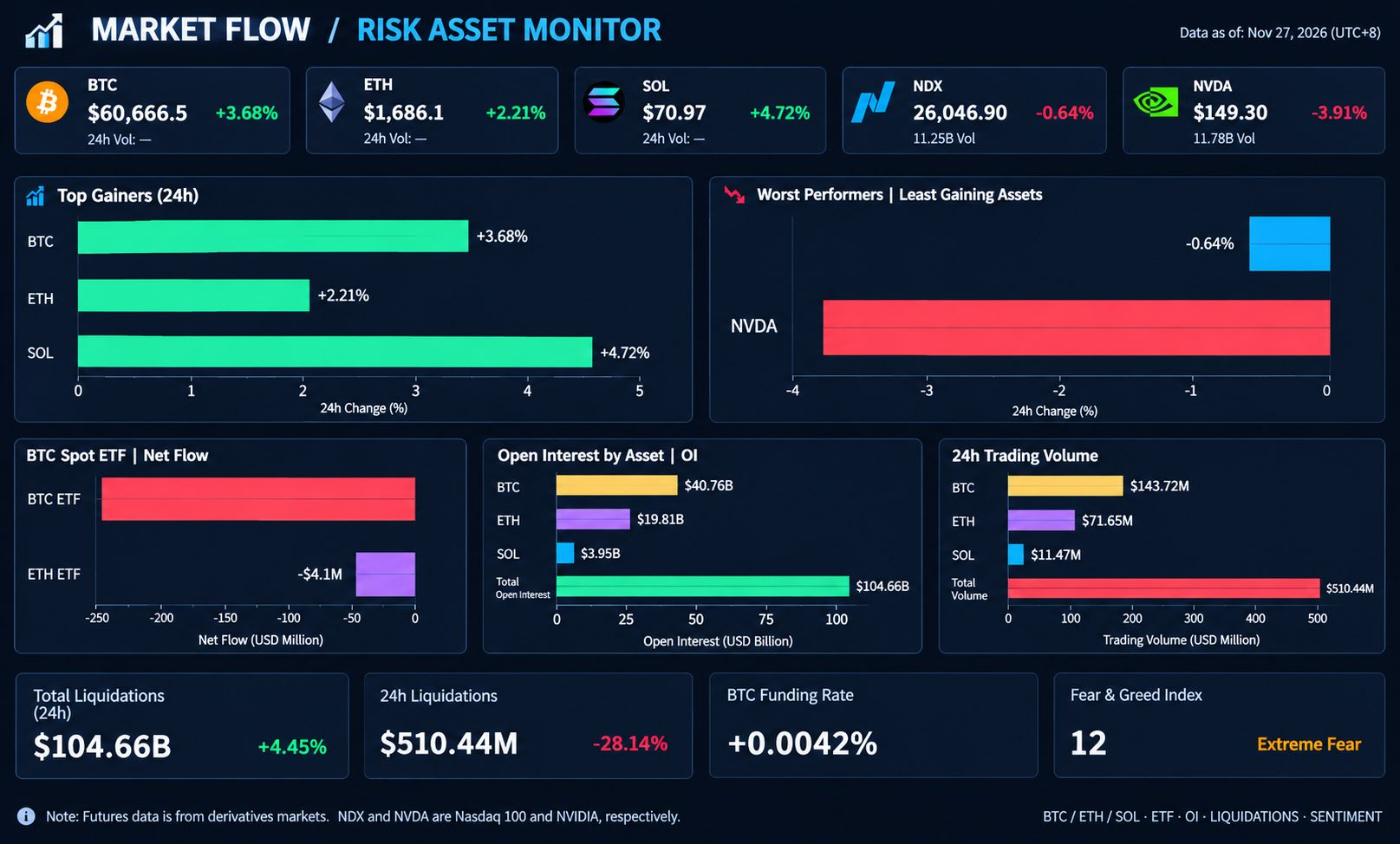

📈 Rising Inflation and Rate-Hike Expectations Put Risk Assets Under Pressure
U.S. core PCE inflation rose again, while economic data continued to show resilience. Markets clearly raised their expectations that the Fed will hike rates in December. The high-interest-rate environment remains in place, putting popular risk assets under pressure and quickly shifting market sentiment toward caution.
BTC has fallen about 25% this month. Net outflows from spot ETFs hit a monthly record, and institutional capital continued to flow out. Prices fluctuated around a key psychological level, temporarily undermining its digital-gold narrative and making it behave more like a highly volatile risk asset. ETH and SOL also came under pressure: ETH tracked BTC’s movements, while SOL fell more sharply due to its higher beta.
Over the same period, the Nasdaq 100 fell nearly 20% from its all-time high, as tech stocks underwent a sharp correction. Despite Jensen Huang’s return, Nvidia still faces significant challenges around demand, competition, and valuation, weighing on overall market sentiment. Risk appetite has clearly declined, and capital has continued to flow out of high-beta assets.
The dominant trend is now clear: inflation and rate-hike expectations are driving the market. BTC and the Nasdaq have both weakened, reflecting the interconnected nature of risk assets.
In the short term, pressure may persist if rate-hike expectations do not ease. Signs of weakening economic data could bring a temporary rebound.
Monitoring the Fed’s policy path and ETF flows is key to assessing the next market move.