If you’re in Spain, could a crypto account at an exchange or payment app be suspended before a court gets involved? To be clear: this is not a new power that has already taken effect today.
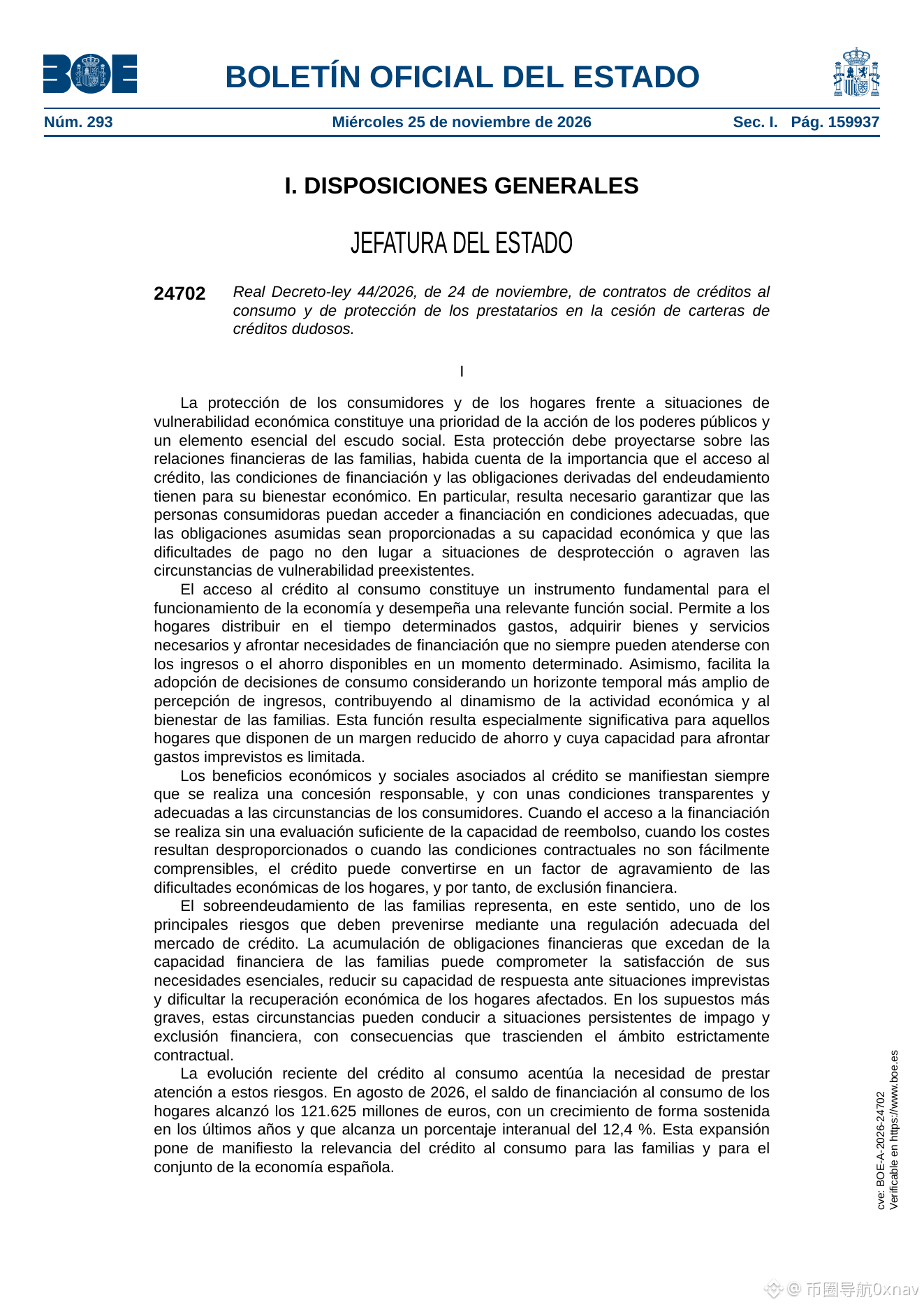
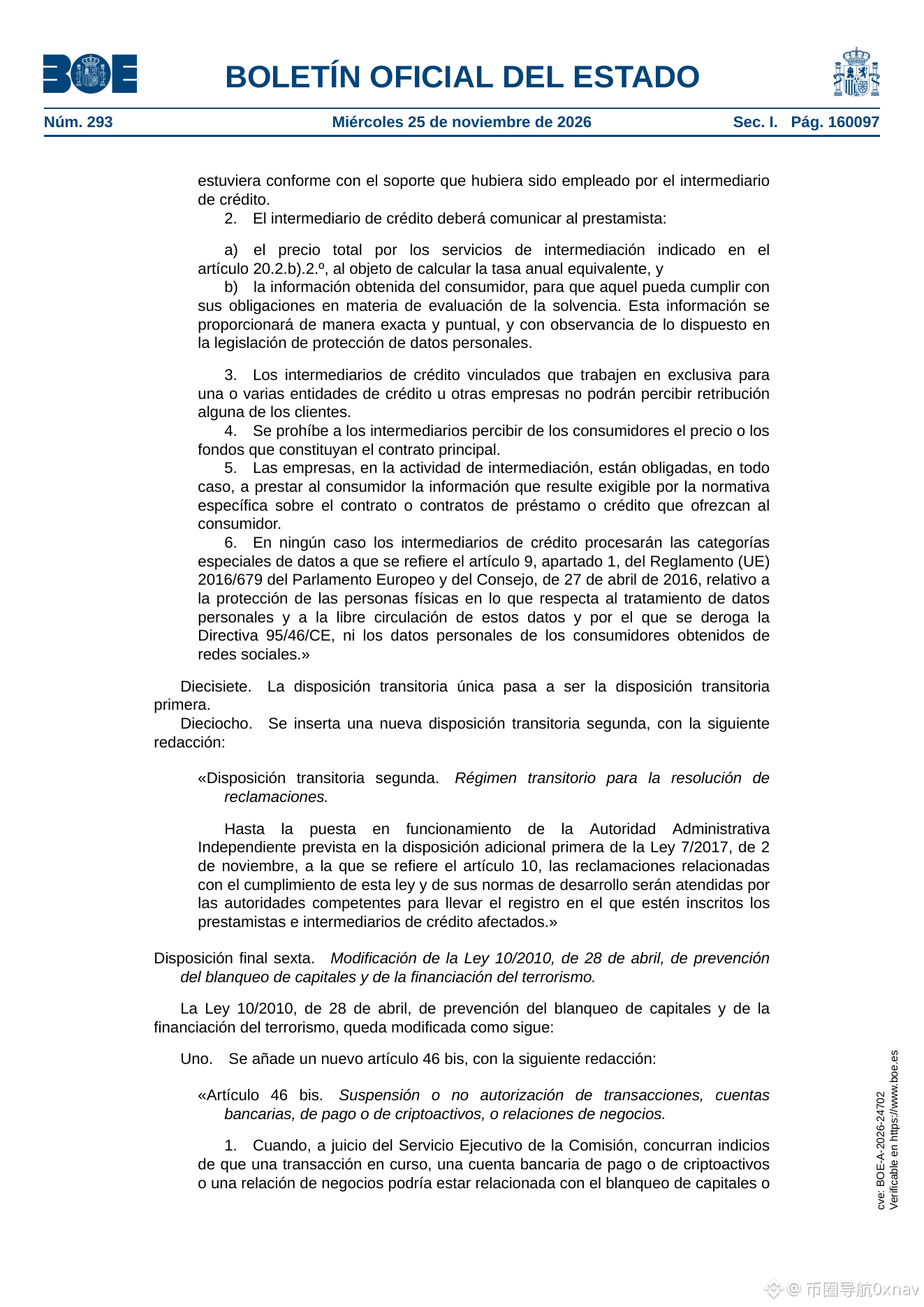
On November 25, Spain’s Official State Gazette (BOE No. 293) published Royal Decree-Law 44/2026 of November 24. Its main subject is consumer credit and borrower protection in the transfer of non-performing loans, but its Sixth Additional Provision amends Article 10 of Law 10/2010 of April 28, on anti-money laundering, by adding a new Article 46 bis.
A few points that are more directly relevant to ordinary people 👇
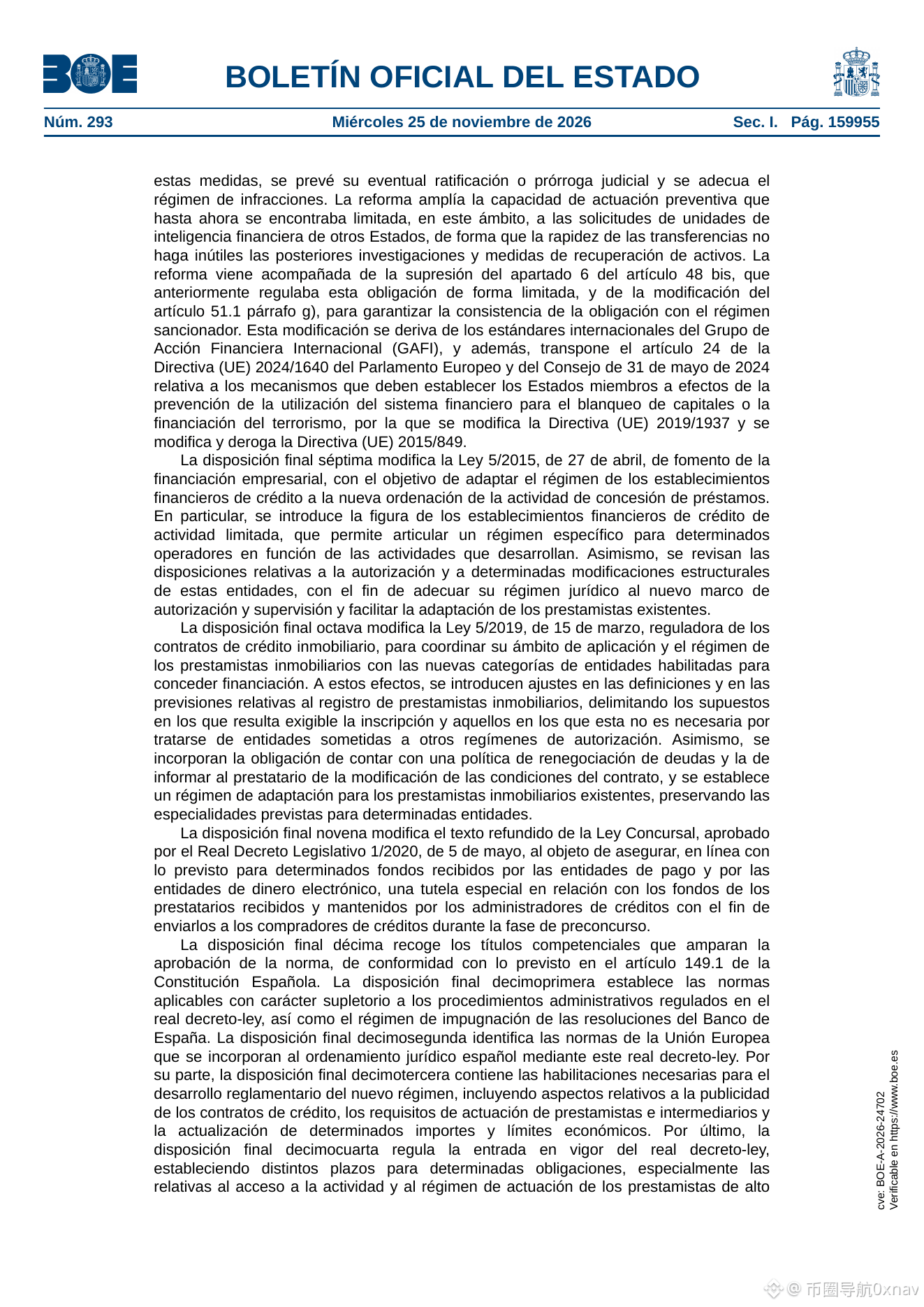
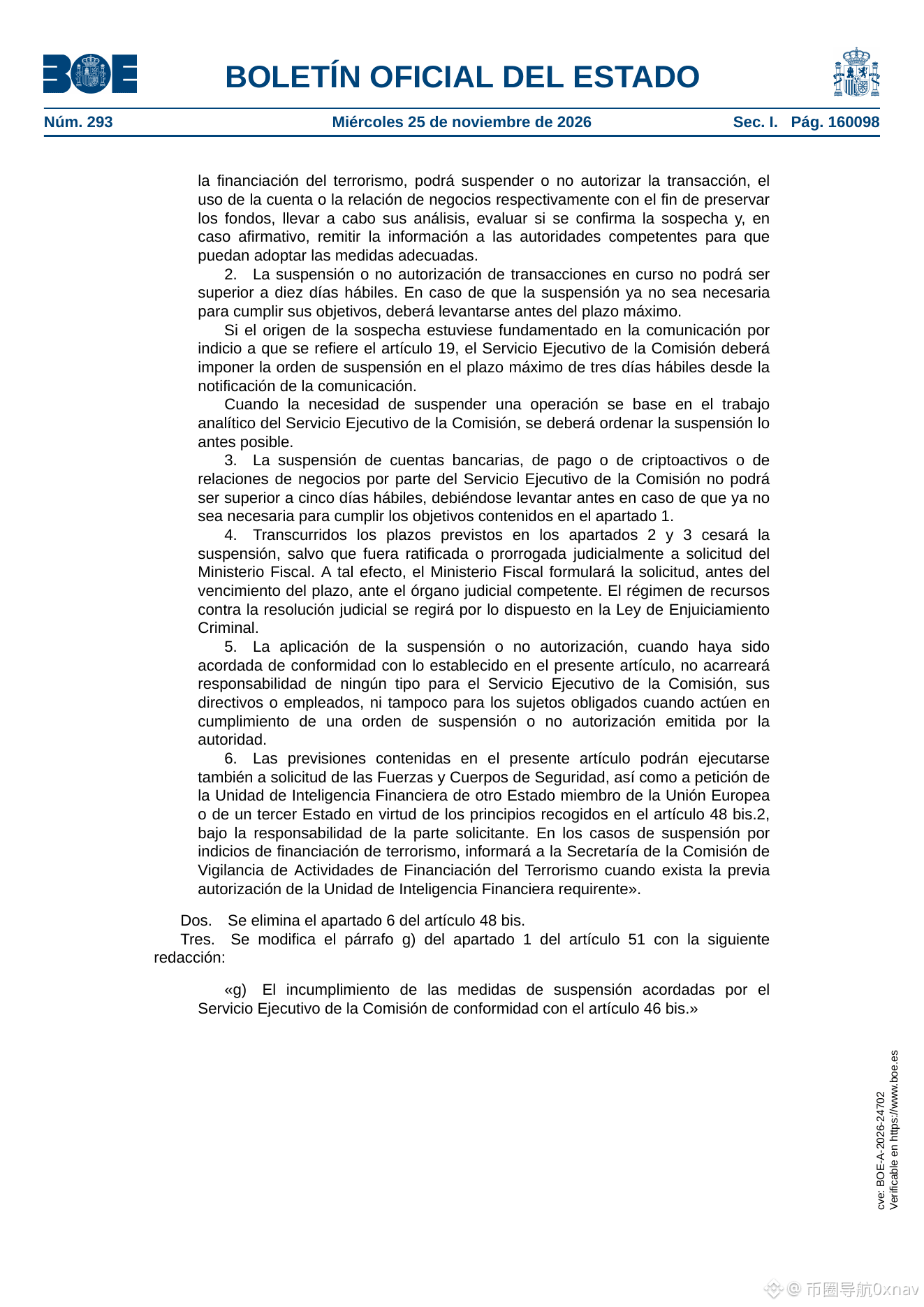
🔹 Who can order it: Sepblac, the Executive Service of Spain’s Commission for the Prevention of Money Laundering. The provision states that if the department considers that an ongoing transaction, bank account, payment account, crypto-asset account, or business relationship may be connected to money laundering or terrorist financing, it may suspend or refuse to authorize the transaction, or suspend the use of the account or business relationship. The official explanatory memorandum is clear: until now, preventive measures in this area were mainly available in response to requests from other countries’ financial intelligence units. This change is intended to remove that restriction, so that transfers cannot happen so quickly that investigations and asset recovery are left behind.
🔹 How long it can last: An ongoing transaction may be suspended or refused for up to 10 working days. A bank, payment, or crypto-asset account, as well as a business relationship, may be suspended for up to 5 working days. If the suspension is no longer necessary, it must be lifted earlier. If the suspension is based on a suspicious transaction report submitted by an obliged entity under Article 19, the Executive Service must order it within no more than 3 working days of receiving the report. If it is based on the department’s own analysis, it must issue the order as soon as possible.
🔹 What happens when the deadline passes: Once the time limit expires, the suspension ends unless, before it expires, the prosecutor applies to the competent court for confirmation or an extension. Any challenge to the court’s decision is handled under the Criminal Procedure Act. In other words, a court does not have to be involved at the outset, but keeping the suspension in place requires judicial proceedings.
🔹 It has not taken effect yet: Under the Fourteenth Additional Provision, this Royal Decree-Law generally takes effect two months after its publication in the Official State Gazette; Article 46 bis is not on the list of exceptions subject to a different delayed start date. The Gazette was dated November 25, 2026, so this suspension power is scheduled to take effect on January 25, 2027. Accounts will not be frozen under the new provision starting today. The Royal Decree-Law must also be submitted to Parliament for confirmation within the statutory period, as required by the Constitution; if it is not confirmed, it will be repealed. Also, the provision concerns the use of “crypto-asset accounts,” referring to accounts managed by an intermediary. Don’t take this to mean that the authorities can directly freeze an on-chain wallet whose private keys you control today, although other existing judicial measures do not mean that self-custody is entirely beyond reach.
So, this is legislative text that has been published, not a routine freezing power that is already in effect. If you’re in Spain and your assets are held in an account at a local exchange or payment institution, it’s worth distinguishing the following: before the provision takes effect, accounts cannot be suspended under this new rule; after it takes effect, if a suspension occurs, first check whether it is a temporary measure lasting up to 5 working days or whether the prosecutor has already applied to the court for an extension.
#西班牙反洗钱部门将可暂停加密账户 #BTC #ETH