



On November 25, Bitcoin mining company Braiins warned of attacks that hijack mining operations through unencrypted connections, leaving miners to pay electricity costs while their work is credited to someone else.
Braiins recorded four attacks on November 20, mainly in Europe. The incidents highlighted the risks of Stratum V1, the protocol that connects mining machines to pools, as the adoption of Stratum V2 remains uneven.
KEY CONTENT
Each attack on Nov. 20 affected between 1,050 and 1,600 mining sites.
The attackers spoofed internet routing to block connections and impersonate pools.
Stratum V2 encrypts traffic and verifies pool identities, but adoption varies.
The scale of the hashrate hijacking attacks
Braiins recorded four attacks on Nov. 20, most of them in Europe. Earlier attacks took place in Latin America from Nov. 7 to Nov. 12.
Metric Recorded data Number of attacks on Nov. 20 4 attacks Mining sites affected per attack 1,050–1,600 Hashrate redirected per attack 0.6–1.9 EH/s Duration of each attack 6–49 minutes
According to Braiins, miners' machines continued to show normal activity, while the pool dashboard recorded no hashrate for them. Operators continued to pay for electricity, even as their work was credited to someone else.
How do attackers impersonate pools?
Attackers spoof internet routing announcements, also known as BGP hijacking, to block unencrypted connections and impersonate pools. Miners reconnect to the same address, making the redirection difficult to detect.
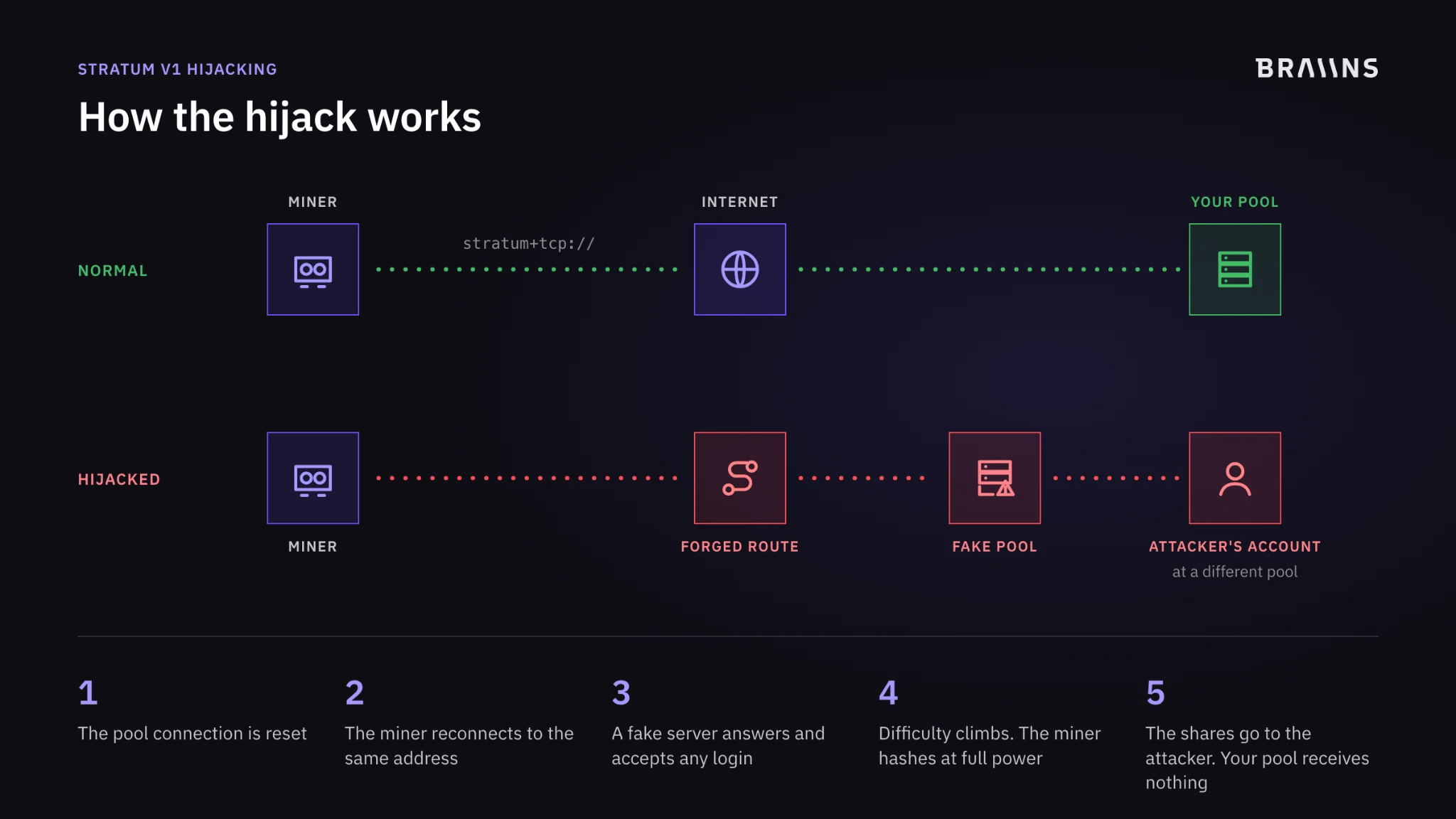 Source: Braiins
Braiins said the attacks exploited weaknesses in Stratum V1. Stratum V2 contributor Pavlenex emphasized on X that miners and their infrastructure were the targets.
“This is an attack on miners and their infrastructure, not a vulnerability in Braiins Pool.”
– Pavlenex, Stratum V2 contributor
Stratum V1 has faced warnings before
Stratum V1 dates back to 2012, and warnings about the protocol's risks have been issued for years.
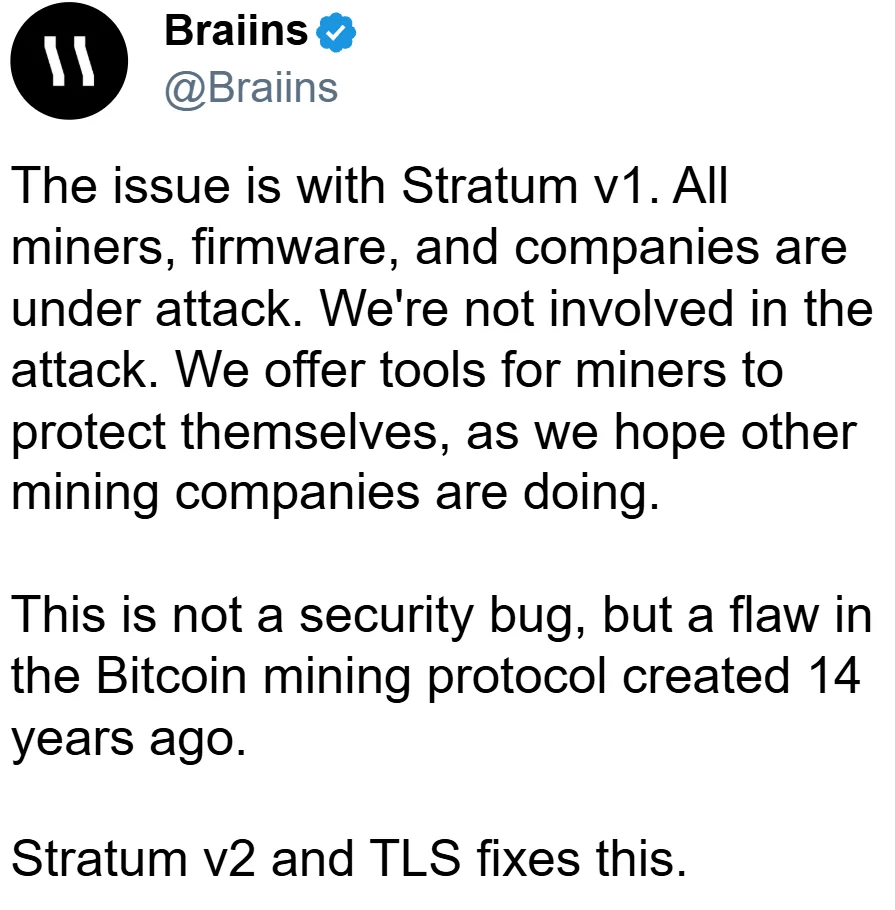 Source: X
Braiins warned about hashrate theft on April 18, 2020. At the time, the company argued that preventing lost revenue and reducing operating costs would encourage upgrades more effectively than simply emphasizing decentralization.
Asked whether this was the first publicly confirmed case, Pavlenex cited earlier reports of connection-blocking attacks on X.
Stratum V2 adoption among pools
Stratum V2 encrypts mining traffic and verifies pool identities to prevent impersonators from assigning work to miners. However, adoption of the protocol varies across mining operators.
Six months before the date in question, seven organizations—ANTPOOL, Foundry, F2Pool, SpiderPool, Block, MARA Foundation, and DMND—joined the Stratum V2 working group. At the time, these organizations were said to represent about 75% of the global hashrate.
As of Nov. 26, the official Stratum V2 directory listed Braiins Pool and DMND as operational pools. It also separately listed several solo-mining pools and MARA Foundation's industrial-scale solo-mining operations.
Foundry was still listed as implementing the protocol, despite reports of testing in November. ANTPOOL, F2Pool, and SpiderPool were not listed as operational pools.
Braiins said that during a check on Nov. 23, the public endpoints of most major pools still offered only unencrypted Stratum V1.
Summary
The attacks recorded by Braiins show that unencrypted mining connections can be exploited to redirect work and deprive miners of revenue. Stratum V2 adds encryption and pool verification, but adoption remains uneven.
Source: https://tintucbitcoin.com/tho-dao-bitcoin-mat-hashrate-khi-tin-tac-chiem-toi-1-600-trang-web/
Thank you for reading this article!
Like, comment, and follow TinTucBitcoin to stay up to date with the latest news about the cryptocurrency market and never miss any important information!
$BTC $ETH $BNB $XRP $SOL