The market read the Zcash warning backwards.
On Thursday, Zcash developers urged holders to move about 400,000 ZEC - roughly $300 million, 2% of supply - out of Sapling, the 2018 privacy pool, into Ironwood. Sapling's proofs use pairings, a shortcut a future math breakthrough or a big enough quantum computer could one day forge. Ironwood's Halo 2 proofs don't use pairings.
Nothing was hacked, nothing was lost, no attack exists. Zakura, the team behind the call, says so itself: "practical pairing breaks are highly speculative." The plan: block new deposits, keep withdrawals open, freeze only if credible attack signs appear. No date has even been set.
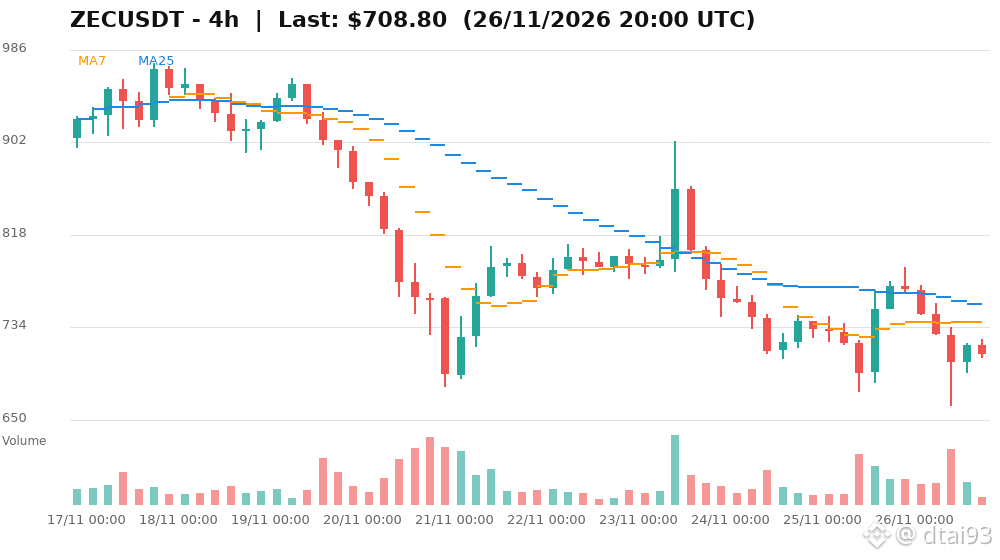
The market sold it anyway. ZEC fell 6.7% to about $709, touching $663 intraday, while Bitcoin bounced and 93 of the CoinDesk 100 went green - the weakest of the ten largest tokens. The warning itself became the sell signal.
That is backwards. Zcash is doing in public what almost no other chain does at all: retiring its own cryptography before it breaks. Bitcoin's earliest coins still sit in addresses with exposed public keys, with no migration plan. Zcash has a written plan, a new pool holding 85% of shielded funds, and a freeze-and-recover path. The migration is 85% done. The remaining 2% is the story, not the risk.
Watch the right things: does the deposit cutoff land in NU7.1 or wait for NU8? And notice the same week - Bitwise filed for a spot ZEC ETF Nov 18, Gemini switched on shielded deposits Nov 24. Institutions filed to own this asset while traders sold a precaution.
ZEC is down about 58% from its September peak near $1,700. A falling price is not a broken protocol. A chain that warns you about its own 2018 math, in public, before anything happens - that is not the red flag. That is the feature.
This is my personal opinion, not investment advice. DYOR.
Disclaimer: This content is for informational purposes only, not investment advice. I am not responsible for any losses incurred.
$ZEC $BTC