One week after the split, the floor price was breached—and then recovered
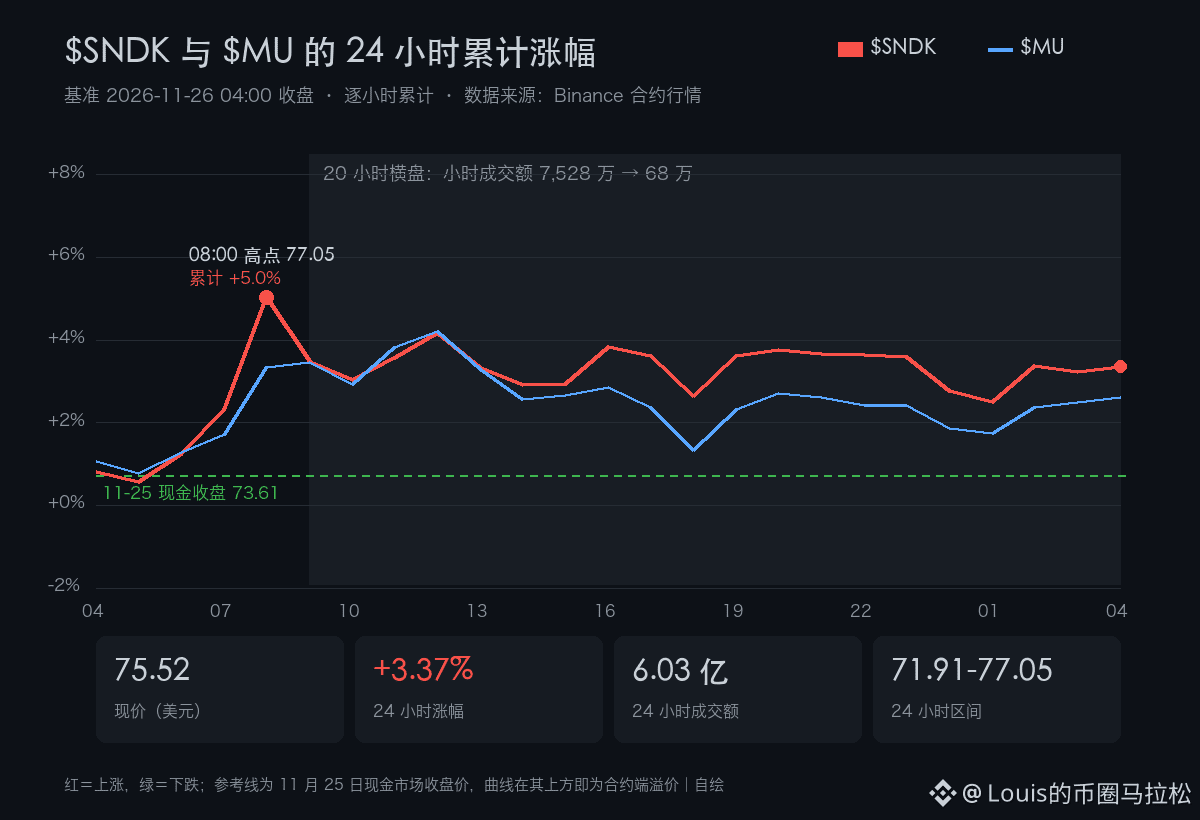
$SNDK 75.50 USD, 1h +0.08%, 24h +3.34%, trading volume $603 million, 24-hour range: 71.91 to 77.05.
The cash market is on Thanksgiving break. On November 25, SanDisk closed at $73.61, down 5.57%, falling below the $78.25 low from the first day of trading after the November 20 split. Futures followed suit, plunging to 71.91—another 2.3% below that close—before climbing back to 77.05 between 4 a.m. and 8 a.m. on November 26, a 7.2% gain in four hours.
Elsewhere in the same supply chain, Micron rose just 2.47% overnight. SOXL, the 3x leveraged semiconductor ETF, gained 8.54% because of leverage—not because of any new developments. The divergence is in contract prices: on November 19, TrendForce lowered its forecast for NAND contract price increases in Q4 from 15%–20% to 8%–13%, and expects prices to flatten or fall by 5% in Q1 2027. DRAM, by contrast, is still expected to rise 10%–15% over the same period. SanDisk has the purest NAND exposure in this supply chain, so when the outlook diverges, it’s first on the weaker side.
Citi’s November 23 price target remains $262.50 on a post-split basis. Its reasoning: even a complete halt to Nvidia-related financing would hurt NAND demand by only 7%. HBM capacity expansion takes up space on the same wafer production lines; sooner or later, the shortage will spill over to NAND. That pure exposure is a liability on the way down and leverage on the way back up.
The 10:30 p.m. cash-market open will tell us more than that 7% figure: a move above 75.5 would suggest futures got it right in advance; a move back to 73.6 would mean last night’s rally was just position covering.
Do you look at contract prices first to gauge a NAND turnaround, or orders for enterprise SSDs?
*Contract prices can be volatile; manage your position size accordingly.
$BTC $BNB $SNDK