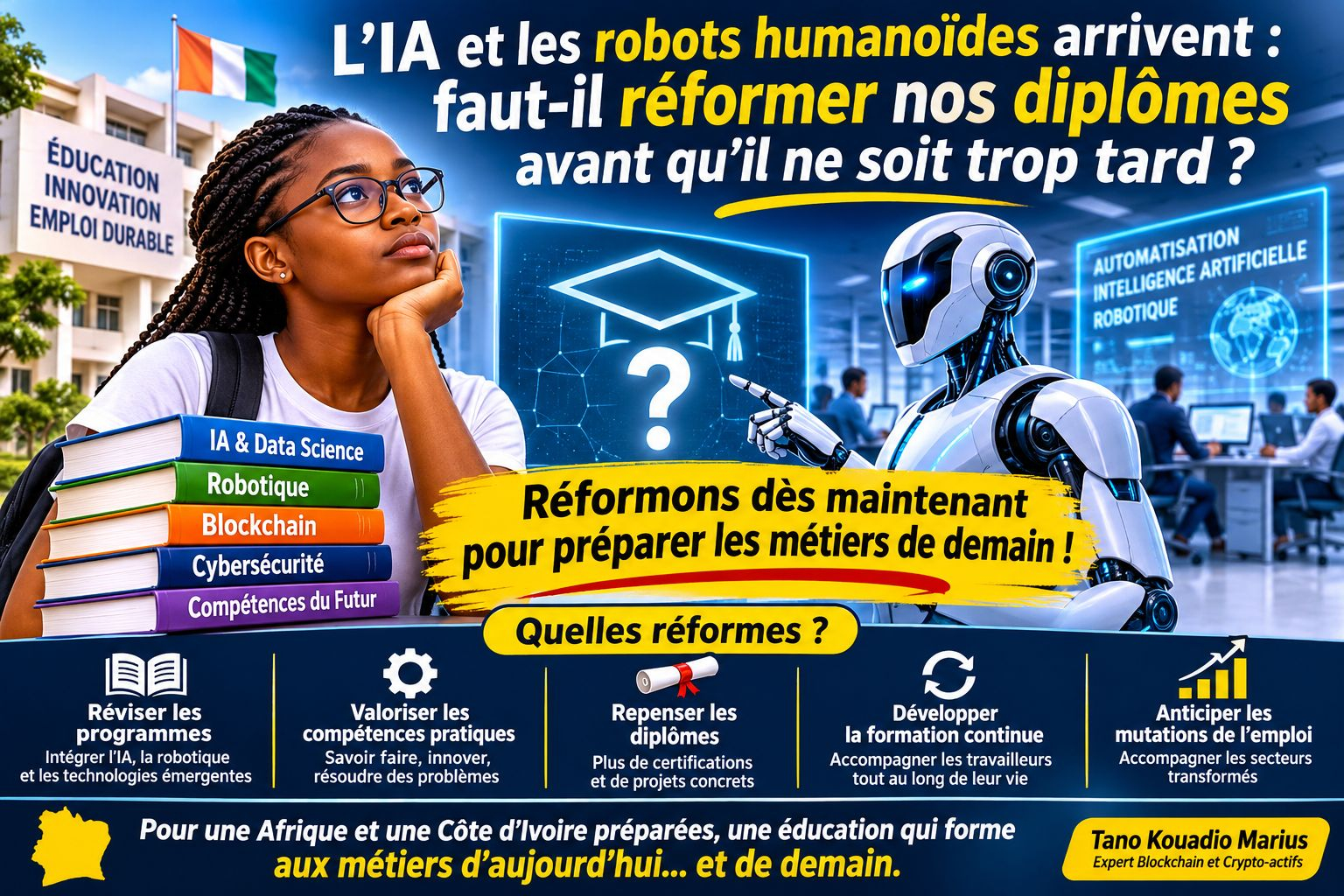
AI and humanoid robots are arriving: should we reform our degrees before it’s too late?
We are entering a new technological revolution that will profoundly transform the world of work.
Artificial intelligence is no longer limited to assisting professionals with their tasks. It is beginning to automate intellectual functions once reserved for human beings.
At the same time, humanoid robots are advancing rapidly. They could gradually be deployed in several sectors: industry, logistics, agriculture, healthcare, services, and even some administrative activities.
In the face of this development, a fundamental question arises: are our education systems truly preparing future generations for the jobs of tomorrow?
For decades, earning a degree was considered a privileged path to employment. But today, the job market is changing faster than training programs.
It is therefore essential to rethink our approach.
What reforms should we consider?
1️⃣ Revise school and university curricula to incorporate AI, blockchain, robotics, cybersecurity, and emerging technologies.
2️⃣ Value practical skills: knowing how to use new technologies, solve problems, and develop concrete solutions should count as much as theoretical knowledge.
3️⃣ Rethink degrees by giving more weight to professional certifications, completed projects, and skills that have actually been mastered.
4️⃣ Develop continuing education to enable workers to adapt to technological changes.
5️⃣ Anticipate changes in employment to support the sectors and professions that will be transformed by automation.
The real challenge for Africa, and particularly for Côte d’Ivoire, is not to be swept up by this revolution, but to prepare for it.