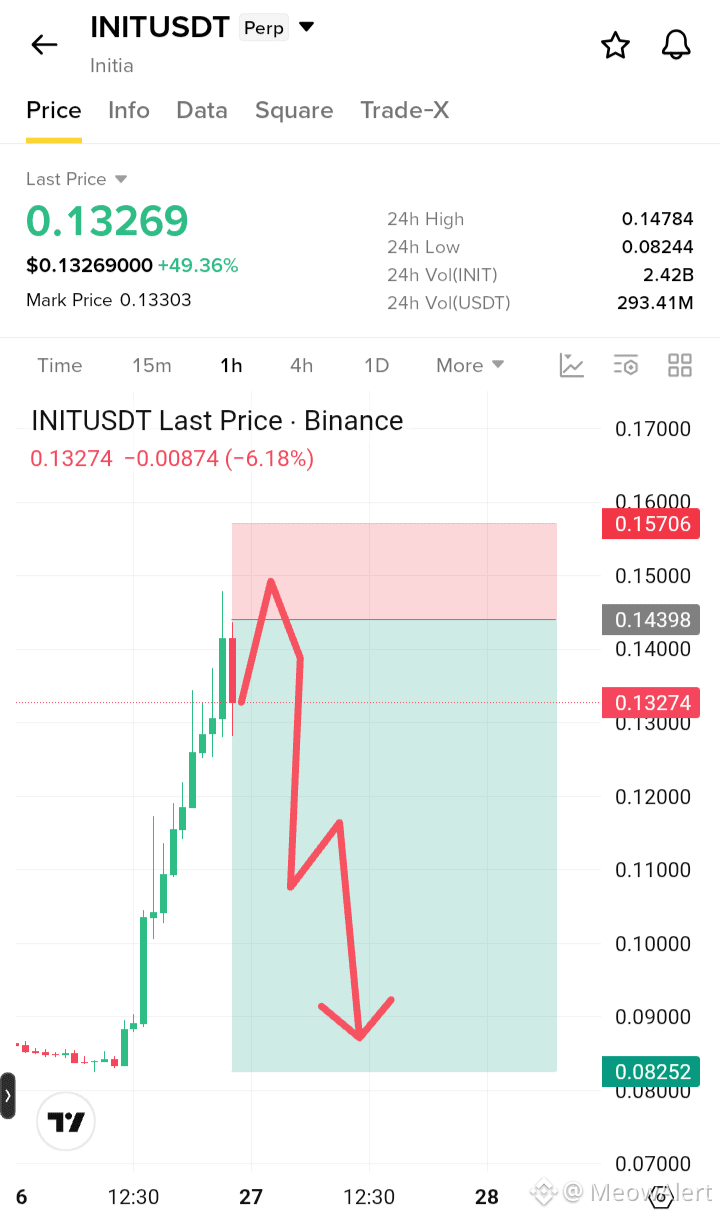
$INIT Is Ready for Another Big Move… But Which Side Should You Choose: LONG or SHORT? 🔥
OI is around $47.15M, up 112.98%, with OI/market cap at 159.53%. Futures volume reached $579.26M against just $25.62M in spot volume. Funding is deeply negative at -0.9293%, and 24H liquidations hit $1.55M, with 76% coming from shorts. Another squeeze is possible.
The liquidation heatmap shows upside liquidity near $0.1403, with higher zones around $0.153–$0.160. Downside liquidity is concentrated near $0.1250, with further liquidity around $0.100–$0.105.
CVD is mixed but weakening short-term. 15M futures CVD is -45.8M and spot CVD is -255.3K. On 1H, spot CVD remains positive at +11.3M. Orderbook delta is negative on both timeframes.
24H flows are positive, but the latest 15M and 30M readings show outflows from both spot and futures.
So, which side makes more sense?
LONG still has a case because of deeply negative funding and short-heavy positioning. Another squeeze cannot be ruled out. But after the recent rejection and weakening short-term flows, chasing a long looks risky.
Honestly, my initial preference was LONG. After reviewing the rejection and short-term data, I'm leaning SHORT. If another bounce fails, the short side could offer better RR.
My SHORT configuration:
Current Entry: $0.130–$0.135 (Risky)
Recommended bounce entry: $0.142–$0.146
SL: $0.155
Extended bounce entry: $0.155–$0.160
SL: $0.165
TP1: $0.125
TP2: $0.110
TP3: $0.095–$0.085
Once price reaches the entry zone, wait at least 15 minutes. Monitor spot CVD, futures CVD and spot flow. I want buying pressure to weaken and selling to return. For safer confirmation, wait for a full 30-minute candle and check the same data again. If price reclaims resistance with improving spot demand, skip the short.
Deeply negative funding means squeeze risk remains high. Don't enter just because price touches the zone. Wait for confirmation, respect the stop and manage position size carefully.